The movie Interstellar is reasonably accurate from a scientific standpoint. Some of the concepts in the movie, such as wormholes and time dilation, are supported by theoretical physics, but have not been proven conclusively. Other aspects of the movie, such as the gravity equation, are based on real-life equations but are not well understood.
Interstellar is a popular science fiction thriller that covers a vast range of topics – from fleeing Earth due to environmental catastrophes to wormholes and time dilation. The movie explores several intriguing concepts, some with varying degrees of scientific accuracy. This article will dive deeper into these ideas and discuss whether they could exist in reality.
Note that this article contains spoilers, so proceed with caution if you have yet to see the film.
Recommended Video for you:
Can People Really Travel Through Wormholes?
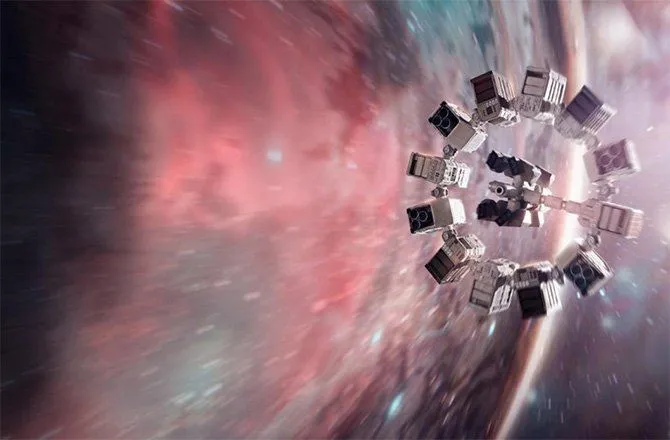
The wormhole in Interstellar is the driving force behind the entire plot; a portal appears somewhere near Saturn that has been seemingly created by omniscient fifth-dimensional beings.
A wormhole is basically a ‘tunnel’ that bends space-time and allows energy and information to move from one side to the other. The simplest explanation for it is actually given by Romilly in the movie itself, but you can read here to learn more.
Can wormholes exist, though?
Well, science points towards the theoretical possibility of one, but we haven’t discovered a wormhole yet, which means that it’s still a giant hypothetical.
Aside from that, the walls of a wormhole are intrinsically unstable, so traveling through it would cause the wormhole to collapse on top of you. The chances of finding a naturally occurring wormhole are improbably small, so for a traversable one to exist, it must be created by some form of advanced civilization with the power to move entire stars. It’s mind boggling, indeed, but theoretical physics still allows for the possibility of wormholes to exist. We just need the fifth-dimensional beings to notice us first.
Verdict: Wormholes have been a sci-fi staple for decades, and will likely remain that way. Traveling through one is all but impossible. (Sidenote: falling into a black hole will definitely kill you.)
Can Robots Like TARS Exist?
The most difficult part of creating a robot like TARS or CASE would be its artificial intelligence, not the motor movements or the design. In fact, the simplistic design behind TARS’s monolithic representation has gained widespread adoration.
Partly due to it being an homage to the monolith in 2001: A Space Odyssey, but mostly because of his funny quips. A rigid and rectangularly designed robot would work in theory, but it would require a massive amount of torque to move its limbs in the way it does in the movie; for example, carrying Dr. Brand and doing cartwheels through the sea would require massive amounts of power.
A real robot in that situation would probably have wheels and claws instead of Lego-shaped hands. Aside from the power, there’s the man-hours that would go into programming everything from its vocabulary to the humor setting, which is just not possible in a single product today, at least not in a version as refined and deterministic as TARS. Not to mention all the sensors, circuitry, wires and hydraulics that would all need to be stuffed into a sleek mobile unit.
For a robot like TARS to exist, dozens of giant tech companies would have to devote thousands of people full time to work on one product – possibly for decades. The movie explains this by saying it’s a retrofitted Military robot, which makes sense in the setting, but probably wouldn’t be the ideal companion in a manned interstellar mission.
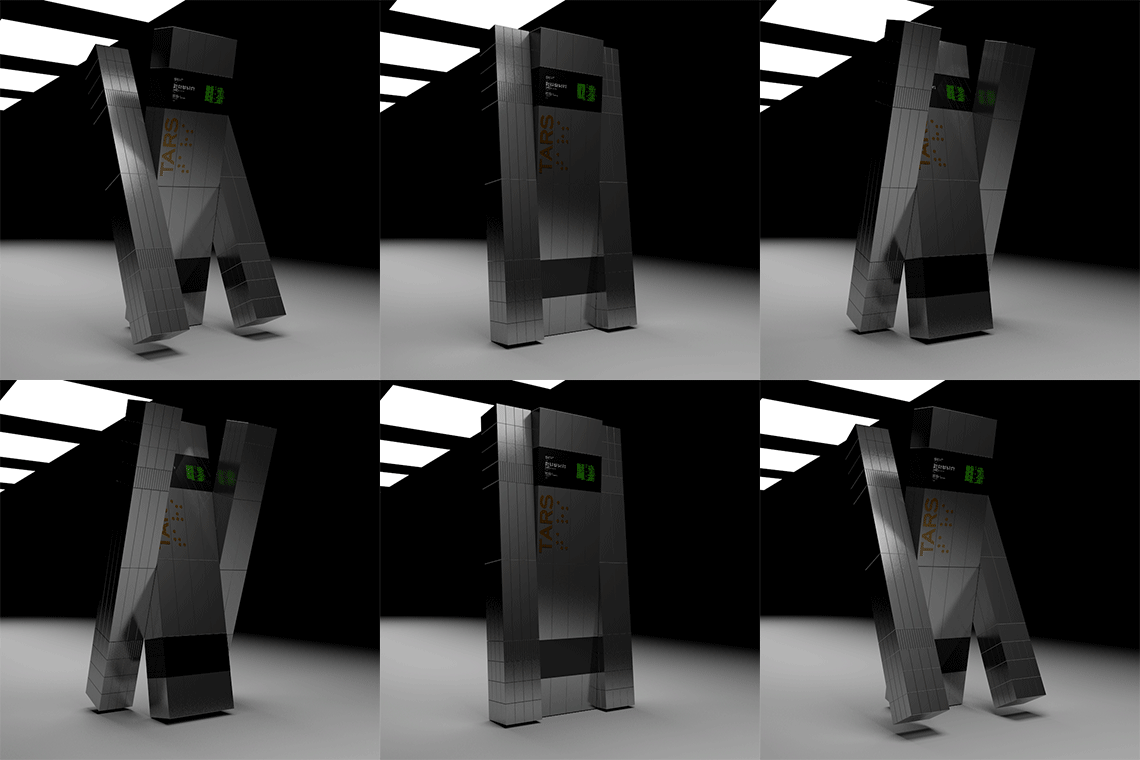
Verdict: Artificial intelligence is making rapid progress (think GPT-class models and humanoid robots like Boston Dynamics’ Atlas), but a single, fully-embodied companion as witty, autonomous and physically capable as TARS is still well beyond what any company has built. The monolithic, slab-like design is also unlikely to be the form factor of choice.
How Does The ‘Gravity Equation’ Help The Mass Exodus Of Humanity?
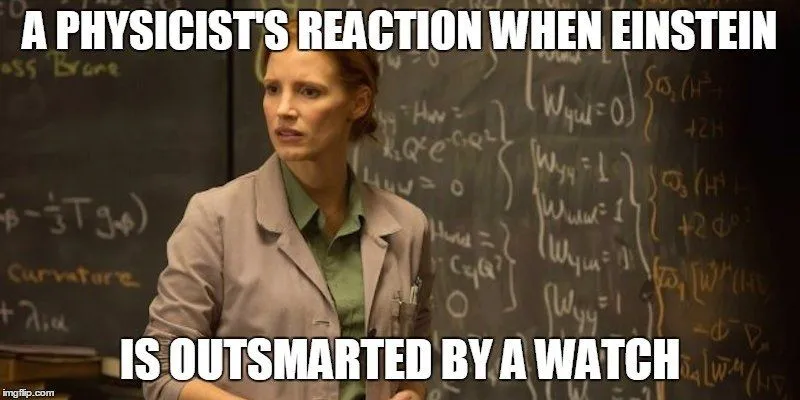
The equation that Murph is trying to solve as her solitary pursuit to ‘save humanity’ is simply called ‘the gravity equation’ in the movie. Well, there’s a gravity equation in real life too, although the two aren’t quite the same. In the movie, Murph and Prof.
Brand are trying to figure out a blackboard’s worth of numbers to ‘solve gravity’, as that would mean the success of Plan A, which is an evacuation response that can help the world’s population move off the planet using gravitational propulsion rockets. She eventually figures it out after getting information about the ‘infinite gravity’ inside the black hole.
One of the equations on that blackboard is a version of the famous Einstein field equation, which is a differential equation for gravity that explains everything from the Big Bang to black holes, and pretty much any gravitational anomaly in between. The discovery of gravitational waves by LIGO — detected on 14 September 2015 (signal GW150914) and announced in February 2016 — confirmed one of Einstein’s key predictions about gravity. The signal came from two colliding black holes roughly 1.3 billion light years away. Kip Thorne, who served as Interstellar’s science adviser, shared the 2017 Nobel Prize in Physics for his decisive contributions to that detection.
What Murph is trying to solve in the movie is essentially an elaborately conceptualized Einstein field equation that helps ‘create gravity of your own’, which could allow you to lift entire cities into space. It’s almost poetic how it is Einstein’s work that ultimately saves humanity in the movie, along with a little help from Murph and some trans-dimensional interaction, of course.
Verdict: The equations exist in some form, but they won’t help us leave Earth anytime soon.
So, what is “the equation” in Interstellar?
On screen, the equation Murph and Professor Brand obsess over is never spelled out as a single line; it’s a board full of tensor calculus. But Kip Thorne, the film’s science adviser, has explained that it represents an attempt to unify Einstein’s general relativity with quantum mechanics — the long-sought theory of quantum gravity. Specifically, Brand is trying to model gravitational anomalies (the falling drone, the dust patterns in Murph’s bedroom) as leakage from a higher-dimensional “bulk”, and to figure out how to control the gravitational constant G so that NASA can lift entire space stations off Earth.
The crucial missing ingredient is data from inside the event horizon of a black hole — quantum information about how spacetime behaves where general relativity breaks down. That’s why Cooper has to fall into Gargantua: TARS scoops up the quantum data from the singularity, and Cooper transmits it back to Murph as Morse code on the second hand of her wristwatch. Armed with that data, adult Murph can finally close out the equation and unlock controllable gravity.
In real physics, this is exactly the kind of information physicists do not have. We have general relativity (which describes gravity at large scales) and quantum field theory (which describes the other three forces at tiny scales), but no experimentally verified theory that joins them. Candidates exist — string theory, loop quantum gravity, causal dynamical triangulations — but none have a Murph-style closed-form solution that lets us hoist cities into orbit.
Time Dilation And The Tidal Wave Planet
This one is probably the biggest wringer in the movie. How can someone up in the spaceship age 23 years, 4 months and 8 days while the people on the ground are there for only about 3.5 hours? Let’s first try to understand some basics about time dilation.
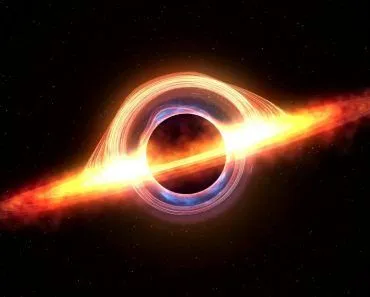
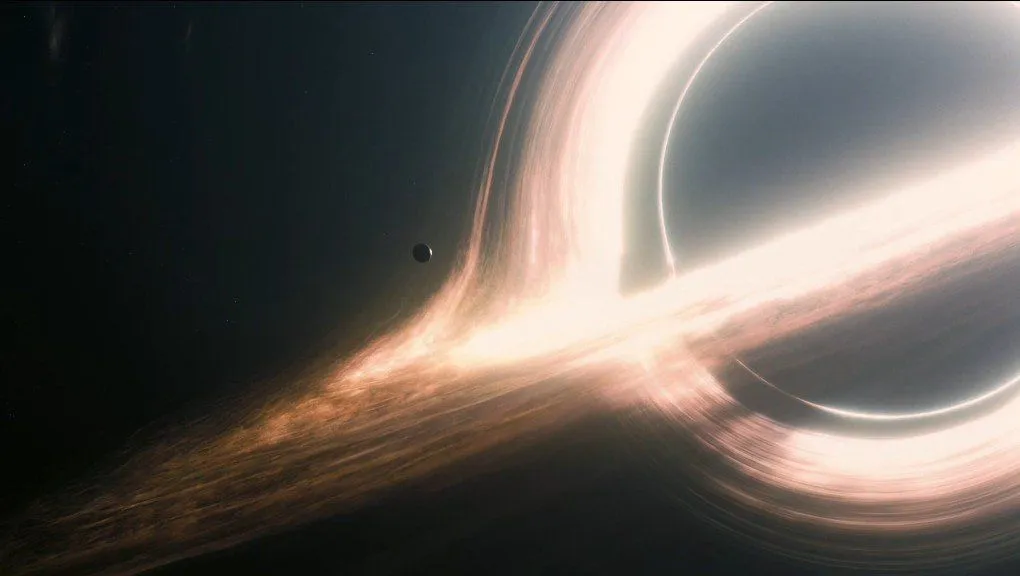
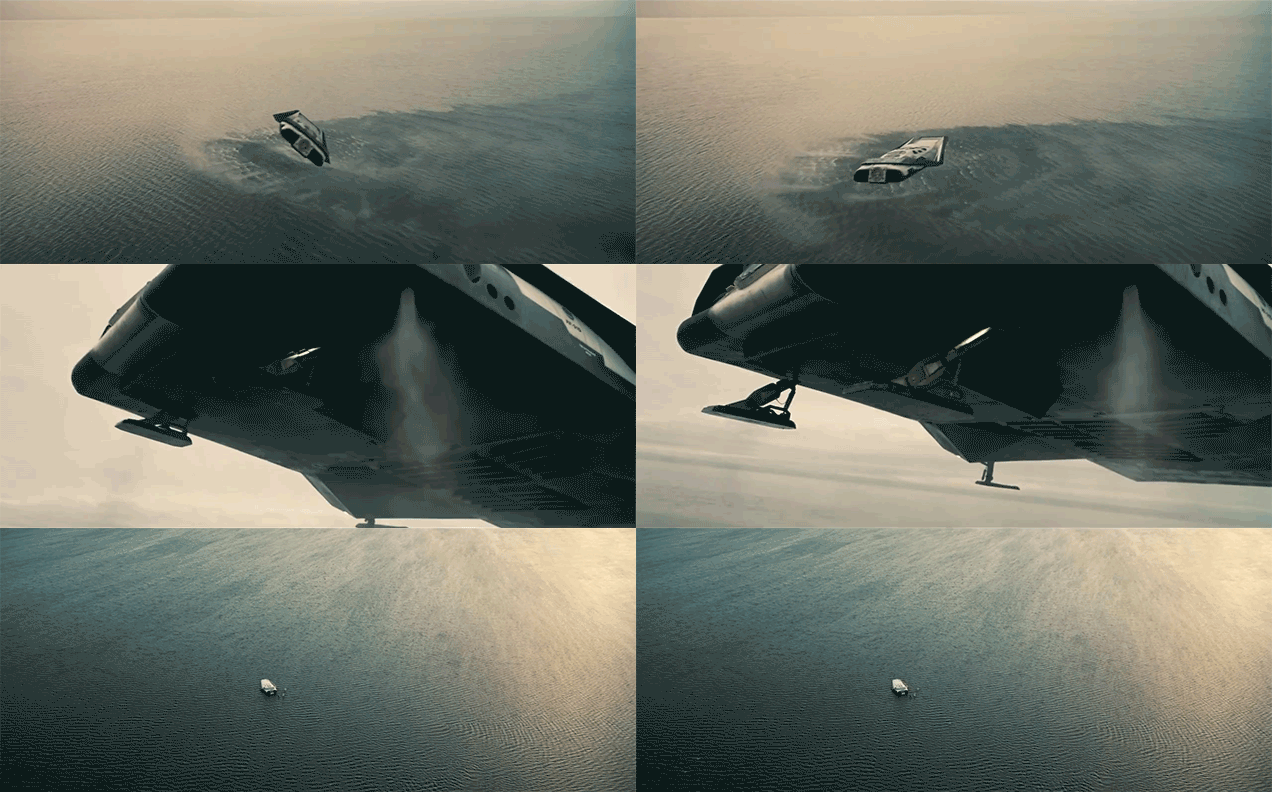
Let’s say that we’re on the surface of Miller’s planet with Romilly up in the spaceship orbiting the black hole, Gargantua. According to Einstein’s General Theory of Relativity, a clock that sits deep inside a strong gravitational field ticks more slowly than a clock far away from any massive object — which is exactly what happens in the movie. Dr. Brand and Cooper land on Miller’s planet, perched dangerously close to Gargantua, where the black hole’s immense gravity drastically slows the local passage of time. The towering tidal waves they encounter aren’t caused by rapid spin of the planet itself; they’re tidal bulges raised by Gargantua, and the planet rocks back and forth through them as it orbits.
 Miller’s Planet Orbiting Gargantua
Romilly, however, is orbiting Gargantua from a distance, making the effect of Gargantua’s gravity on him a lot less. Note that time only slows relative between the two groups of people; if we assume the Endurance spaceship that Romilly is in has an equal gravitational potential as that of Earth, 23 years will also pass for people on Earth as well. No one actually experiences anything in slow motion.

If Cooper wore a GoPro on his head for the entire 3.5 hours and was somehow able to stream that video to Earth instantly in one shot (not actually possible due to information being unable to travel faster than the speed of light), his daughter Murph would just see a 3.5-hour video, not a slow motion one.
If he was live streaming it on Periscope, however, Murph would receive a few bits every few days or even weeks, and the live stream would be in ultra-slow slow-motion.
For the level of time dilation depicted in the movie (one hour on the planet equating to roughly seven Earth years), Kip Thorne worked the numbers backwards. The effect is overwhelmingly gravitational, not motion-based: Gargantua had to be a near-maximally spinning black hole, and Millerâs planet had to sit just outside its event horizon. Even so, to keep a stable orbit at that radius, the planet still has to rip around Gargantua at more than half the speed of light.
Being that close to a black hole would have hugely adverse effects on the planet, and it probably wouldn’t be able to exist in its current form due to the incredible gravitational forces involved.
Verdict: The math is a bit off, but allowing for some creative leeway, since it’s a sci-fi movie, the effects of time-dilation is spot-on.
Interstellar — which celebrated its 10th anniversary with an IMAX 70mm re-release in December 2024 — remains one of the most physically faithful science-fiction films ever made. Kip Thorne, the science adviser for the film, the Feynman Professor of Theoretical Physics Emeritus at the California Institute of Technology and a 2017 Nobel laureate in Physics, wrote an entire book on it called âThe Science of Interstellarâ walking through the relativity, wormholes, and tesseract scenes in detail.
A lot of the questions that arise in the movie are explained, and his involvement pushes the movie within the realm of possibility from the fringes of sci-fi, despite its metaphysical elements… but that’s a post for another day.
Last Updated By: Ashish Tiwari