Table of Contents (click to expand)
Astronaut suits come in two flavours: launch/entry suits and EVA spacewalk suits. Launch suits are typically orange — like NASA’s old Advanced Crew Escape Suit (ACES) and today’s Orion Crew Survival System (OCSS) — because orange is the most visible colour for search-and-rescue teams to spot in the ocean or wilderness. EVA suits are white because white reflects more sunlight, keeping the astronaut from overheating during a spacewalk and standing out clearly against the blackness of space.
The moment I hear or think of the word ‘spacesuit’, my mind immediately pictures an astronaut clad in a white spacesuit enjoying the feeling of weightlessness in the vast expanse of space (fortunately, I also imagine their space shuttle in the immediate vicinity). I’m sure many of you also associate the color white with spacesuits, right? Or are you among those who relate the color orange with spacesuits? Or perhaps you belong to an altogether different category of people who, when they think about spacesuits, can’t help but wonder why white and orange spacesuits are the only choices to cover people launching off on space voyages…
If you belong to that third category of people, then you’re about to find out the real reason behind the color choices of white and orange.
Recommended Video for you:
Spacesuits
To start with, there are two main kinds of spacesuits: Launch/Entry suits and EVA suits. Let’s look at them individually to determine their different purposes.
Launch/Entry Suit: The Orange One
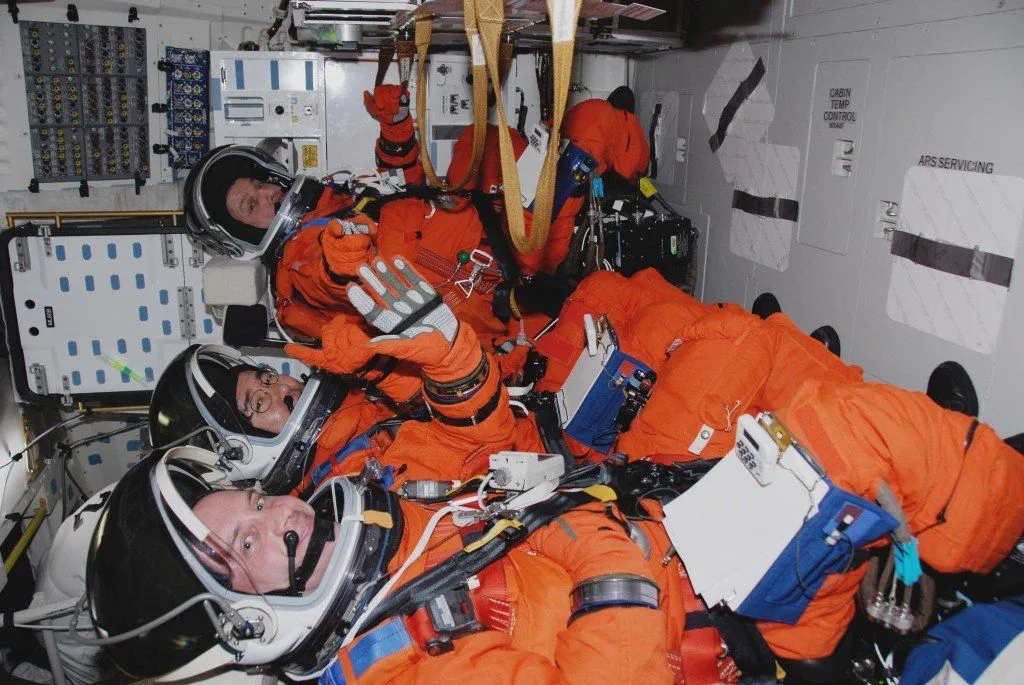
The suit is designed to protect the wearer from accidents during the launch or landing of the spacecraft. It consists of certain vital components, including medicine, a radio, flares, survival gear and, of course, a parachute.
But Why Are ACES Orange In Color?
It’s not that NASA thought this color would look cool (which, by the way, it does)… there’s more to it. “It’s highly visible for search and rescue; it’s one of the most visible colors, especially for sea rescue,” said shuttle crew escape subsystem manager Brian Daniel at NASA’s Johnson Space Center in Houston. The same logic applies to today’s OCSS launch suit on Artemis.
Not every launch suit is orange any more, though. Astronauts riding to the International Space Station on a SpaceX Crew Dragon wear a sleek black-and-white pressure suit designed by Hollywood costume designer Jose Fernandez. Astronauts on Boeing’s Starliner wear a bright blue suit. Cosmonauts launching on a Soyuz wear the Russian Sokol suit, which is white with blue trim. Chinese taikonauts on Shenzhou launch in white suits. So the “orange = launch” rule is really an American shuttle/Orion tradition rather than a universal one.
EVA Suit: The White One

The purpose of an EVA (Extravehicular Activity) suit is entirely different from a launch suit; an EVA suit is what astronauts wear when they actually step outside the spacecraft. These are designed for survival in the harsh conditions of space, which include a near-vacuum, thermal extremes ranging from roughly −150°C in shade to +120°C in direct sunlight, and a constant rain of micrometeoroids. NASA’s current ISS workhorse is the Extravehicular Mobility Unit (EMU), in service since the early Shuttle era. SpaceX debuted its own white-ish EVA suit on the Polaris Dawn mission in September 2024, the first commercial spacewalk. For the Artemis Moon landings, Axiom Space is delivering the white AxEMU suit, while Chinese taikonauts already use a white Feitian EVA suit for spacewalks outside the Tiangong station. EVA suits are much bulkier than launch suits because they contain multiple layers of heavy fabric, insulation and a complete life-support backpack.
Why Are EVA Suits White?
The most important reason for selecting the color white for EVA suits is that white reflects most of the incoming sunlight, so the astronaut doesn’t cook in direct sun (which can drive surface temperatures well past 120°C). However, they can also get too cold when in shadow — temperatures plunge to around −150°C — so the suit also runs a built-in heating and water-cooling loop, and the gloves have small heaters embedded to keep fingertips functional during precision work.
White is also the best option due to its contrast against the vast blackness of space, which renders the wearer easy to spot.