Table of Contents (click to expand)
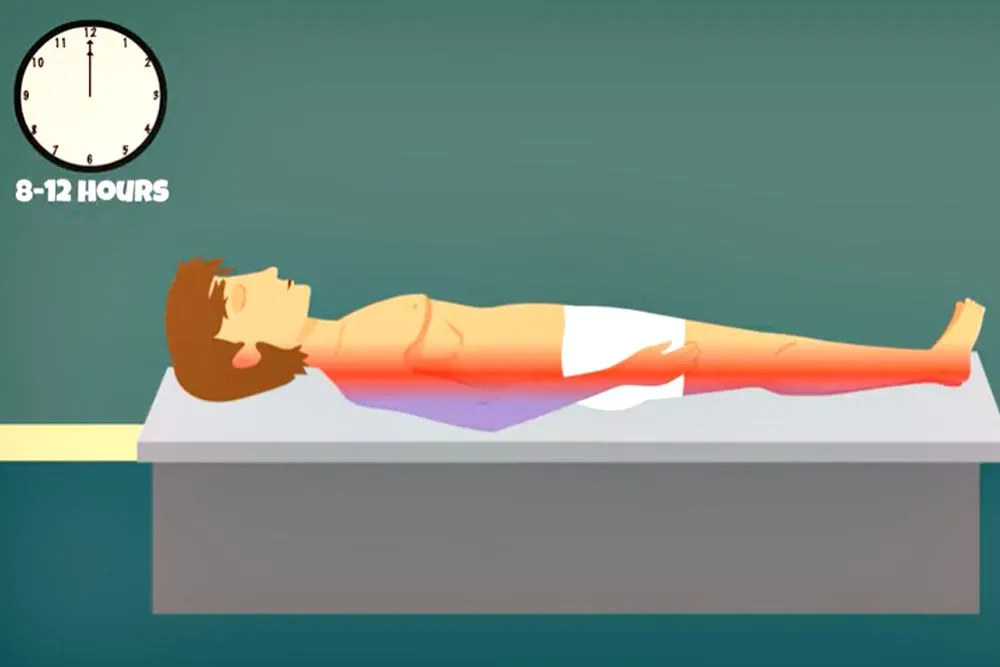
Livor mortis (also called lividity, suggillation, or postmortem hypostasis) is the gravity-driven pooling of blood in the lower-lying parts of a body after the heart stops beating. It produces a reddish-purple discoloration of the skin that is typically visible about 2 hours after death and becomes fixed — no longer blanching when pressed — at roughly 8 to 12 hours. Forensic pathologists use livor mortis, alongside algor mortis, rigor mortis, and pallor mortis, to estimate the time and circumstances of death.
Death has always fascinated and terrified mankind. We’ve written and documented countless texts and treatises on disease and death, all so we can understand what’s actually happening. What most people consider macabre and morbid has also enthralled philosophers, spiritual leaders, scientists and doctors.
There are a number of changes that happen to a body after death. These changes are the result of physical and chemical shifts happening to the body as it begins to decay. There are four discernible postmortem changes that occur in the first 24 to 72 hours after death: pallor mortis, algor mortis, rigor mortis, and livor mortis. This article focuses on livor mortis and how forensic experts use it to better estimate time of death.
Recommended Video for you:
What Is Livor Mortis?
Livor mortis is one of the four classic postmortem signs of death. It is the appearance of a reddish or purple discoloration of the skin caused by blood settling in the lowest-lying tissues. The discoloration is typically visible about 2 hours after death and gradually becomes fixed — meaning it no longer fades when the corpse’s position is changed — over the next 8 to 12 hours.
The earliest known description of livor mortis comes from 13th century China by Song Ci (also Romanized as Sung Tz’u, 1186–1249), a Southern Song dynasty judge who wrote Xi Yuan Ji Lu (“Collected Cases of Injustice Rectified”, 1247) — widely regarded as the world’s first systematic forensic-medicine handbook. In it, he notes:
“Generally, dead persons have a slight red coloration on the back of the neck, on the top of the back, on the ribs, the back of the waist, the insides of the legs, the knees, the feet and the stomach. Check to determine if after death these corpses were laid out supine overnight. The collapse of the blood vessels may cause this slight red coloration, which does not indicate any other cause of death.”
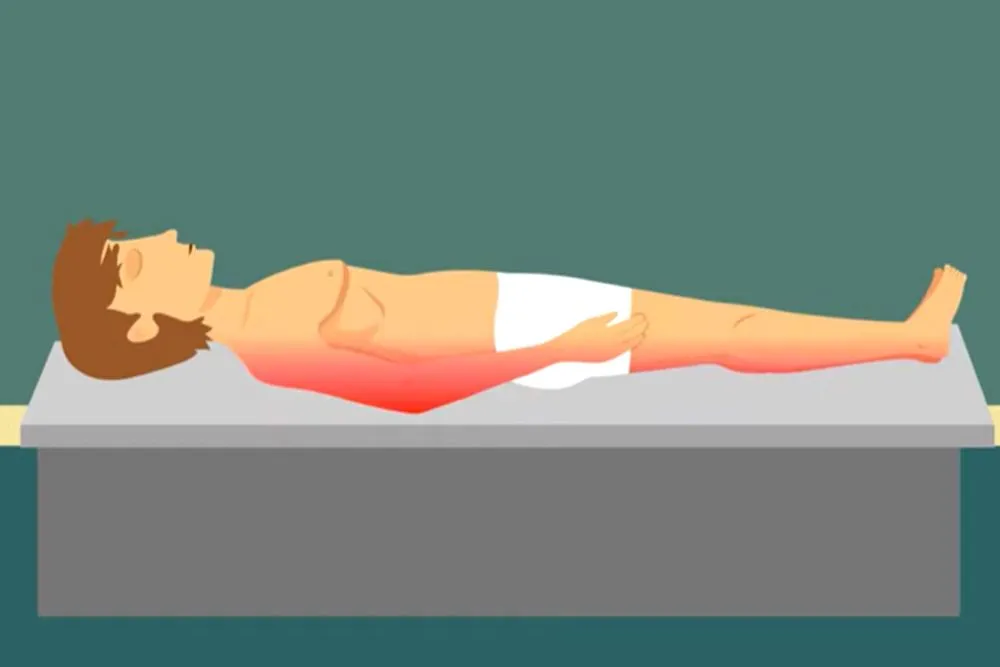
Lividity will develop in the direction of gravity. Thus, if the corpse is lying horizontally on its back, then lividity will develop on the backside, where the pull of gravity is the strongest. If the corpse was in a sitting position, the blood will pool towards the thighs, lower back and buttocks.
Why Does Livor Mortis Happen?
The heart is constantly pumping blood throughout the body. At rest, it moves about 5 litres of blood every minute — roughly 7,000 to 8,000 litres (around 1,800–2,000 gallons) over a single day — and beats around 100,000 to 115,000 times in those same 24 hours. The body’s entire blood volume (about 5 litres) circulates through the system roughly once every minute. Without the heart, every organ — and every cell in those organs — would fail to receive the oxygen and nutrients that blood transports, and all of this blood would simply fall under the influence of gravity.
This is what happens after death, once the heart stops beating. The blood in the blood vessels will begin to stagnate. The cells in the blood, such as the red blood cells (RBCs), white blood cells (WBCs) and platelets will begin to “sink” in the direction of the gravitational pull. This stagnation and settling of blood corpuscles leads to the development of livor mortis, but livor mortis would not develop without another physiological change.
Autolysis
After death, cells in the body begin to decay in a process called autolysis. Certain proteins, activated by the lack of oxygen and nutrients, begin to break down cellular components, including other proteins and DNA.
This process eventually leads to the breakdown of the cells that constitute the blood vessels. The blood contained within these vessels leaks out and pools between the layers of the skin, which leads to the development and fixing of livor mortis.
Deoxygenation Of Blood
There is a color change that happens after lividity has developed. Lividity in its initial stages is a red color, like that of normal blood, but over time, the color changes to a more purple hue because the RBCs become deoxygenated.
RBCs are the cells that collect oxygen from the lungs and transport it to the peripheral tissues for consumption. It is hemoglobin within the RBCs that actually holds the oxygen. The red color of blood (the bright red seen in arteries) is a result of oxygen binding to hemoglobin. When hemoglobin releases oxygen, this deoxyhemoglobin loses that bright red color and becomes a bluish-purple.
After death, tissues consume the existing oxygen held by hemoglobin. Once that pool of oxygen is depleted, the color of the blood will change from red to purple.
How Do Forensic Experts Use Livor Mortis To Calculate Time Of Death?
There are some visible changes that take place in a body after death. These changes are called postmortem signs of death and forensic experts use them to determine the time of death or post-mortem interval (PMI), if you want to use scientific jargon.
The appearance of lividity and the associated color change that occurs over time can tell forensic experts and pathologists a good deal about when the individual died. As mentioned earlier, lividity is usually visible by about 2 hours after death and becomes fully fixed somewhere between 8 and 12 hours, though these time stamps depend heavily on external conditions. Cooler temperatures slow the departure of oxygen from hemoglobin, which delays the color change.
Lividity also may not develop in those that are anemic. Depending on how advanced livor mortis is when investigators discover the body, forensic experts can usually estimate time of death.
Livor Mortis Can Give Clues In An Investigation
Livor mortis can also give clues about how an individual might have died, or what the body’s condition was soon after death. The development of lividity can be hindered in certain parts of the skin if there was an obstruction that blocked blood supply to that area.
This perturbed area of the skin will not have red or purple coloration and will instead have normal pale skin color. This is called contact blanching.
This can tell experts whether an individual was tied up using a rope or some other material, and provide information on what sort of surface the individual was laid on. If the body was laid on a hard surface, the area of skin that made contact with the surface would not have lividity as the hard surface would obstruct the blood vessels in that area.
It can also tell investigators if the body was moved after death, depending on how lividity developed.
There are different molecules that change the color of livor mortis. In carbon monoxide poisoning, lividity is a persistent cherry-red color, because CO binds tightly to hemoglobin and prevents the usual deoxygenation-related darkening. Cyanide poisoning produces a similar bright pink-to-red lividity, but for a different reason — cyanide blocks the cells from using oxygen, so the hemoglobin in the blood remains saturated with O₂.
Although livor mortis provides a lot of information to investigators about the nature of an individual’s death, it cannot be the only postmortem sign that coroners rely on. Investigators often use multiple clues, such as body temperature (algor mortis), stiffness of the muscles (rigor mortis) and insects near the area where the body was found (forensic entomology) to calculate PMI. Relying solely on a single postmortem sign would lead to inaccurate results.
References (click to expand)
- Bisker, C., & Ralebitso-Senior, T. K. (2018). The Method Debate. Forensic Ecogenomics. Elsevier.
- Hayman, J., & Oxenham, M. (2016). Supravital Reactions in the Estimation of the Time Since Death (TSD). Human Body Decomposition. Elsevier.
- (2021) Postmortem Changes - StatPearls - NCBI Bookshelf. The National Center for Biotechnology Information