Table of Contents (click to expand)
Algor mortis is the gradual cooling of a body after death, as it loses heat to its surroundings until it reaches the ambient temperature. As a rough rule of thumb the body drops about 2°C in the first hour and roughly 1°C per hour after that, eventually equilibrating with the environment in 18–20 hours under temperate conditions. Forensic pathologists use this cooling — most rigorously via the Henssge nomogram — to estimate time of death.
Most mammals, including humans, are homeothermic. In other words, we don’t have to sunbathe to increase our body temperature or lie in the shade when we get too hot like “cold-blooded” poikilotherms. This is because homeotherms maintain a constant internal body temperature.
The human body is traditionally cited as maintaining a core temperature of about 37°C (98.6°F), the figure Carl Wunderlich set in the 1850s — although a 2020 Stanford study (Protsiv et al., eLife) found that the modern average has drifted closer to 36.6°C (97.9°F). Either way, when the ambient temperature threatens to push us off that set point, mechanisms in our body — controlled by the brain — take over and try to restore balance. When it’s too hot outside, we sweat to cool down (while other animals pant). When it’s too cold, we shiver, get goosebumps (though they don’t do much to warm one up), and curl up to conserve our body heat.
After death, these mechanisms stop working. As a result, the body’s temperature will begin to match the ambient temperature. This change in body temperature after death is called Algor Mortis.
Recommended Video for you:
What Is Algor Mortis?
Algor Mortis is the second post-mortem sign of death. It is the change in the body temperature to equilibrate with the ambient temperature. If the ambient temperature is less than 37°C, it takes between 18-20 hours for the body temperature to balance with the ambient temperature, although this varies depending on other external conditions.
Why And How Does Algor Mortis Happen?
Algor mortis develops because the body’s temperature control mechanisms have shut off. These mechanisms include the master controller, the brain and the circulatory system (primarily).
The body controls its temperature through the circulatory system. The blood moves the heat generated by deeper organs like the liver or muscles to the outer organs, such as the skin, where it can dissipate. Heat is produced by metabolic reactions that occur in the body, such as the chemical reactions for muscle movement, or those required to digest food.
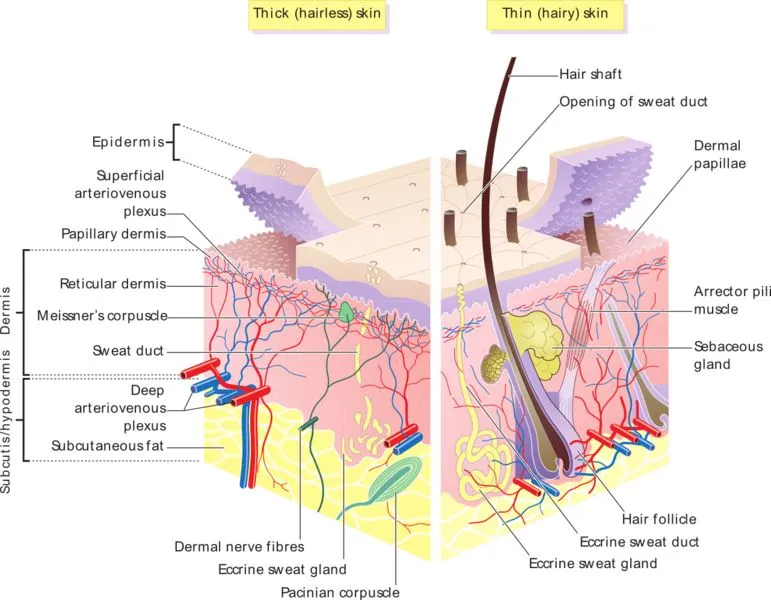
There is a dense network of capillaries beneath the epidermis of the skin. The arterioles supplying these capillary beds widen (vasodilation) or narrow (vasoconstriction) to control how much blood — and therefore heat — reaches the surface, depending on whether heat needs to be released or conserved. The brain instructs the circulatory system on which way to swing.
There are certain receptors in the skin that can ‘sense’ the temperature. These thermoreceptors give the brain a weather report and, based on this, the brain makes its executive decision. Without the brain and heart working, there’s no way for the body to control its internal body temperature.
There are more mechanisms that the brain employs to maintain 37°C than just changes in blood vessel size. These mechanisms involve generating heat by increasing metabolic reactions. Muscle movement generates heat, which is why one shivers when it’s cold.
After death, the metabolic rate of the body decreases. Although certain metabolic reactions are still occurring in the body, it’s no longer making new molecules or generating any energy.
Without the brain and heart functioning, there’s no way for the body to control its temperature. Therefore, based on the laws of physics, the temperature of the corpse will equilibrate with the surrounding ambient temperature. As a rough simplified rule, the body cools roughly 2°C in the first hour after death and then about 1°C per hour, until it nears the ambient temperature — but the real cooling curve is sigmoidal, with an initial "temperature plateau" of one to three hours where the core barely drops at all, followed by a steeper decline and an asymptotic approach to ambient. That plateau is one of the main reasons simple linear formulas are inaccurate in the first few hours.
Using Algor Mortis To Determine Time Of Death
The post-mortem interval (PMI) is the gap between when an individual died and when the body was found. It is also called the "time of death". Forensic experts and pathologists usually provide a window of roughly ±3 hours under ideal conditions — but in practice that uncertainty can widen to ±7 hours or more depending on environmental variables, the body’s state, and how much time has actually passed since death.
Glaister Equation
Algor mortis, though useful to calculate PMI, isn’t always the most reliable factor. The Glaister equation (also called the "rule of thumb") is a general formula used to back-calculate the time since death from rectal temperature, when the ambient temperature is below body temperature. In its standard form:
PMI (hours) = (98.4°F − rectal temperature in °F) ÷ 1.5
So a body found at 88.4°F would correspond to roughly (98.4 − 88.4) ÷ 1.5 ≈ 6.7 hours since death. The rule is a quick first pass, not a precise tool, and it loses accuracy beyond about 12 hours post-mortem.

Henssge Nomogram Technique
The Henssge nomogram is the more rigorous modern method of using algor mortis to calculate PMI. A nomogram is a graphical calculating device: a graph relating several parameters, where matching the known ones lets you read off the unknown. Henssge's nomogram takes four inputs — the rectal temperature, the ambient temperature, the body weight and a corrective factor that accounts for clothing, air movement and whether the body is wet or dry — and assumes an initial body temperature of 37.2°C. It is most reliable in the first 10 hours post-mortem and is generally considered valid up to 24–48 hours under standardized conditions.
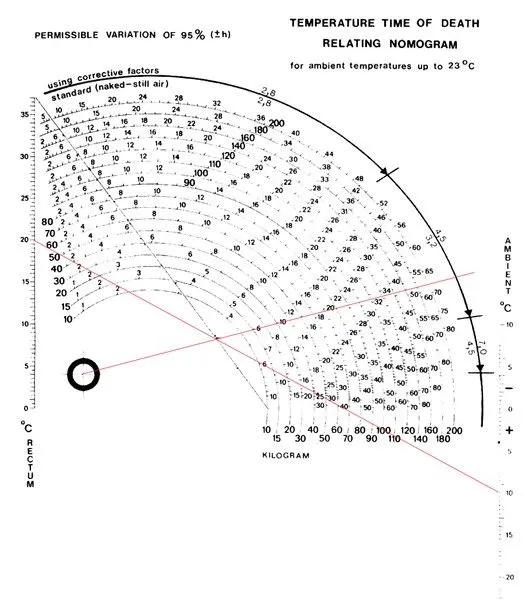
Even then, algor mortis shouldn’t be the only indicator used to determine PMI — it works best in the early stages of death, and the rate of cooling (or heating, in rarer situations) varies depending on the location of the body. Was the body outside being exposed to sunlight or was it under shade? Was the corpse clothed or not, and were the clothes removed at some point after death? Modern forensic toolkits also use complementary biochemical and biological clocks: the steady rise of potassium in the vitreous humor of the eye gives reliable PMI estimates well past 24 hours, and over the last decade pathologists have begun pairing classical Henssge calculations with thanatomicrobiome (post-mortem bacterial succession) analysis and machine-learning regression models, which can outperform the nomogram alone under unusual conditions.
Forensic experts don’t only record the body temperature, but also the ambient temperature when the body was found and temperatures over the past few days. When coupled with other collected evidence (other physiological changes the body goes through, such as rigor mortis and livor mortis, and insects at the sites), this can give forensic experts an approximate PMI.