Table of Contents (click to expand)
Too tired to read? Listen on Spotify:
Some colors, like pink and brown, are created when two different colors mix together, and the colors in a rainbow do not mix. Also, our eyes can only detect a certain range of colors, and some colors, such as those in the ultraviolet and infrared regions, are invisible to us.
I can see pink, black, purple, and all the other colors around me, but I can’t see those in the rainbow.
Could it be possible that there are many more colors present in the rainbow, but our eyes can only distinguish those seven?
That is precisely true.
The rainbow has colors that range from the ultraviolet to the infrared region!! That’s a lot of colors, but we simply can’t see them.
Why is that?
Recommended Video for you:
How Many Colors Are In A Rainbow?
A rainbow contains seven traditionally named colors. They always appear in the same order, from the outer edge of the arc (top) to the inner edge (bottom):
- Red (longest wavelength, ~700 nm)
- Orange (~620 nm)
- Yellow (~580 nm)
- Green (~530 nm)
- Blue (~470 nm)
- Indigo (~445 nm)
- Violet (shortest wavelength, ~400 nm)
The familiar mnemonic for this sequence is ROYGBIV. But here is the catch: a rainbow is not really seven separate stripes. It is a continuous spectrum of color, with each wavelength blending smoothly into the next. The number "seven" is a human convention, not a physical fact.
Why Seven? Blame Isaac Newton
The seven-color count comes from Isaac Newton, who split sunlight with a prism in the 1660s. Newton originally identified only five colors in the spectrum, but later added orange and indigo so the number would match the seven notes of the Western musical scale—a connection he believed reflected a deep harmony in nature.
Today, many scientists argue that indigo should be dropped, because most people cannot reliably distinguish it from blue or violet. To make matters more confusing, Newton’s "indigo" is closer to what we now call "blue," and his "blue" is closer to "cyan." Modern depictions of the rainbow often show just six colors: red, orange, yellow, green, blue, and violet.
Rods And Cones: How Your Eyes See Color
Have you ever noticed that it takes time for your eyes to adjust when you walk into a dark room? That happens because the back of the retina is lined with two kinds of photoreceptors: rods and cones. Rods are highly sensitive to dim light but only register brightness, not color. Cones are responsible for color perception and work best in well-lit conditions.
Humans have three types of cones, named for the part of the spectrum they are most sensitive to:
- S-cones (short-wavelength) peak near 420 nm—blue light.
- M-cones (medium-wavelength) peak near 530 nm—green light.
- L-cones (long-wavelength) peak near 560 nm—yellow-red light.
Every color you see is the brain’s interpretation of the relative signals from these three cone types. 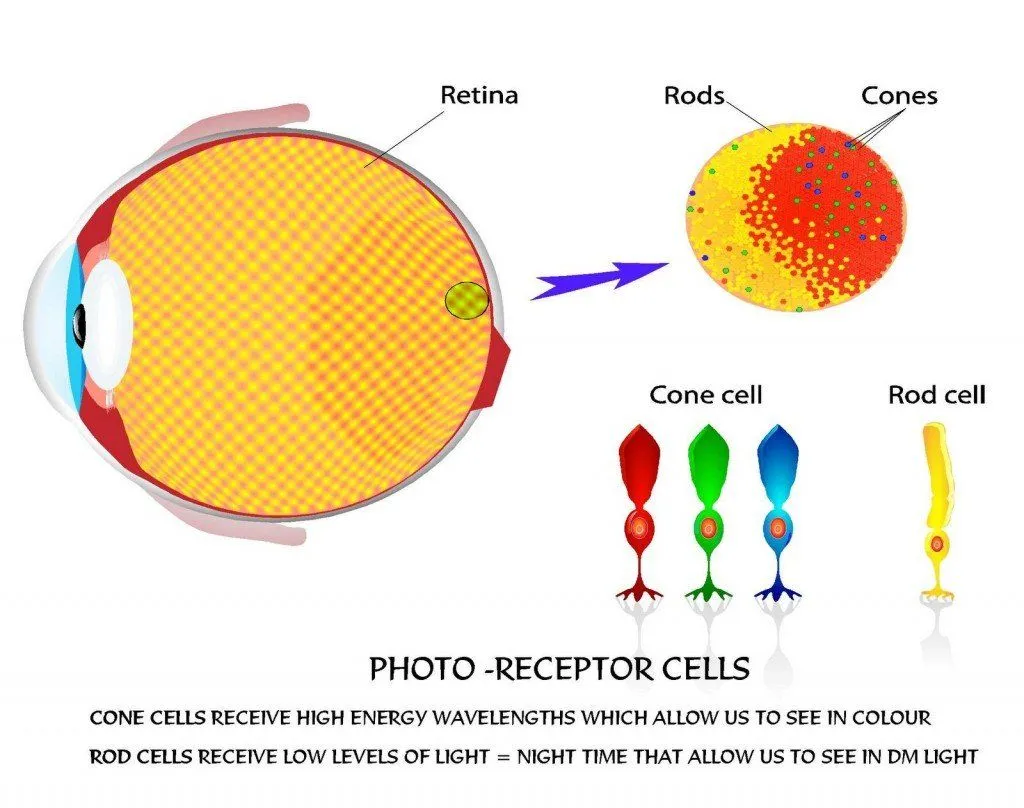
When you look at a banana, light around 580 nm reaches your eye and triggers both your L-cones and M-cones at roughly the same level. Your brain reads that combination and tells you "yellow." Different mixes of cone signals produce different colors—the brain literally averages the inputs to land on a hue.
For some colors, one cone fires fully while another fires only partially. White light triggers all three cone types together, which is why you perceive the mixture as white rather than as individual wavelengths.
People with color blindness have one or more cone types that do not function normally—most commonly the L- or M-cone, which is why red-green color blindness is the most prevalent form. They still see a rainbow, but with fewer distinguishable bands.
Why Aren’t Pink, Brown, Black, And White In The Rainbow?
Now that we know how the eye picks up color, here is the puzzle: we never see brown, white, black, pink, or magenta in a rainbow. Why?
The colors that appear in a rainbow are spectral colors—each one corresponds to a single wavelength of light in the visible spectrum (roughly 380 nm to 700 nm). Pink, brown, magenta, white, and black are non-spectral; no single wavelength produces them on its own.
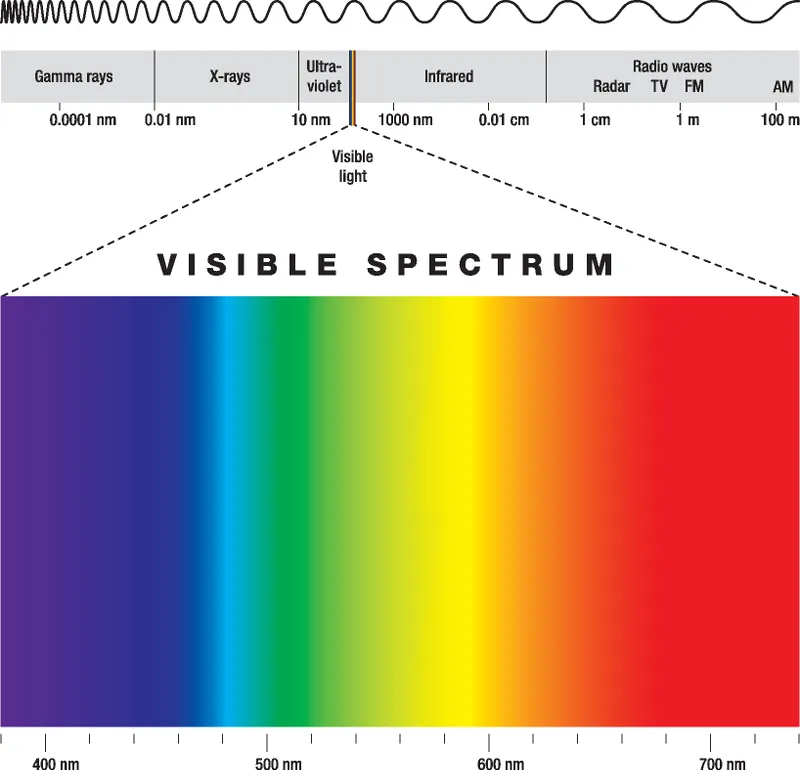
Notice that the visible spectrum has no pink, no brown, and no magenta. To see those colors, your eyes have to receive a mix of wavelengths at the same time. Pink and magenta, for example, only appear when red light (long wavelength) and blue light (short wavelength) hit the retina together. Your brain "invents" magenta to bridge the two ends of the spectrum, because there is no real wavelength between red and violet.
Look at a rainbow. The red band is at one end and the blue band is at the other. Because they never overlap, the rainbow cannot produce pink or magenta.
The same logic explains brown, which is essentially a dim mixture of red, orange, and yellow with some green. Those bands sit side by side in the rainbow but never combine in the right proportions and brightness to register as brown.
(Quick clarification: violet is a true spectral color and does appear in the rainbow at around 400 nm. Purple—a vivid mix of red and blue—is non-spectral and does not.)
What about black and white? That is the most elegant part of the puzzle.
A rainbow exists because white sunlight is being split apart. White is what you get when all wavelengths reach your eye at once, so it cannot also appear as one of the bands.
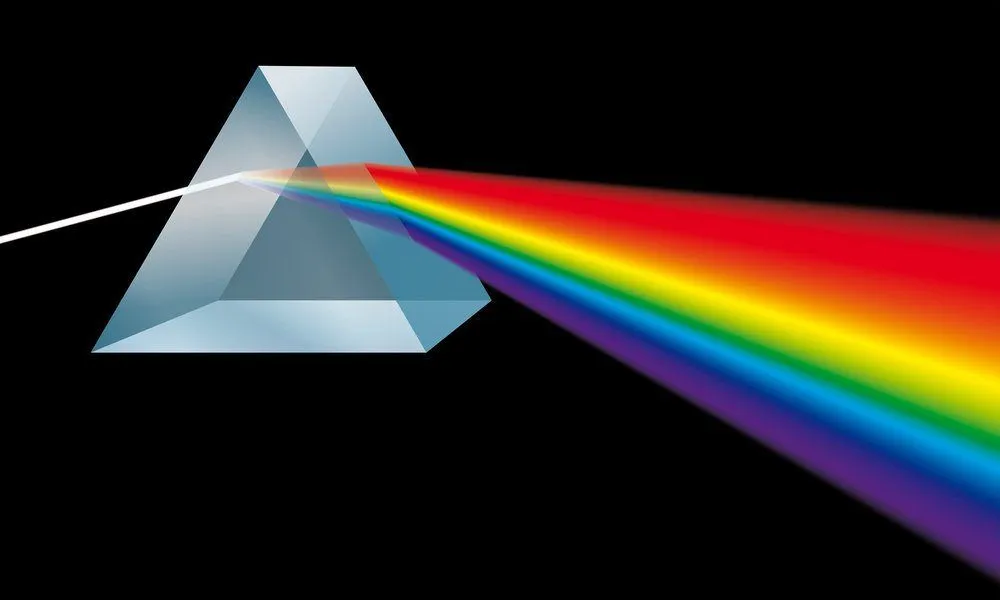
Black is simply the absence of light, so it cannot be a band of a rainbow either—a rainbow is, by definition, light.
One more fascinating wrinkle: no two people see exactly the same rainbow. The number, density, and ratios of cones differ slightly between individuals, so the same arc of light produces subtly different colors for every observer. A small fraction of women carry a fourth functional cone type and may perceive shades the rest of us cannot distinguish.
The rainbow is also only a slim slice of the full electromagnetic spectrum. Beyond violet lies ultraviolet (and then X-rays and gamma rays); beyond red lies infrared (and then microwaves and radio waves). Bees, birds, and many insects can see into the ultraviolet, while pit vipers and some fish detect infrared. Our visible window—roughly 380 to 700 nm—is just a narrow band the human eye evolved to use.
So the next time you see a rainbow, remember: those seven bright stripes are a continuous spectrum, "indigo" is a leftover from Newton’s love of music, and the colors you don’t see—pink, magenta, brown, white, black—are the ones your brain has to invent.
Last Updated By: Ashish Tiwari