Table of Contents (click to expand)
Starfish (sea stars) move using thousands of tiny tube feet located on their underside. These tube feet are powered by a water vascular system that uses hydraulic pressure to extend and retract the feet, allowing the animal to crawl slowly across surfaces.
During your long walks on the beach, have you ever taken a step back and noticed the creatures around you? The crabs, the birds, and most importantly, the starfish? If not, then you’ll certainly take note after reading this article! Not only does the starfish have a gimmicky name, but it’s also a pretty enigmatic creature! Few animals are clever enough to leverage water to their advantage like a starfish. How? Let’s find out!
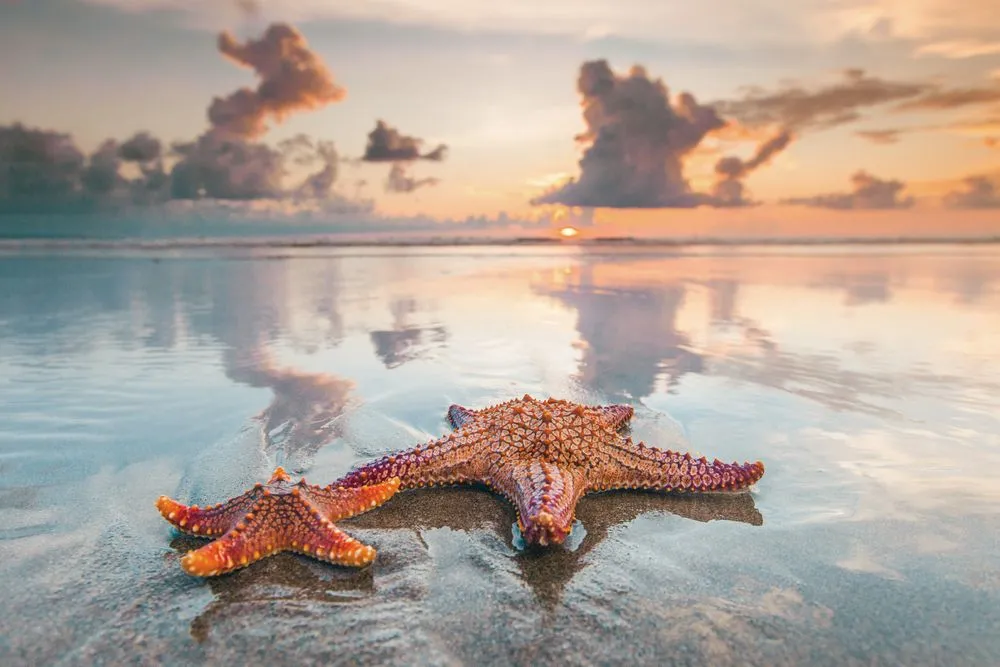
The means of locomotion for a starfish is through their tube feet. A starfish has thousands of these tube feet on its lower surface. When water enters the canals inside the body of a starfish, it eventually reaches these feet. A series of contraction and relaxation procedures take place, which displaces the animal from one place to another. Pretty cool! Now, let’s take a more in-depth look to understand this all a bit better!
Recommended Video for you:
What Is A Starfish?
Starfish are also known as sea stars. Interestingly, ‘sea star’ is also a more correct way to refer to this animal, because a starfish is nothing like an actual fish! It doesn’t have a streamlined shape or any fins for swimming. Scientifically, a starfish is actually an Echinoderm. The term echinoderm comes from the Greek language, which means “hedgehog skinned”. It is an entire phylum of zoological classification, and several other well-known animals fall under this category, such as sea urchins, sea cucumbers, and brittle stars!
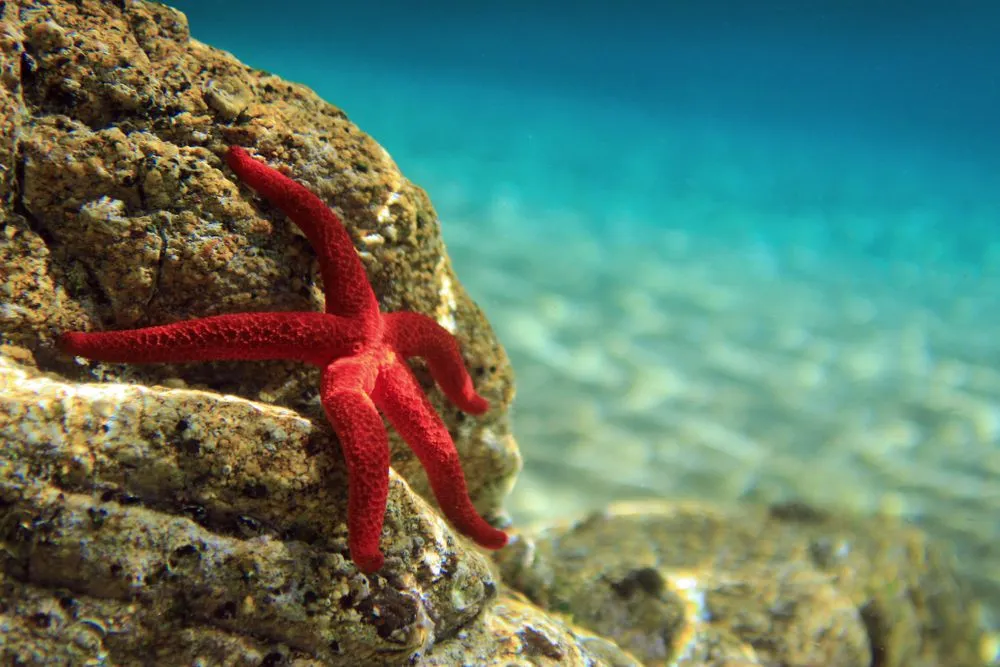
Sea stars are free-living marine animals that are often found on sandy or muddy bottoms, crawling over rocks and shells. From tide marks to deep waters, these creatures are found everywhere. Most sea stars are carnivores, meaning that they feed on other smaller animals, including small crustaceans and mollusks, though some species are omnivorous and also consume algae. On a hard surface, such as rocks or sand, sea stars move very slowly. They adhere firmly to these surfaces with their tube feet by creating a vacuum.
What Is The Water Vascular System In A Sea Star?
Now, if a sea star doesn’t have any fins or legs, does it just remain attached to one place forever? Well, the obvious answer is no! So how does movement take place? For that to be understood, we need to look at the general anatomy of a sea star. Don’t worry; sea stars are not very complex organisms. As such, they don’t have elaborate body systems like us!
The water vascular system is primarily responsible for locomotion in all Echinoderms, including the sea star. It is a system of canals inside the body of the animal that contain seawater. The water vascular system also contains the madreporite, which is a sieve-like plate located on the aboral (upper) surface of the sea star. It has very minute pores that filter the water and transfer it to the stone canal, which lies beside it.
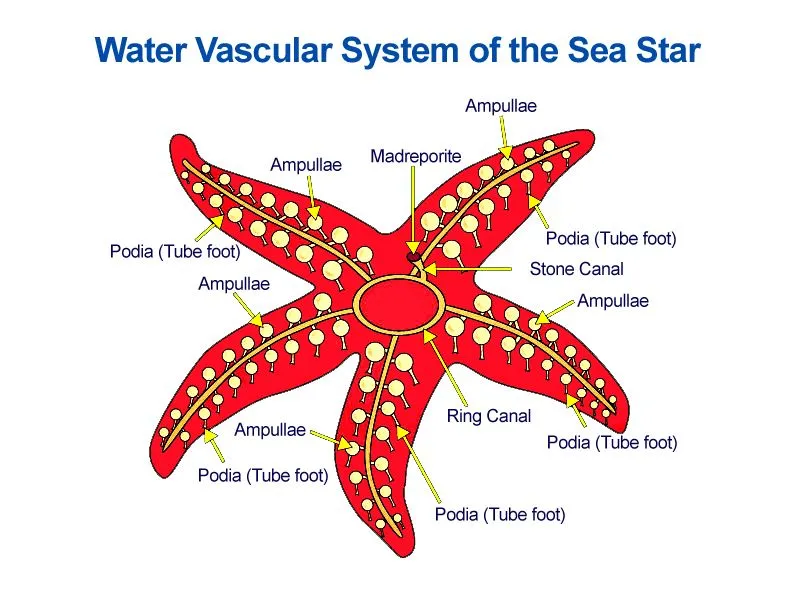
The stone canal has that name because hard rings support it. This canal then connects to the ring canal, which is a circular canal encircling the mouth. From this ring canal, five canals arise and terminate into each foot of the sea star. These are called the radial canals. Now comes the star of the system—the tube foot. Two double rows of tube feet line the radial canals, and are connected to the canals via tenuous links. These connections are called lateral canals.
This whole system of canals might sound a little intimidating, but the whole picture becomes clear once you consider the movement of water!
How Does The Sea Star Move?
The water vascular system is critical to the movement of a sea star. It helps in setting up hydraulic pressure, which pulls in the water. All the tube feet have a swollen structure called the ampulla, which end at a thinner base that forms the podium. The podium consists of suckers that help in adhering to the ground.
When the water is taken inside this system through the tiny pores of the madreporite, it travels through the stone canal, the ring canal, the radial canals, and finally, the lateral canals. This then reaches the ampulla, where the water is maintained at all times. When the ampulla contracts, it forces the water towards the suckered podium, which results in their extension. This helps in detaching an arm of the sea star from the surface. The animal may then choose a different point of attachment, which brings about another displacement in its position.
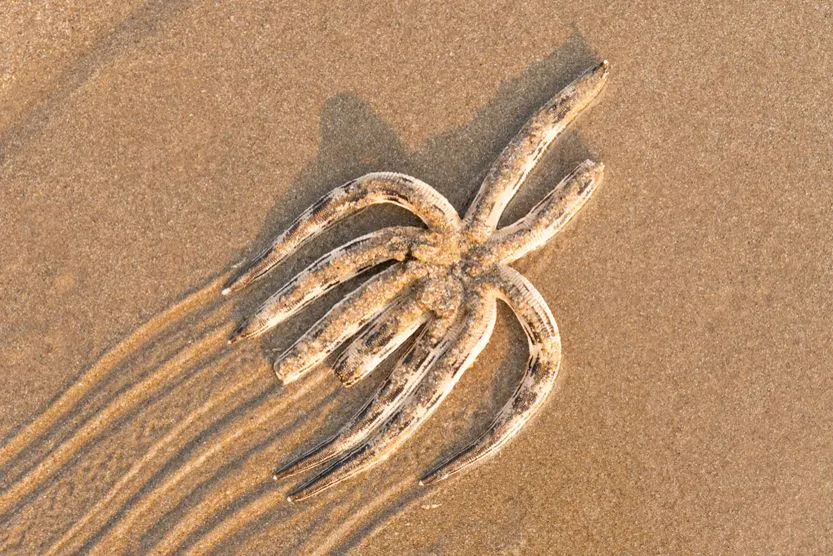
After it reaches the position where it wants to stay, the ampulla relaxes. This relaxation causes the formation of suction cups. The suction cups create a vacuum and help to adhere the sea star to the surface. After both the steps are completed, the sea star has reached an entirely new location. As such, even though the motion is slow, it is quite effective!
Conclusion
An interesting thing to note is that the water vascular system is functional at all times. The water inside the canals and the ampulla of the tube feet are present 24/7. Thus, a sea star can move from one place to another whenever it wants, and doesn’t need to wait for a wave of water to change location.
How fast can a starfish move? Most species are quite slow, traveling at just a few centimeters per minute. However, some species are surprisingly quick. The sunflower sea star (Pycnopodia helianthoides), with up to 15,000 tube feet, can move at about one meter per minute. The sand star (Luidia foliolata) can reach speeds of nearly three meters per minute. It is also worth noting that starfish cannot swim; they are strictly bottom-dwellers that crawl along surfaces using their tube feet.
Recent research has also highlighted how important sea stars are to ocean ecosystems. Since 2013, sea star wasting disease has devastated populations along the Pacific coast of North America, killing billions of individuals. By 2025, however, scientists at the University of Washington developed a groundbreaking captive breeding program, and captive-raised sunflower sea stars are now being released into the wild, offering hope for the recovery of this critically endangered species.
There are some things that sit right in front of our eyes, but we never really appreciate how wonderful they truly are. Sea stars certainly fit in that category!