Table of Contents (click to expand)
Unlike humans, the “eyes” of most jellyfish are not concentrated in a single organ; instead, the ability to see is facilitated by a network of nerves and proteins called opsins.
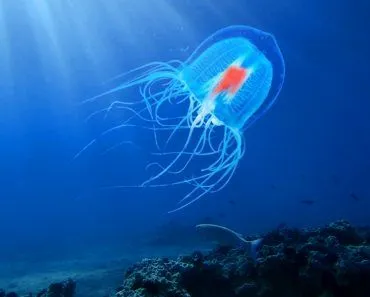
Imagine that you’re wading out into the ocean with a snorkeling mask on your face, the sun beating down on your back. As you slip under the Caribbean waters and open your eyes, eager to catch your first glimpse of tropical fish or colorful coral, you come face to face with a tiny, transparent mass of tentacles just a few feet away. You’ve stumbled onto a jellyfish, and while they’re beautiful, they can also be dangerous! You slowly wade backwards through the water, hoping that the jellyfish won’t spot you and make any aggressive moves in your direction.
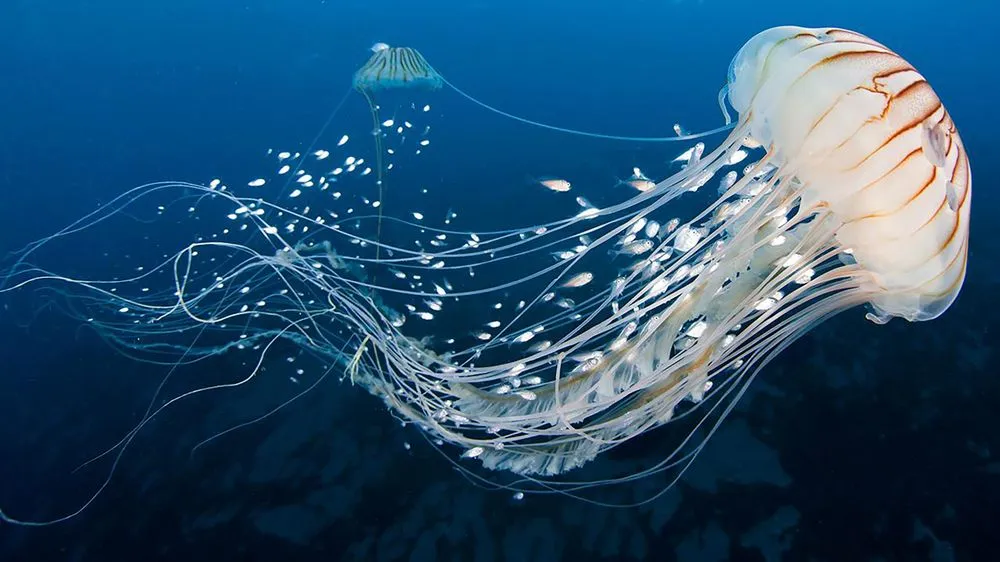
At that point, an important question hits you… can that jellyfish see me? Do jellyfish even have eyes?
Recommended Video for you:
Jellyfish: Not Too Complicated
When talking about jellyfish anatomy, the conversation is usually quite brief. In comparison to the vast majority of animals that we are familiar with, jellyfish are quite simple. Jellyfish lack a brain, a heart or bones, as well as every other critical organ that we cherish as human beings.
Jellyfish are members of the Cnidaria phylum, and can’t scientifically be classified as fish, who belong in the phylum Chordata. In fact, jellyfish are a type of plankton, and are related corals and sea anemone, which form the foundation of most marine food chains.
These evolutionary ancients, having been on Earth for 600 million years, are physiologically simple. Their body is mainly composed of water – about 95 to 98%, along with a short list of body parts.
The jellyfish is basically a sandwich of two cellular layers—the outer epidermis and the inner gastrodermis layer. Between these two cells is a thick, jellylike fluid called the mesoglea, hence the name jellyfish.
The jellyfish has a single opening that serves as both a mouth (orifice) that takes food in and an anus that excretes it out. The mouth leads to the gastrovascular cavity, a rudimentary stomach where the jellyfish digests and absorbs the nutrients from its food.
The last element of their physical structure, and what most people associate with these cnidarians, is the tentacles. While these can vary widely in terms of length and number, they are arguably the most important body part of any jellyfish. They are also the primary sensory organs for these basic creatures, even giving them the power of “sight”.
Do Jellyfish Have Eyes?
When we think of eyes, it is natural to picture them as structures similar to our own, but the variety of eye and sight-providing organs in nature is immense. There remains an intense debate over whether eyes developed once or multiple times throughout the evolutionary tree of life on Earth. The consensus is that some sort of light-detecting mechanism was present in an early ancestor of sighted animals, and the diversity of how that genetic programming developed remains a source of fascination for researchers.

The even more fascinating bit is that jellyfish do have eyes. In fact, eyes are thought to have evolved independently at least nine separate times across the animal kingdom, and jellyfish were among the earliest groups to develop them. Their eyes don’t look much like ours, except those of the box jellyfish, whom we’ll discuss later, but they’re good enough to detect basic light signals. The light signals are sent to the jellyfish’s rudimentary nervous system, which looks like a net, so researchers cleverly called it a nerve net. Slightly more complex jellyfish have a nerve ring, a set of nerves that borders the jellyfish’s bell — its floaty, head-like structure. The nerve ring is the closest thing to a central nervous system the jellyfish has, and as we’ll see later in the article, it still holds plenty of mysteries for scientists.
The Rhopalia
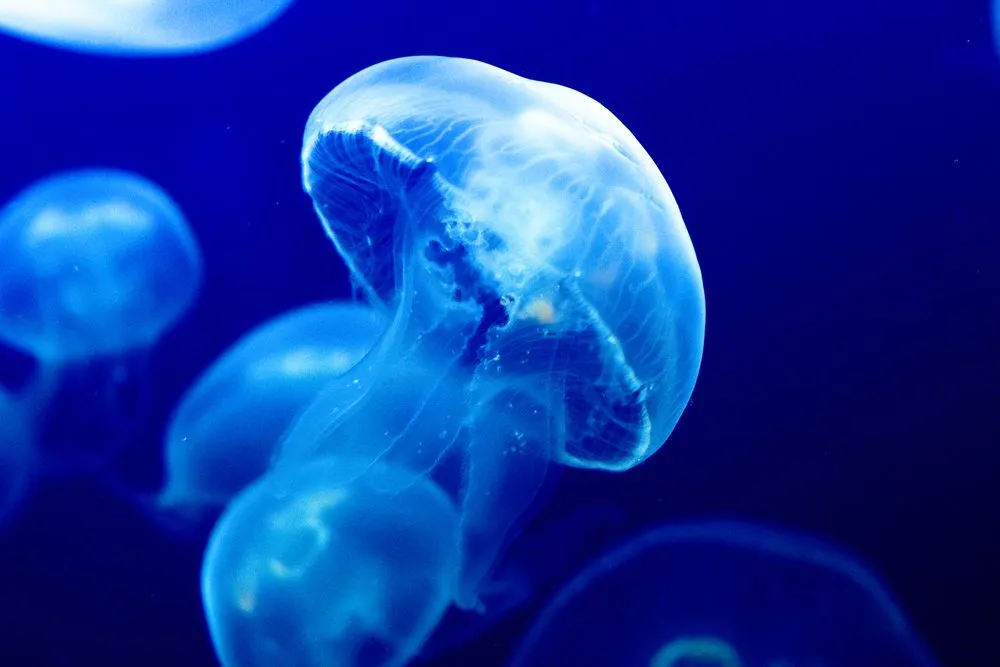
The jellyfish’s light sensing organ lies within a structure called the rhopalia, which lies at the edge of the jellyfish’s bell. If you look at the picture of this ethereal moon jellyfish, you’ll see that the margin of its bell isn’t straight, it curves inward. Those inward points in the bell are where the rhopalia is located.
Within each rhopalium are tiny gravity-sensing organs called statocysts — fluid-filled chambers that contain a calcium-rich crystal called a statolith. As the jellyfish tilts, the statolith shifts and brushes against sensory hairs, telling the animal which way is up. Sitting alongside these balance organs are the light-sensing pigment spots called ocelli. The rhopalia are special in that they also house nerve nodes — concentrated, organized sets of neurons — unlike the diffuse nerve net that runs through the rest of the jellyfish’s body.
The moon jellyfish and many of its relatives in the class Scyphozoa have rather rudimentary ocelli. They can detect light and its intensity, but nothing more than that.
Box jellyfish, however, have leveled up to eyes much like our own, complete with a retina, cornea and lens. The box jellyfish Tripedalia cystophora has 4 rhopalia, within each of which lie 6 eyes — making a total of 24 eyes. Those six eyes are not all alike; they come in four distinct types: an upper lens eye that gazes up at the world above the water, a lower lens eye angled obliquely downward to spot obstacles, a pair of pit eyes that detect light from above, and a pair of slit eyes that pick up shaded contrasts to help the animal find shelter. The two lens eyes are the most sophisticated, with structures comparable to ours, while the four pit and slit eyes are simpler.
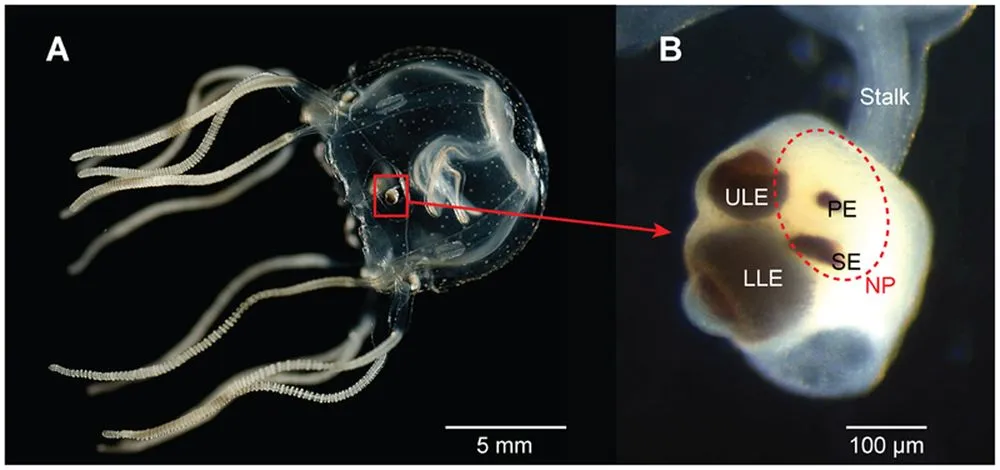
This sight, both the simple one of the moon jellyfish and the more detailed one of the box jellyfish, is due to opsins, proteins that can detect light. These opsins are similar to those that allow humans to see the world around them. When light hits these opsins, a series of complex biochemical changes occur that finally lead to the activation of neurons, which allow the jellyfish to respond appropriately to the light stimulus.
With these eyes, Tripedalia cystophora can see — much like we do — although its vision is rather blurry. Scientists have observed the box jellyfish using its sense of vision to identify habitats it prefers, such as among the roots of mangroves, and to track down prey. Some jellyfish varieties, like the box jellyfish Carybdea sivickisi, even perform mating rituals characteristic of animals with far more sophisticated nervous systems.
And in 2023, researchers from the University of Copenhagen and Kiel University showed something even more startling: Tripedalia cystophora can learn from experience. In the lab, Caribbean box jellyfish were placed in tanks with grey-and-white striped walls that simulated muddy mangrove roots. Within just a few minutes, the jellyfish learned to associate the dim contrast with an obstacle and began steering away from the walls — a feat known as associative learning that, until then, had been documented only in animals with proper brains. The findings suggest the rhopalia themselves may serve as miniature learning centers.
The story keeps getting richer. In 2025, scientists at UC Santa Cruz sequenced the genome of a tiny jellyfish-like cnidarian, Bougainvillia cf. muscus, which carries an astonishing 28 eyes and 20 different opsin genes — five times the number humans have. The opsins differ from those of better-known jellyfish, hinting that vision evolved more than once even within the cnidarian family tree.
These behaviors, scientists think, arise from how the nerve ring integrates incoming information from the environment and translates it into action. Exactly how it does this remains a puzzle. So, even though we call the jellyfish’s nervous system “primitive,” it still hides a few fascinating secrets.
References (click to expand)
- NOAA Ocean Explorer | Ocean Explorer | Creatures and Features: Mysubmarine Exploration | jellyfish - oceanexplorer.noaa.gov
- Garm, A., Oskarsson, M., & Nilsson, D.-E. (2011, May). Box Jellyfish Use Terrestrial Visual Cues for Navigation. Current Biology. Elsevier BV.
- Suga, H., Schmid, V., & Gehring, W. J. (2008, January). Evolution and Functional Diversity of Jellyfish Opsins. Current Biology. Elsevier BV.
- Lewis, C., & Long, T. A. F. (2005, March 31). Courtship and reproduction in Carybdea sivickisi (Cnidaria: Cubozoa). Marine Biology. Springer Science and Business Media LLC.