Table of Contents (click to expand)
WiFi signals are a type of electromagnetic radiation, much like visible light. The electromagnetic waves that have a wavelength in the range of WiFi signals pass through walls just as easily as light passes through glass windows.
One of the most common problems of the modern world is the lack of WiFi availability, especially when you need it most!
However, there are some things about Wi-Fi technologies that, if you’d mentioned them a few decades ago, would have made people think you’d lost your marbles. For instance, the very existence of a technology that enables you to stream videos and connect to the rest of the world—wirelessly—would have boggled everyone’s mind.
Also, WiFi signals reach your device even when the WiFi router is far away from you. For example, you’re able to browse the internet using WiFi even if the WiFi router is in a different room with one or more walls/doors between your phone and the router.
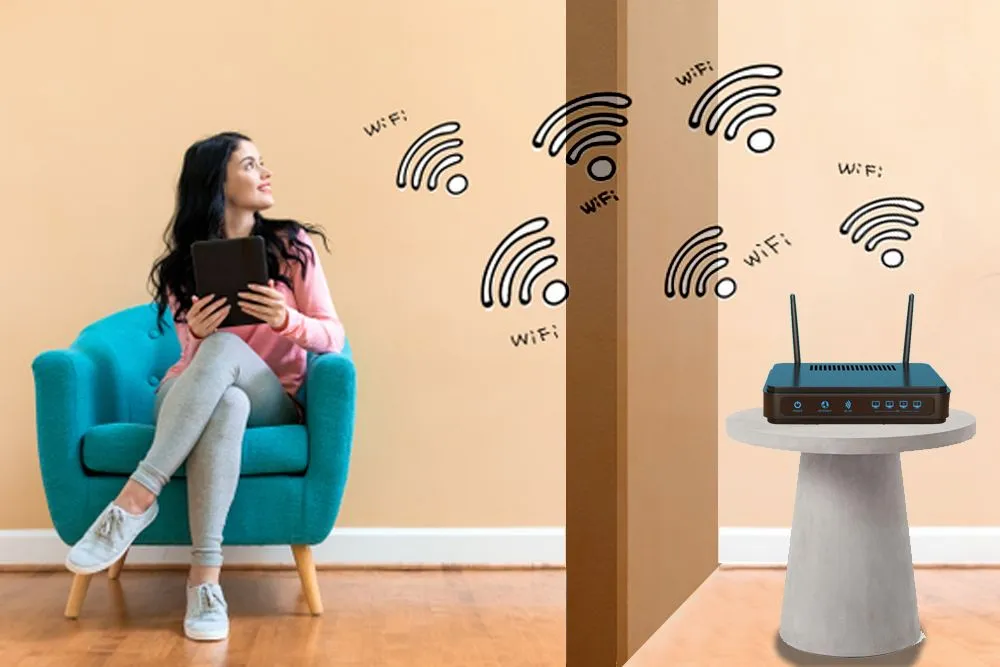
Isn’t it strange that light can’t travel through walls, but WiFi signals can? How does that happen?
Recommended Video for you:
Electromagnetic Radiation And WiFi
You’ve probably come across electromagnetic radiation at some point recently. After all, we’re constantly surrounded by it. Visible light, Bluetooth, WiFi signals, infrared—it’s everywhere. From a technical standpoint, it is a form of energy that travels at the speed of light and is categorized into radio waves, microwaves, UV rays and so on, depending on its frequency (or wavelength).
Take a look at the following picture:
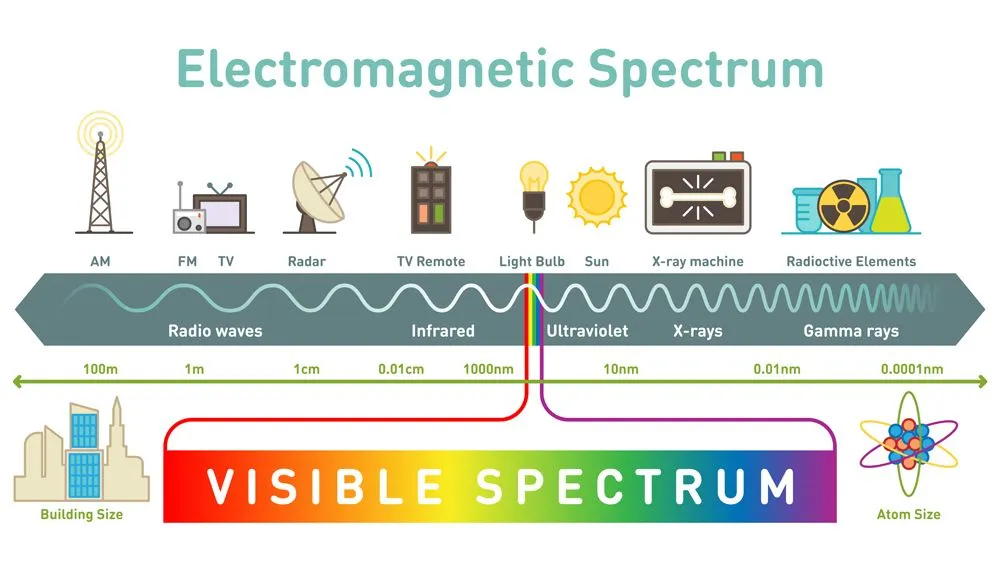
As you can see in the image above, there are 6 main types of electromagnetic radiation (7, if you count visible light separately).
Radio waves are one of the types, and WiFi works on these radio waves.
WiFi uses radio waves to establish wireless communication between two or more devices. Strictly speaking, the 2.4 GHz, 5 GHz, and 6 GHz bands that WiFi uses sit at the boundary between radio waves and microwaves on the electromagnetic spectrum, but they are conventionally called radio frequencies. Modern routers operate on more than one of these bands depending on the amount of data being transmitted, and the higher the frequency, the greater the amount of data that can be sent per second.
The 2.4 GHz band travels farthest and penetrates walls best, but is more crowded (microwaves, cordless phones, Bluetooth, baby monitors). The 5 GHz band carries more data with less interference, but its shorter wavelength is absorbed more by walls. The newer 6 GHz band, opened up by Wi-Fi 6E and used by Wi-Fi 7 (IEEE 802.11be, certified in January 2024), offers even more bandwidth and lower latency, though its range and wall penetration are the most limited of the three.
How WiFi Signals Travel Through Walls
When an electromagnetic wave (in this case, a WiFi signal) strikes a surface, it can do one of three things:
1 – pass through (transmission)
2 – get reflected (reflection)
3 – get absorbed (absorption)
(In practice, all three usually happen at once: some of the wave is reflected at the surface, some is absorbed inside the material, and the rest is transmitted out the other side. Refraction — the bending of the wave as it crosses the boundary — is also involved, but it is what bends the transmitted portion, not the act of passing through itself.)
When an object reflects a particular wavelength of visible light, the color associated with that wavelength becomes the color of the object. An apple is red because, when light falls on its surface, the wavelength of light that it reflects the most is the one associated with the color red.

Now, the next logical question: what makes an object absorb, reflect or refract only a particular wavelength of electromagnetic radiation?
That depends entirely on the composition of the object in question. You see, everything in this universe is made of tiny building blocks called atoms. It is the size of these atoms and the distance between them (how closely or loosely they’re packed together inside an object) that determines whether the object will absorb a particular wavelength of electromagnetic radiation or let it pass through.
Take visible light, for example. When you close your bedroom door, the light from outside doesn’t enter your bedroom, right? Why not?
Well, because visible light cannot pass through solid objects, such as walls or your bedroom door. However, it can easily pass through certain other solid objects, such as glass windows. This is exactly why WiFi signals are able to pass through walls and doors.
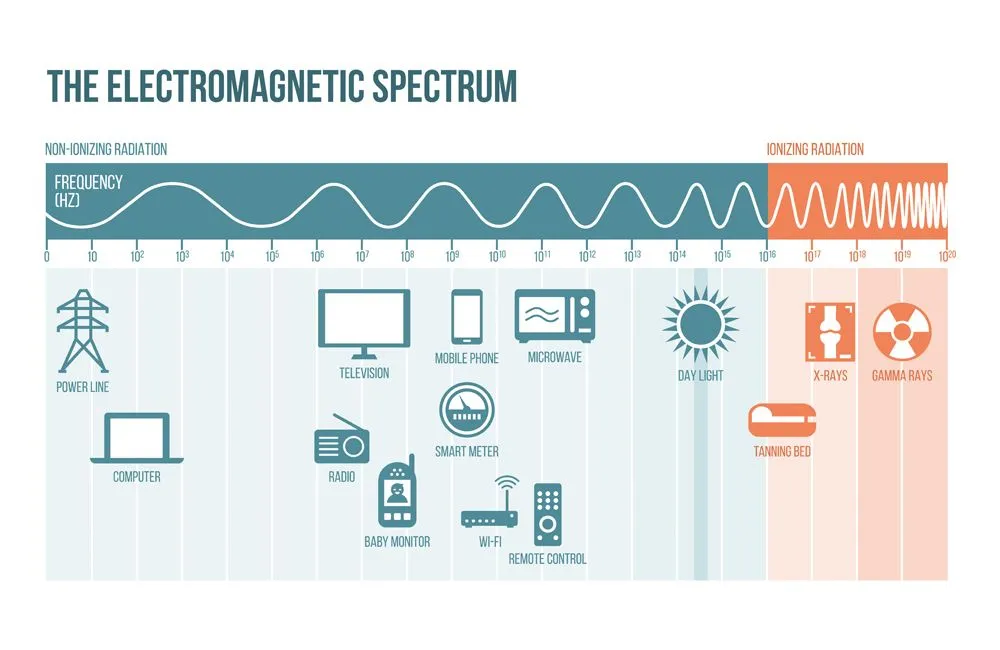
Just like how glass windows are transparent to visible light, walls are transparent to WiFi signals (another kind of electromagnetic radiation) because the frequency (or wavelength) of radiation associated with WiFi signals is able to penetrate solid objects, but only up to a certain point.
If the walls in question are too thick, the WiFi signals won’t be able to pass through them. Also, as WiFi signals travel through air, they get attenuated, meaning they lose some of their energy.
This is why, if you operate a WiFi router within a room surrounded by thick concrete walls, you won’t get any WiFi reception outside the room. Similarly, you won’t get good WiFi reception on your device if the router is a considerable distance away from you (150-300 feet).
How much a WiFi signal is weakened depends almost entirely on what the wall is made of. Drywall and plain wood are nearly transparent to WiFi, costing only a few decibels of signal. Plain glass windows let WiFi through with very little loss, which is why your WiFi often works better through a window than through an interior wall. Modern energy-efficient windows are a different story: low-emissivity (low-E) and tinted glass have a thin metallic coating that, while great for blocking heat, also reflects radio frequencies — they can attenuate WiFi by 20 dB or more compared to ordinary glass. Brick, plaster, and tinted glass cause moderate attenuation, while thick concrete (especially steel-reinforced concrete), stone, and any large sheet of metal — including foil-backed insulation, metal studs, mirrors, refrigerators, and metal filing cabinets — strongly block WiFi. Water also absorbs the 2.4 GHz band heavily, which is why a fish tank, a wet wall, or a roomful of people can noticeably weaken the signal.
Put simply, walls are just as transparent to WiFi signals as glass windows are to visible light, which is why WiFi signals can easily pass through most walls and ensure you stay connected!