Table of Contents (click to expand)
Dry ice is solid carbon dioxide that has a temperature of -79°C or less. Dry ice can be prepared at home using very simple instruments and some proper safety equipment.
Have you ever seen a dense white fog emerging from a vessel, a fog often used for decorating dance floors or creating a dancing-on-clouds effect at weddings? Or maybe you went to a Halloween party and saw a graveyard brought to life with chilly mist running all over it. If you’ve ever witnessed these things and wanted to know what was used to create these effects, you’re reading the right article.
All the effects mentioned above, and many more—such as the cascading fog effect in a champagne glass tower or the fog effect created around dishes in some high-end restaurants—are created using Dry Ice. The name is a bit confusing, as you are probably wondering how ice can be “dry” if it’s made of water. Well, that’s the thing… it’s not made using water, but something entirely different!

Recommended Video for you:
What Is Dry Ice?
Dry ice is the solid form of carbon dioxide. At ordinary atmospheric pressure it does not melt — it sublimes, turning directly from solid to gas, at -78.5 °C (-109.3 °F). Among the three states of matter, gases have the largest intermolecular spaces and their molecules possess the highest amount of free kinetic energy, which is one reason why CO₂ requires such a low temperature to solidify. Dry ice itself is colorless, non-flammable and essentially odorless; CO₂ has only a faint, slightly pungent smell at very high concentrations. When dry ice is added to water, some of the subliming gas dissolves to form carbonic acid, giving the solution a pH below 7.
How Is Dry Ice Manufactured At An Industrial Level?
On an industrial level, dry ice is manufactured by pressurizing and liquefying gases with a high concentration of carbon dioxide. For this process, heavy engineering equipment like compressors, alloy steel gas chambers and expansion valves are required. Once the carbon dioxide has been liquefied, it is sent through an expansion valve to a condensation chamber. Here, some of the liquid CO2 vaporizes, lowering the surrounding temperature to a great extent. As such, most of the liquid and gaseous CO2 present solidifies into dry ice snow. The remaining liquid and gaseous CO2 is recycled back to be used again.
How Can You Make Dry Ice At Home?
Before we explain the process of making dry ice at home, it’s very important to understand how dangerous it is to handle dry ice without proper guidance. To carry out the experiment, you must always follow one condition—be responsible with the equipment, especially where your hands are concerned! You can’t work without protection, because dry ice can cause severe burns. If you don’t feel confident doing the experiment on your own, call an experienced person to help you!
The Equipment Required
Dry ice can be prepared at home using some simple equipment used in your day-to-day life. The following materials would be needed to complete the process.
- A carbon dioxide-based fire extinguisher
- Strong cloth or polymer bag
- Heavy-duty cloth gloves
- Duct tape or some other form of strong tape
- Safety Goggles and other safety instruments

The Process
To start the process of making dry ice, you should first wholly cover your body from top to bottom, as direct contact between your skin and dry ice would burn your skin. Next, take the nozzle of the fire extinguisher and insert it into the cloth bag or sock. Use duct tape or a rubber band to secure the bag around the nozzle — the bag should grip the nozzle firmly, but the cloth itself must remain porous so that expanding gas can escape through the fibres. Never seal the bag completely, since trapping the rapidly expanding CO₂ effectively turns the setup into a pressure vessel that can rupture violently. Then briefly discharge the fire extinguisher so that CO2 is released into the bag. As the highly pressurized CO₂ expands suddenly into atmospheric pressure, it cools dramatically (the Joule–Thomson effect), and a small fraction freezes into snow-like flakes of dry ice that collect inside the bag while the rest escapes as gas.
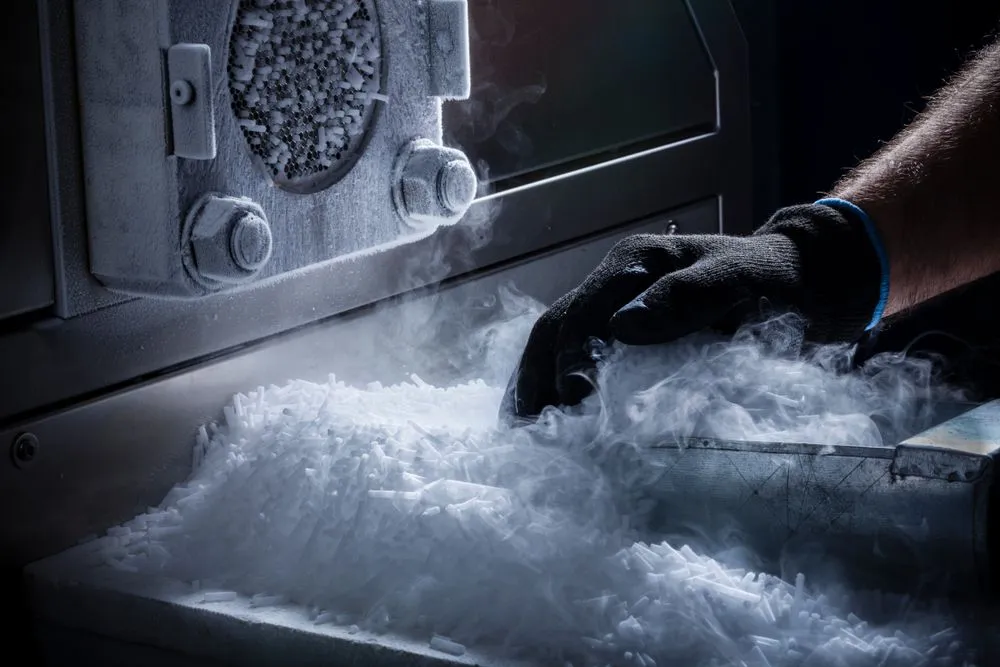
As already mentioned, dry ice is extremely dangerous and must be dealt with carefully. The oral intake of dry ice can lead to many problems, including the freezing of cells in your respiratory system, to the point that they stop functioning. Again, dry ice is nothing but highly pressurized CO2, and if the pressure is not allowed to release correctly, it may lead to blasts injuring anyone in the vicinity of the experiment.
Applications Of Dry Ice
The most important use of dry ice is in the field of food preservation. Dry ice can keep produce at a chilled temperature for a very long period of time. These low temperatures, in turn, render the food products dormant, so that no form of bacterial growth or fungal growth is possible, and they remain fresh as long as they stay frozen. However, dry ice cannot come directly in contact with the food items, as it would over-freeze them. Instead, the food should be placed in a compartment with some sort of packing or buffer between the food item and the dry ice.
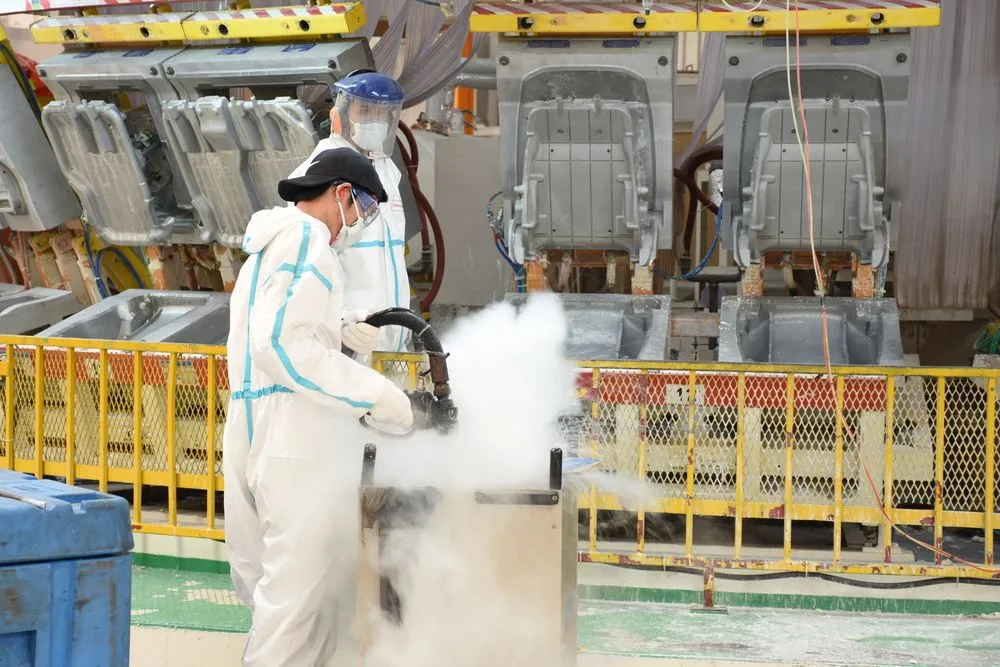
One of the lesser-known uses of dry ice is in the field of cleaning industrial equipment. Oils and other toxins are very difficult to remove, as they are insoluble in water and stick to the machinery with the help of covalent bonds. Dry ice blasts freeze these impurities, converting them into solids that can be removed easily. This method is also environmentally friendly, as it leaves behind no residue. Plumbers often use dry ice to clean drain pipes and remove blockages. Compressor pumps force pressurized liquid CO2 into the region around a pipe that the plumbers are trying to repair or replace by creating a false scaffolding around the pipe. The dry ice instantly freezes the water by creating a sort of ice plug, allowing the plumbers to perform repairs without turning off the entire water system!