Table of Contents (click to expand)
Soccer balls are deliberately not perfectly spherical — they are stitched or thermally bonded from curved panels whose seams give the ball stable, predictable flight. When Adidas’s 2010 World Cup ball, the Jabulani, came close to a true smooth sphere (just 8 thermally bonded panels), it instead developed an unpredictable “knuckleball” effect at typical free-kick speeds. Players couldn’t tell where shots were headed, goalkeepers struggled to judge the trajectory, and the seamier 2014 Brazuca was specifically designed to fix it.
For thousands of years, human beings have invariably enjoyed kicking things around. The experience of kicking an object is even more fun when the thing is round or spherical in shape. That’s why it comes as no surprise why we invented the game of soccer (known as football in many countries).
At first glance, soccer balls appear to be perfectly spherical or round in shape. However, one has to look very close to ascertain the roundness of the ball. There are several reasons why soccer balls are not perfectly round in their shape.
Nevertheless, in the 2010 FIFA World Cup, which was held in South Africa, the ball that was used was the ’roundest’ ball ever used in the history of FIFA World Cups. Needless to say, it made a definite difference, some of which were not desirable to many teams.
Recommended Video for you:
The Case Of Jabulani
Every four years, before the FIFA World Cup, the official ball is ‘launched’ on the market, i.e., the ball that will be used throughout the tournament is released to the world. Usually, these balls are given an official name as well. The one they used for the 2010 World Cup was named Jabulani, which means ‘to celebrate’ in isiZulu (one of South Africa’s 11 national languages). It was Adidas’s 11th edition of balls used in World Cups.
Now, let’s take a look at the features of the ball.
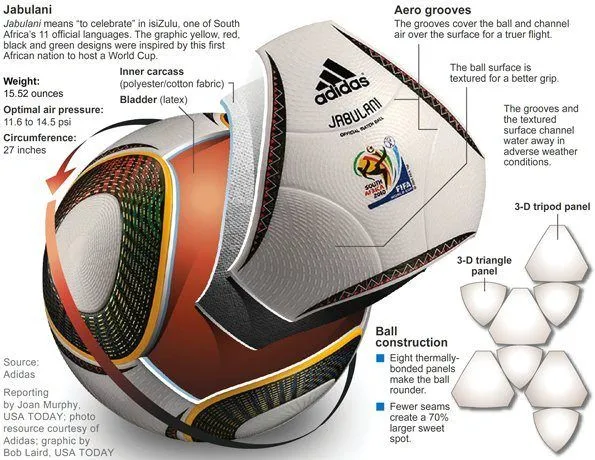
Jabulani weighs 439 grams and has a circumference of 69 centimeters (27.1 inches). This ball boasts a newly designed “Grip ‘n Groove” surface, which would offer a better grip on the ball and excellent stability while in flight due to its (claimed) highly favorable aerodynamic properties. The reduced number of panels — just 8 thermally bonded, spherically curved panels, down from the 14 used on 2006’s +Teamgeist and the 32 on the older Tango-style ball — combined with internal stitching to make it the roundest ball ever used in FIFA World Cups up to that point. Adidas claimed that Jabulani was the most accurate and stable ball it had ever made.
Experiences Of Players With Jabulani
Since soccer is the most watched sport in the world, it is only fair that the ball used in the most important tournament of the game gets a lot of attention, including scientific analysis. For Jabulani, the world’s views were mixed. Some commended the makers of the ball for its exceptional stability in flight, while others were not so happy, as the ball was ‘too round.’
The general public had plenty to say about the ball, but the players of the game also had some difficulty in dealing with the new kind of ball. It was seen that the perfect roundness of the ball rendered many players confused due to its unpredictable swerving. There were reports from certain players that they didn’t know where the ‘ball was headed after all.’ The outfield players had other woes to deal with, as the lack of any imperfections and the total roundness of the ball made it difficult to control and it was a challenge to put a spin on the ball.

Goalies had other experiences that were far from ideal. They argued that the ball appeared to slow down in midair or balloon up suddenly, making it difficult to ascertain the trajectory of the ball.
While some may say that these were random excuses of under-performing players, the fact that it was ‘the roundest ball’ ever gives some credibility to the numerous complaints and comments. Researchers at NASA Ames and Tsukuba University later confirmed the effect was real: the smoother surface meant the air around the ball stayed in the “transitional” regime — between laminar and turbulent flow — at typical free-kick speeds (roughly 72–80 km/h, or 45–50 mph), producing a knuckleball-like flight pattern with little spin to stabilize it.
The lesson stuck with Adidas. The 2014 Brazuca cut the panel count further (to just 6) but added much deeper, longer seams (about 327 cm of seam length, vs. 203 cm on Jabulani) plus a textured “bumpy” outer skin. NASA tests found that this lowered the knuckling threshold to about 30 mph (48 km/h) — well below typical kicking speeds — so the ball flew much more predictably. The same design philosophy carried into 2018’s Telstar 18 (also 6 panels) and 2022’s Al Rihla (20 textured panels), and is expected to continue with the 2026 World Cup’s Trionda. Remember, feedback is a good thing!