Table of Contents (click to expand)
The Grim Reaper is Western culture’s personification of Death — a hooded skeleton in a robe, carrying a scythe and sometimes an hourglass. The composite image grew out of the 14th-century Black Death and the Danse Macabre tradition that followed it, fusing skeletal figures from late-medieval Christian art with the harvest sickle of the Greco-Roman god Cronus/Saturn. The English name "Grim Reaper" itself didn’t appear in print until the 1840s.
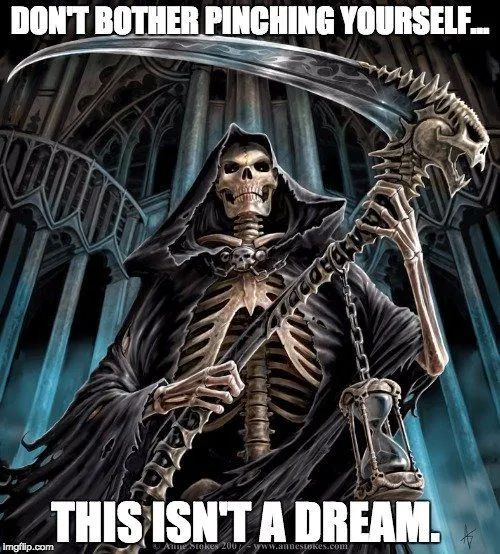
The Grim Reaper is the personification of Death itself, and although his image has shifted over the centuries, he is almost always shown in a long dark robe, with a skeletal face and hands, sometimes with empty or glowing eye sockets, and carrying a scythe — the long stick with a curved blade on the top.
Imagine walking down a dark country road as the fog rolls in, and just out of sight is a shadowy, cloaked figure who appears to be holding something… a walking stick, perhaps, or maybe…. a scythe? At that point, if you haven’t already turned and run away screaming, it might be too late. Pinch yourself to wake up, if you can, because that ominous figure in the distance sounds a lot like the Grim Reaper.
That name may send a shiver down your spine, but what does it really mean? What is the significance of the Grim Reaper, and where did it come from?
Recommended Video for you:
Where Did The Grim Reaper Come From?
Although the personification of death stretches back thousands of years, to ancient Egypt, Norse mythology and beyond, the most influential ancestor of the modern Grim Reaper image emerged in one of the darkest periods in human history — the Black Death. Skeletal Death figures had already appeared in late-13th-century Christian art, in works such as the legend of "The Three Living and the Three Dead", but they exploded into European visual culture during and after the plague years of 1346–1353. Modern estimates put the global death toll at roughly 75–200 million people, wiping out between 30 and 60 per cent of Europe’s population and reducing the world’s population by an estimated 17–22 per cent.
In this horrible period in history, death was everywhere, with piles of bodies in city centers, stacked and skeletal, like something out of a terrifying movie. Over the course of the 14th century, there were many small outbreaks and flare-ups of the plague throughout the world, leading to a nearly constant fear of death. People felt like Death was literally walking amongst them, so the personification of Death was inevitable.
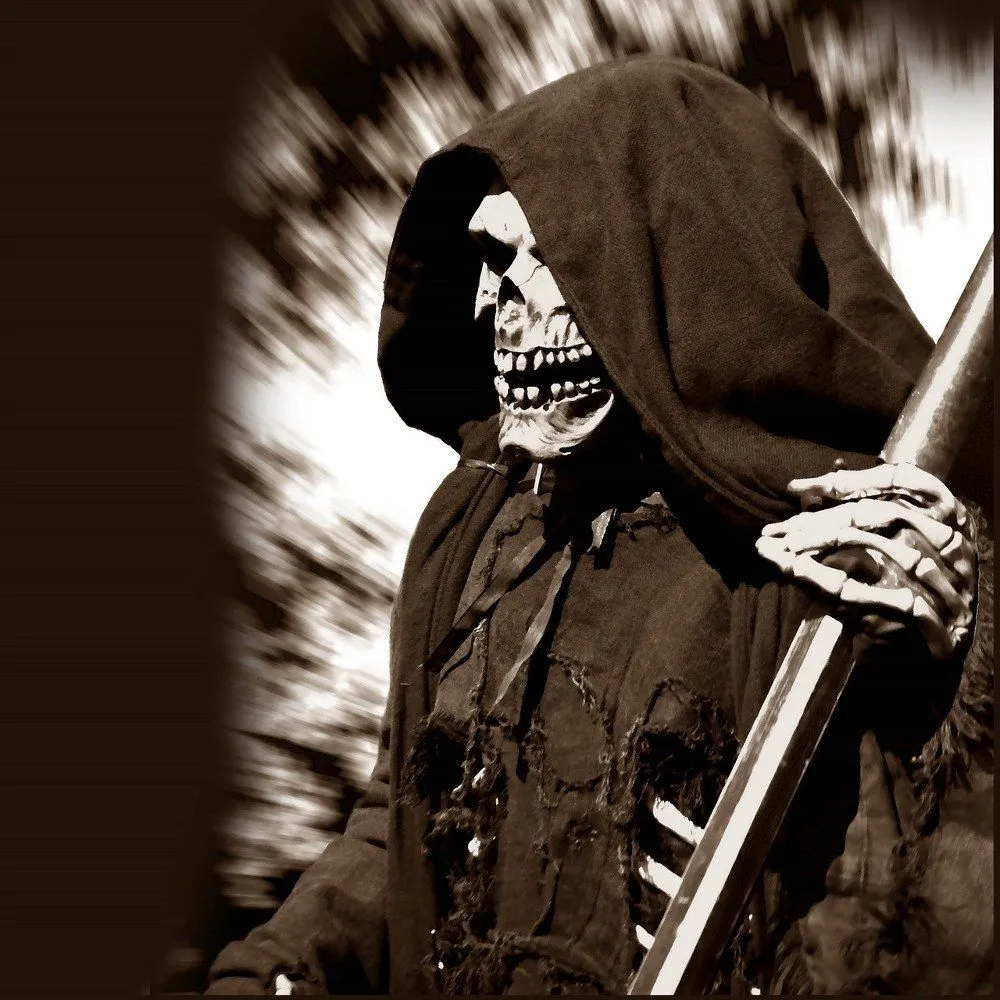
Although the image has shifted over the centuries, the Grim Reaper is almost always shown in a long dark robe, with a skeletal face and hands and a scythe — the long stick with a curved blade on top. Each part of this iconic outfit carries meaning. The robe lets Death hide in the shadows, menacing people beyond their sight. The skeletal hands and face emphasise that this is the body stripped to its raw, equalising end-state. The glowing eyes (and especially the glowing red eyes) you sometimes see today are largely a 20th-century horror flourish from films, comics and video games — medieval depictions usually show empty skull sockets. Likewise, the all-black cloak we picture is a relatively modern convention; the medieval Death was more often a naked skeleton, or one wrapped in a white burial shroud or rags.
At times, he is also shown holding an hourglass, waiting for the grains of sand to run out on a person’s life before he brings down his blade to snuff out their life.
That blade – the scythe – is perhaps the most iconic aspect of the image. A scythe is actually an agricultural tool that is used to reap grain by cutting down large swaths with a single sweep of the blade. Similarly, when Death walks among the living – as in the Black Death – he similarly cuts down human life as easily as wheat.
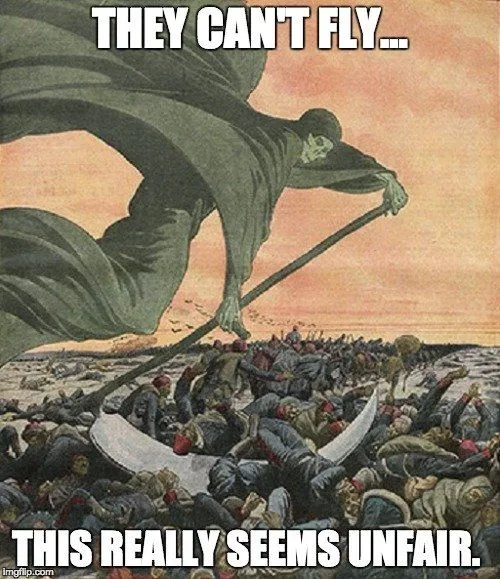
In total, the Grim Reaper is a terror-inducing image that has become extremely recognizable in modern pop culture. There are countless references to the Grim Reaper in music and movies, as well as satirical or creative takes on this figure in movies like Scream, Bill and Ted’s Bogus Journey and Hellboy II: The Golden Army, among many others.
Why Does The Grim Reaper Persist?
While many today view the Grim Reaper as folklore rather than literal belief, death personifications still hold deep meaning in living traditions around the world. When people struggle to understand something, or are afraid of it, they tend to create more manageable and tangible explanations.
When Death is in the shape of a man, it humanizes one of the most abstract concepts for humanity. In the same way that primitive people created stories that personified the moon, thunderstorms, meteor showers, eclipses and every other natural phenomenon, more advanced cultures still maintain certain traditions that shield them from the fear of death.
The skeletal personification of Death (under names like Mors, "Death" or simply the Reaper) appears in religious texts and devotional art from the 14th, 15th and 16th centuries — in Books of Hours, the Ars Moriendi manuals, and the great Danse Macabre cycles painted on church and cemetery walls (Holbein’s woodcut series of 1538 is the most famous). The specific English term "Grim Reaper" only appears in print from the 1840s, but the figure it names had already been everywhere in Christian art for half a millennium. Organised religion thrived for centuries on the fear of death, exorcisms and dark occult subjects, so it is no surprise that this physical representation of Death became tangled up with religious institutions.

Today, the image of the Grim Reaper doesn’t instill the same level of fear in most people, as it has become ingrained in the cultural collective. However, it remains a common trope by which we are entertained, or that people can use to express some part of their personality.
At the end of the day, the Grim Reaper has truly grisly roots in the Black Death of the 14th century, but death has always been a subject of fascination and fear for people. From the jackal-headed Anubis, the Egyptian god of mummification and guide to the afterlife (Osiris being the actual ruler of the dead), to Mexico’s Santa Muerte (one of the fastest-growing devotional figures in the Americas), the Japanese shinigami and Western Europe’s Father Time — a scythe-wielding Cronus/Saturn descendant who is the Reaper’s closest iconographic cousin — humans will always find ways to pour out their fear and anxiety over death.
Death is the great social equalizer, which is why everyone would be scared when they see a cloaked figure in the distance, holding a scythe, slowly approaching, and counting down those final grains of sand!