Table of Contents (click to expand)
Inner conflict, in Freud’s 1923 structural model of the mind, comes from the tug-of-war between three faculties: the id (the unconscious, pleasure-driven seat of biological drives), the superego (the moral compass instilled by parents and society in early childhood), and the ego (the rational mediator that satisfies the id’s urges in ways the superego will allow).
Have you ever come across a situation when you’re out in the world and just finished a packet of Doritos, but can’t find a garbage can anywhere in sight? You’re really tempted to just toss the packet on the road, since you’re alone and no one is looking. However, there is also a voice in your head saying “That’s not the right thing to do. Don’t pollute the environment.” Hopefully, you end up holding on to the packet until you come across the nearest trash can. If so, then you may already be familiar with Id, Ego and Superego.
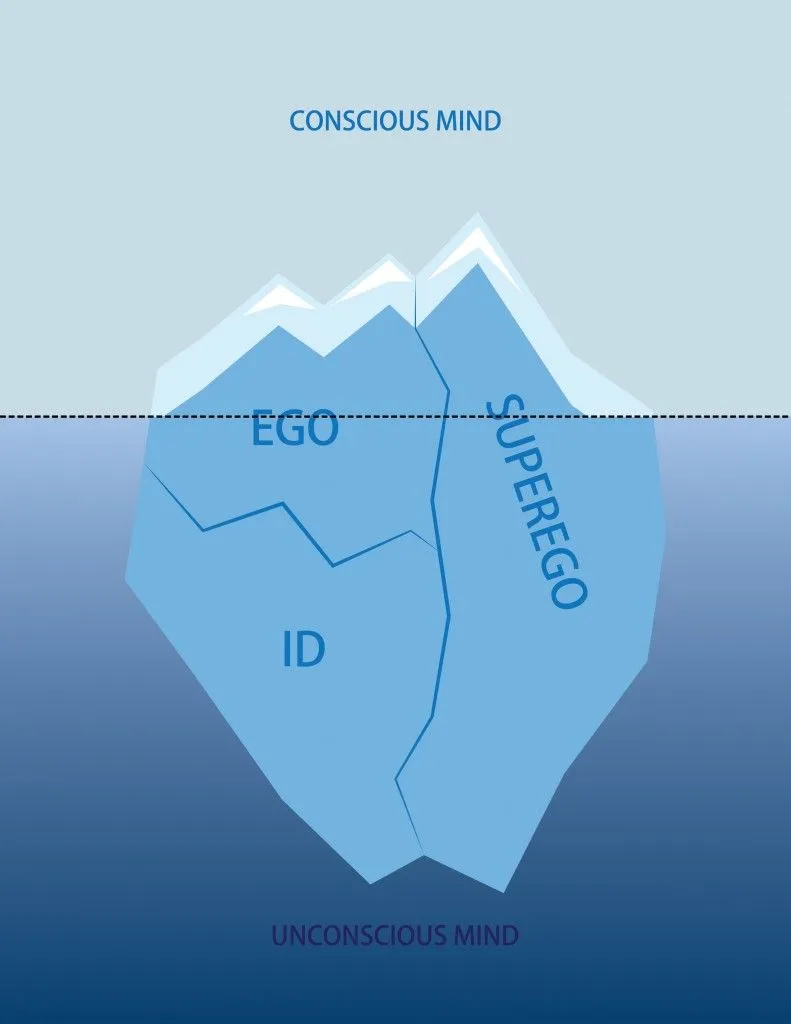
The part of you that just wanted to get rid of the packet to free your hands was the id. The part that warned you of your responsibility towards the environment was your superego. The part that made a rational decision to wait till you found the nearest garbage can, keeping in mind both your comfort and your conscience, was the ego. The id, ego and superego are the three faculties of your mind, or psyche. This tripartite structural theory was proposed by Austrian psychoanalyst Sigmund Freud in his 1923 work Das Ich und das Es (The Ego and the Id), and it overlaid his earlier "iceberg" topographical model of conscious, preconscious and unconscious mind.
Recommended Video for you:
Structural Theory: Id, Ego And Superego
As humans, we constantly need to make decisions regarding anything and everything. We need to consider various parameters and take into account the consequences of the decisions that we take. This happens constantly, at different levels. Making decisions is not always easy because we’re always in conflict with what we want and what is ideal or right.
This inner conflict is due to the workings of the Id, Ego and Superego. The id is the primitive instinct or the biological needs that we have. Then emerges the ego, which needs to rationalize these needs so that they don’t cause harm to others in their pursuit. The superego usually develops last, which is the self-observing agency that works on the basis of morality and ethics.
Id: The Pleasure Principle
The id is the unconscious faculty of the mind that works on the ‘pleasure-principle’, which consists of maximizing pleasure and avoiding pain. The id represents the biological needs of the body that require instant gratification. The two main instincts observed by Freud were sex and aggression, arguing that every human is wired with these desires. The id needs instant gratification, regardless of the consequences; when the needs are met we experience pleasure and when not, we experience stress, which can cause aggression/pain.

Newborns operate primarily through the id, since Freud believed only the id is present at birth; the ego begins forming in infancy as the child interacts with reality, and the superego emerges later, around ages 3–5 (modern developmental psychology adds the caveat that infants display social cognition and rudimentary self-regulation far earlier than Freud’s framework predicted). That’s why, when we observe children throwing tantrums and wanting toys instantly, it is the id talking. They will not consider the consequences of their behavior and cannot delay gratification. If they want food or a particular toy, that means they want it now!
Id Is The Driving Force, But What Drives The Id?
Freud later proposed, in Beyond the Pleasure Principle (1920), that two opposing drives operate within the id: Eros, the life drive, and Thanatos, the death drive. The death drive is the most controversial part of his theory and is rejected by most modern empirical psychologists, though it survives in some psychoanalytic schools (notably Kleinian and Lacanian).
On a side note, did you know that the supervillain Thanos, created by writer-artist Jim Starlin for Marvel Comics in 1973, takes his name from this very word — Thanatos, the Greek personification of death? Starlin has said the character was directly inspired by Freud’s death-drive concept, which he encountered in a college psychology class.
The will to live perpetuates the need for survival (food, water, shelter) and the desire to continue the species (sex and reproduction). Freud called this drive’s energy libido — originally meaning sexual or erotic energy, which he later associated with Eros, the life drive. Thanatos, by contrast, points toward what Freud called the "nirvana principle": the urge to reduce all instinctual tension to zero. It is difficult to understand it as a need, but drugs, alcohol, movies and books are all manifestations of a need to escape from life and its drudgery. It also expresses itself through aggression.

Ego: The Reality Principle
The id needs a mediator to intervene in its irrational and illogical expression of needs. Humans are social animals, meaning that we cannot escape others and only focus on the advancement of our own needs. The ego acts as a link between the internal world and the external world. It acts on the reality principle. Freud compared id and ego to a horse and a horseman, the latter needing to control the strength of the horse. The ego is the decision-making faculty of the mind, which works on satisfying the needs of the id in the least destructive way possible.
The id is not the only master that the Ego must consider. The ego also needs to take the needs of the superego into account, which operates on the level of morality and ethics. The ego does not decide on right and wrong; the superego helps the ego arrive at morally correct decisions. Thus, the ego act as a referee between the id and the superego.

The ego uses defense mechanisms when the needs of the id cannot be satisfied in the real world. Anxiety is caused when needs are not met, and this feeling of uneasiness must be resolved, which takes the form of unconscious behaviors like repression, denial, projection, reaction formation etc. The needs of the id can also be channelled in a creative way by the ego. This involves expressing taboo ideas and concepts in the form of stories and movies. Authors use this technique, known as sublimation, where their unconscious desires are expressed through fictional characters and their needs are met indirectly.
Superego: The Moral Compass
The superego usually develops around the age of 3-5. It incorporates the ideals imposed by parents and takes into account social needs. In literal terms, it means above-ego, and is a high-functioning faculty of the mind that develops differently in individuals. It is also known as conscience, the moral compass, inner voice, or the voice of God. It helps distinguish between right and wrong, good and bad. It helps control the main primitive impulses of the id—sex and aggression.

The superego consists of the conscience and the ego ideal. The conscience acts on the fear of punishments and the ego ideal acts on positive reinforcements. According to Freud, the superego arises from the Oedipal Complex, which is the need to overcome sexual feelings towards the opposite sex parent. That is why we are capable of feeling guilt, even when we haven’t consciously done anything wrong.
Each individual develops these three faculties in varying strengths. For some people, the superego can be the strongest faculty — they may be rigid, perfectionistic, prone to excessive guilt or self-criticism. Those high on id tend to be impulsive, narcissistic and dis-regulated. A healthy individual, in this framework, is one whose strongest faculty is the ego, since it regulates both the id and the superego.
It’s worth flagging where this stands today: Freud’s structural model is no longer treated as a literal map of the brain. Modern psychology regards id/ego/superego as a useful metaphor for internal conflict and self-regulation rather than as empirically validated structures. Contemporary clinicians more often draw on cognitive-behavioral, attachment and neuroscientific frameworks; modern neuroscience offers loose parallels (limbic-system structures resemble id-like impulses while the prefrontal cortex performs ego-like executive control), but most researchers caution that direct one-to-one brain mapping oversimplifies both Freud’s theory and the brain itself.