Table of Contents (click to expand)
Plant and animal cells are both eukaryotic — they have a true nucleus, mitochondria, ribosomes, ER, Golgi and a plasma membrane — but they differ in ten important ways. Plant cells uniquely have a rigid cellulose cell wall, chloroplasts for photosynthesis, a single large central vacuole, plastids, plasmodesmata, and glyoxysomes; animal cells uniquely have centrioles, lysosomes and (usually) cilia or flagella. Plants store energy as starch and animals as glycogen, plants divide by laying down a cell plate while animals pinch with a cleavage furrow, and plant cells tend to be larger (10–100 μm) and more polygonal in shape than animal cells (typically 10–30 μm).
When you look at a tree growing in your backyard and your dog running circles around that tree, the two organisms are clearly very different. One is rigid and unmoving, while the other is a wildly barking creature with a personality and a penchant for licking your plate clean. However, on a cellular level, these organisms are quite similar in many ways. That being said, understanding the differences between the two, such as how they grow, maintain their shape, and generate their food, will also provide greater insight into these two eukaryotic cell types.
Recommended Video for you:
Plant And Animal Cells – Similarities
The fundamental purpose of both animal and plant cells is to keep the larger organism alive through a variety of processes, which are carried out by membrane-bound organelles. As both plants and animals are eukaryotic cells, they also contain a nucleus, separated from the remainder of the cell by a nuclear membrane. The nucleus is where the transcription and replication of genetic material (DNA) occurs.
When it comes to the replication of plant and animal cells, they both undergo similar processes, namely mitosis and meiosis. Cellular respiration is the powerhouse process of energy generation in both plant and animal cells, a critical process that occurs in a similar way, although the raw materials come in different forms.
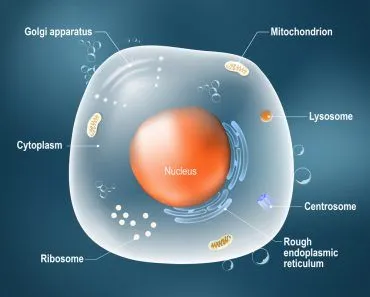
Although both types contain organelles, only some are found in both varieties, such as ribosomes, mitochondria, Golgi complex, nucleus, cytoskeleton and plasma membrane, among others. The organelles that are not found in both cell types will be explained below.
Plant And Animal Cells – Differences
The similarity of these cell types ensures that the fundamental tasks of life are fulfilled, but the specific details of how those goals are achieved differ in a number of critical ways. Here are the ten most important differences at a glance:
- Cell wall: Plant cells have a rigid cellulose cell wall outside the plasma membrane; animal cells do not.
- Chloroplasts: Plant cells contain chloroplasts and carry out photosynthesis; animal cells have neither.
- Central vacuole: Plant cells have a single large central vacuole that can occupy up to 90% of the cell. Animal cells have several small vacuoles.
- Plastids: Plant cells contain plastids (chloroplasts, chromoplasts, amyloplasts). Animal cells have no plastids.
- Plasmodesmata: Plant cells are connected to neighbours through plasmodesmata. Animal cells use gap junctions instead.
- Glyoxysomes: Plant cells have glyoxysomes for converting fats into sugars (especially during seed germination). Animal cells lack them.
- Centrioles, cilia and lysosomes: Animal cells typically have all three. Most plant cells have none (with rare exceptions, such as flagellated moss/fern sperm).
- Shape: Plant cells are usually polygonal/rectangular (because of the rigid cell wall). Animal cells are flexible and irregular in shape.
- Cell division: Plants form a cell plate down the middle that hardens into a new cell wall. Animal cells pinch in two via a cleavage furrow.
- Energy storage: Plants store energy as starch. Animals store energy as glycogen and triglycerides.
Shape, Size and Structure
Animal cells are enclosed by a plasma membrane, which is flexible, allowing animal cells to take on a number of shapes based on the requirements of that specific cell. Plant cells, on the other hand, are typically square or rectangular in structure, as they are bounded by a rigid cell wall, in addition to a plasma membrane.
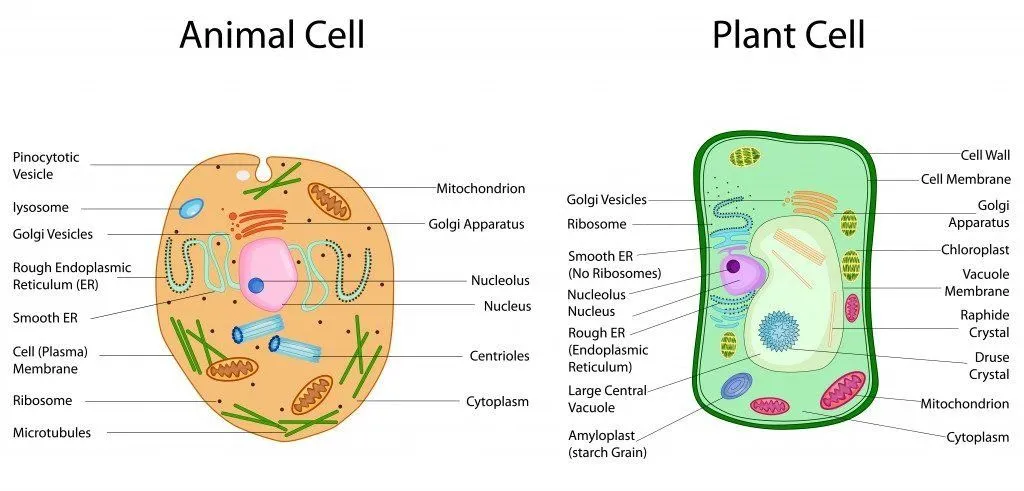
In terms of size, plant cells typically range from 10 to 100 micrometres, while most animal cells fall in the 10–30 micrometre range — though there are striking outliers in both directions, such as nerve cells over a metre long and large mammalian egg cells well above 100 μm. Plant cells generally grow by enlarging individually, often by drawing additional fluid into their central vacuole, while animal tissues grow mostly by replicating and adding cells rather than expanding individual ones. Animal cells do contain a number of smaller vacuoles, but plant cells are often dominated by their single central vacuole, which can take up as much as 90% of the cell’s volume.
Division and Differentiation
When an animal cell replicates and prepares to divide, a cleavage furrow forms that gradually slices the cell in half, pinching the parent cell into two daughter cells. In plants, however, a cell divides by gradually forming a cell plate that eventually hardens into a new cell wall.
In plants, most new cells have the potential to differentiate into whatever type of cell the plant needs; in animals, however, stem cells are the only “flexible” cells that are able to fill a variety of different needs for the organism.
Protein Synthesis
Amino acids are the building blocks of proteins, and thus a critical part of cellular function and survival. There are 20 standard amino acids that make up proteins, all of which can be generated within plants. Humans, by contrast, can synthesise only 11 of these (the “non-essential” ones) and must obtain the other 9 “essential” amino acids — histidine, isoleucine, leucine, lysine, methionine, phenylalanine, threonine, tryptophan and valine — from the diet.
Energy Generation and Storage
As mentioned above, animal and plant cells both utilize cellular respiration for the conversion of carbohydrates to usable ATP, but the raw materials for this process are not acquired in the same way. Animals consume food, break down the carbohydrates into glucose, and generate ATP through a 3-step process. Plant cells undergo photosynthesis, in which they convert sunlight, water and carbon dioxide into glucose and oxygen, at which point they can use that glucose to proceed through the steps of cellular respiration, like animals, and generate ATP. However, animal cells store energy in the form of glycogen, whereas plants store their energy in the form of starch.
Organelle Variations
Animal cells contain centrioles, cilia/flagella and lysosomes, which help in organising microtubules for cell division, aid in cell mobility, and digest macromolecules, respectively. Typical plant cells have none of these. (A pedantic footnote: motile sperm of mosses and ferns do have flagella, and plants have lytic vacuoles that play a lysosome-like role — but as a general rule, the textbook contrast holds.) However, plant cells are in possession of glyoxysomes, plasmodesmata and plastids — a family of organelles that includes chloroplasts (photosynthesis), chromoplasts (pigments) and amyloplasts (starch storage). Of these, chloroplasts are the famous ones, capturing sunlight to drive photosynthesis and ultimately produce sugar and ATP. These organelle variations represent some of the most critical differences between these types of cells, as these organelles are specialised for the unique needs of plants and animals.
A Final Word
While the main functions of plant and animals cells fulfill the same purposes, the internal engineering of these microscopic machines is necessarily different. Although plants are often considered a simpler form of life than animals, the ability of plant cells to generate their own food via photosynthesis is one of the most important developments for the existence of any life on this planet. In other words, next time you’re looking at that tree and your dog running circles around it, remember that both organisms are deeply fascinating, with a myriad of similarities and differences that allow them both to survive and thrive.