Table of Contents (click to expand)
The yield strength of a material is the stress at which it stops behaving elastically and begins to deform permanently. It is calculated as force per unit area (σ = F/A) and is typically expressed in megapascals (MPa) or pounds per square inch (psi). Mild steel yields around 250 MPa, structural aluminum alloys at 95–280 MPa.
Yield strength is one of the most important numbers an engineer ever looks up about a material. It tells you exactly when a piece of metal stops springing back to its original shape and starts to deform for keeps. The point at which a material ceases to be elastic and becomes permanently plastic—the point at which it yields—is called its yield point, and the stress required to reach it is the yield strength.
For an engineer, thoroughly studying the properties of a material is an absolute necessity before venturing into any new project. Imagine the horrific consequences if the engineers building the Brooklyn Bridge had been shamelessly ignorant and used plastic or bricks instead of steel. On the other hand, if most of today’s toys were built from steel and not something as pliant as plastic, they would’ve been impossible to mold into the most eccentric of shapes we so adore.

In short: every material has a stress threshold called its yield strength. Below it, the material springs back; above it, the deformation is permanent. The number is usually quoted in megapascals (MPa) in SI units or pounds per square inch (psi) in the US, with 1 MPa ≈ 145 psi.
Recommended Video for you:
The Stress-Strain Graph
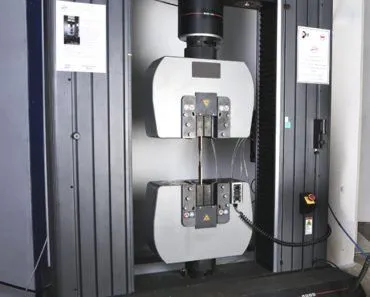
The strength of a material is determined by a tensile test, a test that requires the material to be mercilessly pulled from its two ends. The relationship between the stress to which it is subjected and the strain it consequently suffers can be limned by a graph called the stress-strain curve.
We have already explained the graph in detail in a previous article, which you’ll find here. However, this will be a quick crash course.
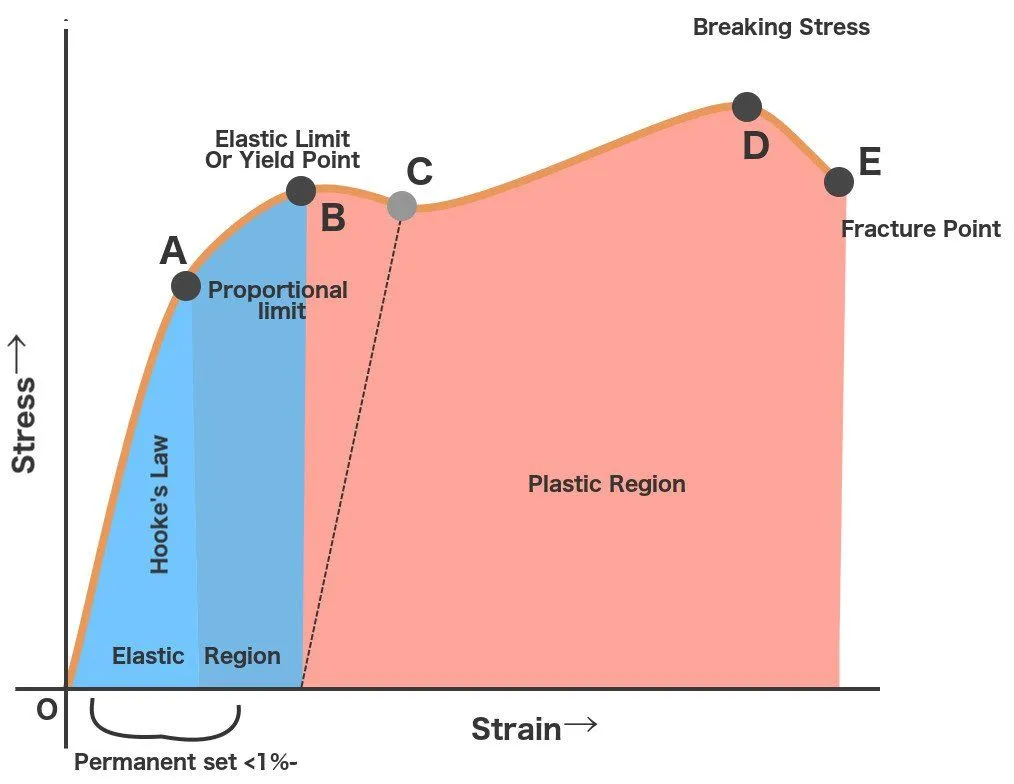
Initially, a material, even steel, behaves like an elastic when stretched. When within the elastic limit, the strain caused by the stress is reversible; yes, the material elongates, but once the stress is released, it retains its original length. This elasticity, however, is not permanent. Excess stress will deform a material permanently.
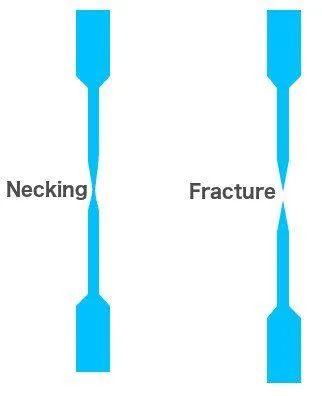
In fact, applying greater stress causes the formation of what is called a ‘neck’ along the deformation. The neck is analogous to the ropes of cheese that barely hold the slice and the rest of the pizza together. An even greater stress will break the neck as well — the material ultimately succumbs to the stress and suffers a tragic breakage or fracture.
Yield Strength
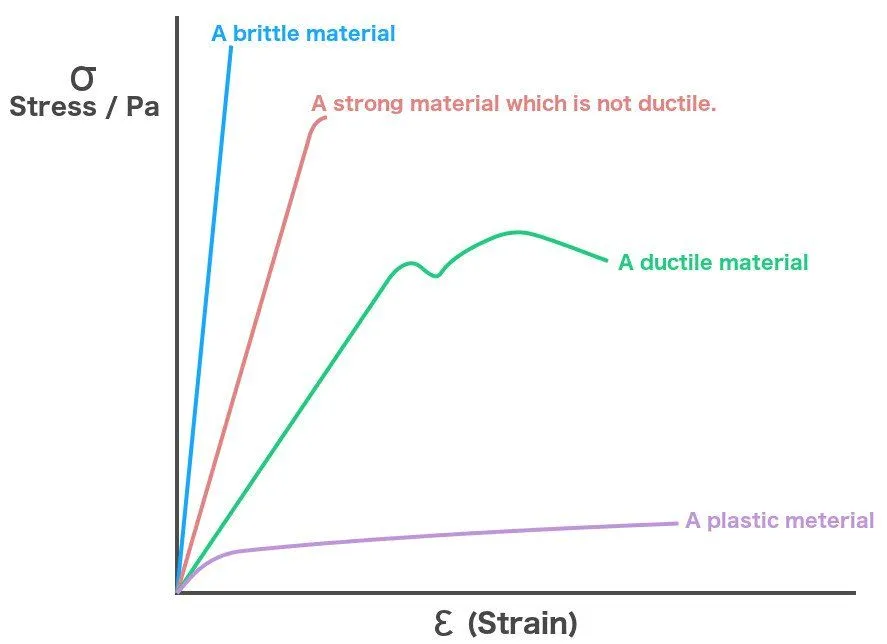
Each and every material draws its own characteristic stress-strain curve, which allows us to determine what applications are suitable for its use. Each material’s curve exhibits different points of transitions, from elasticity to plasticity and finally to breakage.
The point at which a material ceases to be elastic and becomes permanently plastic, the point at which it yields, is called its yield point. The magnitude of stress at which this transition occurs is known as the material’s yield stress or strength. The yield strength is a material constant that represents the limit of its elastic behavior. Ductile materials like iron boast higher yield strength values than plastics, such as polyethylene.

A ductile material like iron is not permanently deformed because its atoms “break”, but because the stress exerted is persuasive enough to overcome its lattice energy and disturb the material’s rigid structure; it is enough to literally displace the atoms from its crystals. This phenomenon is called crystalline dislocation.
Plastics deform more easily because they succumb to dislocations more easily than ductile materials do. There are also brittle materials, which have absolutely no concept of yield stress. These materials, when subjected to a stress greater than the yield stress, as the name suggests, don’t undergo any transition from elasticity to plasticity, but directly break instead.
Lastly, because the yield strength of a material essentially determines its tolerance for tension, engineers realized they had to devise clever ways to increase it. One classic trick is to add deliberate “impurities”—solute atoms—that distort the host crystal lattice and pin dislocations in place, making them harder to move. Alloys like steel, in which iron is laced with carbon and other elements, are the textbook example of this solid-solution strengthening. Other tricks include shrinking the grains (Hall–Petch strengthening), cold-working the metal to tangle dislocations, and precipitation hardening—the principle behind aircraft-grade aluminum alloys like 7075, which can yield above 500 MPa, more than twenty times stronger than the pure metal.
Another way to achieve a greater yield stress is to work the material at lower temperatures. Higher temperatures actually lower the yield strength, since thermal energy keeps the atoms vigorously jiggling and helps them slip past lattice obstacles. The material is, in a sense, halfway to yielding before you even pick up the hammer—so an external stress now requires far less energy to drive dislocations and produce permanent deformation. Why else would you think we must strike while the iron’s hot?