Table of Contents (click to expand)
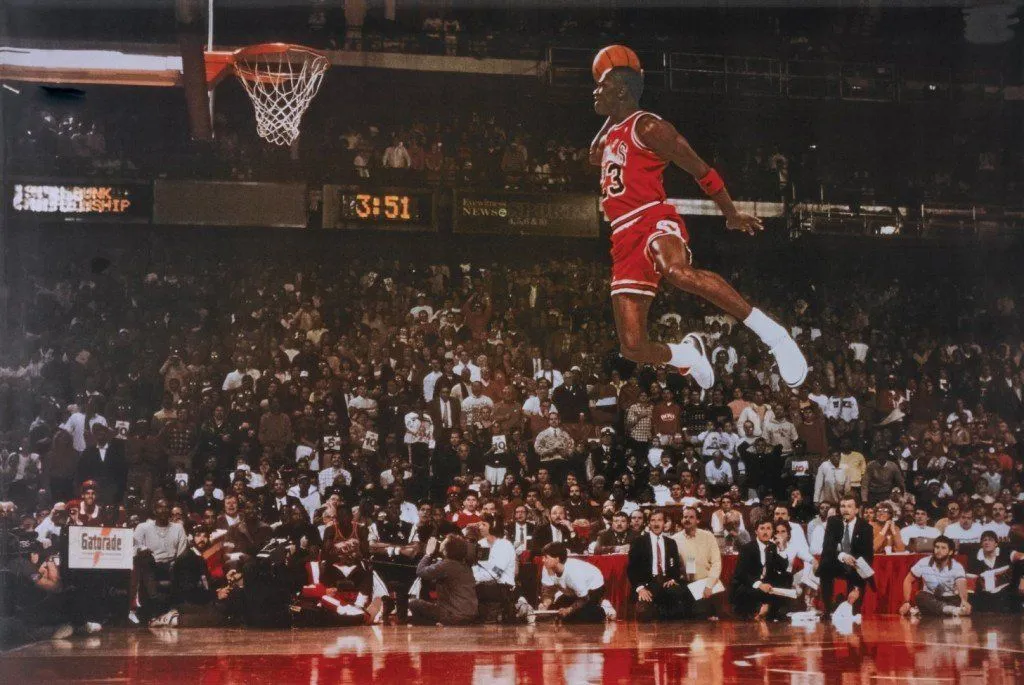
Michael Jordan's hang time of 0.92 seconds let him appear to defy gravity, making his slam dunks legendary.
Michael Jordan is undeniably one of the greatest basketball players of all time, and his name is known even by those who are not interested in basketball.
Although Jordan was outstanding in every aspect of his game, one trait left his competitors in awe: his hang time.
You might be wondering what hang time is, so let me explain.
Recommended Video for you:
What Is Jordan’s Hang Time?
Hang time is the length of time that an object or person remains in the air after leaving the ground. In basketball, it refers to a player’s time in the air after jumping to perform a slam dunk, lay-up, or jump shot. The duration of hang time is between the moment your feet leave the ground and when they touch the ground again.
Although Michael Jordan appeared to defy the laws of physics, his impressive hang time was simply because he remained airborne for longer than most people. On average, a person’s hang time is less than 1 second, with an average of approximately 0.53 seconds. A hang time of 1 second requires a vertical leap of about 1.2 meters (4 feet), which only elite athletes can achieve. However, Michael Jordan’s longest recorded hang time is an impressive 0.92 seconds, making him one of the greatest basketball players ever.
The Science Behind Hang Time
Obviously, a person can’t remain airborne for long. Why, you ask?
As with everything in life, Newton’s beloved gravity comes into play. Earth’s gravitational force begins pulling you back down as soon as your feet leave the ground (despite your desire to soar through the air).
Earth pulls you back to the ground with an acceleration of 9.81 m/s2 (the standard value of g, though it varies slightly with altitude and latitude).
To calculate hang time, you need to consider a few values, namely your initial height from the ground (which is 0), the initial velocity of taking the jump, and the value of acceleration coming back down to the ground.
Is Hang Time The Same Everywhere?
For practical purposes, yes. Whether you are in New York, London, New Delhi, or Tokyo, your hang time will be essentially the same. Technically, gravity is slightly weaker at higher altitudes (about 9.77 m/s2 atop Mount Everest vs. 9.81 m/s2 at sea level), but the difference is too small to notice in a basketball game.
However, let’s talk about the broader universe, where some truly impressive basketball games could be played.
On different planets, the value of acceleration due to gravity changes, and so does the hang time.
If Jordan tried to dunk a basketball on Venus, he would remain airborne for a little longer than on Earth, as the value of g on Venus (8.87 m/s2) is lower than the g variable on Earth. If he were to do a slam dunk on the moon, he would remain airborne longer than on Earth because the moon’s gravity is almost one-sixth of that on Earth.
If he tried to dunk on Jupiter, what would happen then? Check out the video to find out:
Last Updated By: Ashish Tiwari
References (click to expand)
- Southworth Planetarium - University of Southern Maine.
- Kaula, W. M. (1975, June). The gravity and shape of the Moon. Eos, Transactions American Geophysical Union. American Geophysical Union (AGU).
- The Moon's Influence on Us.
- Gupta, D. (2015, August 17). Biomechanics of hang-time in volleyball spike jumps and its effect on performance. The University of Texas at Austin.