Table of Contents (click to expand)
Pure elemental carbon takes on whatever color its atomic arrangement allows: diamond is transparent and colourless, graphite is grey-black with a metallic sheen, amorphous carbon and soot are deep black, and a crystal of fullerene (C60) is brown-purple. Climate scientists also use a “carbon rainbow” — black, blue, brown, green, teal and grey carbon — to describe how the element moves through the Earth system rather than what it looks like.
What is the most common element you remember from your high school chemistry lessons? Aside from Oxygen, Nitrogen, and Hydrogen, you should definitely remember Carbon!
Carbon is one of those famous members of the periodic table who has an entire branch of Chemistry associated with it, namely Organic Chemistry. As such, carbon is found in all living organisms. It should come as no surprise that it’s often referred to as the King of Elements due to its ability to form a plethora of compounds.

From humans to stars, carbon is everywhere you look in the universe. It can be as hard as a diamond or as soft as graphite.
However, there’s one more thing that might interest you.
You may have heard scientists, experts and media outlets talk about “blue carbon” or “brown carbon”. You have also seen the effect of “black carbon” on the environment.
Does this mean that, apart from being the King of Elements, carbon also has a color spectrum? Let’s find out!
Recommended Video for you:
What Color Is Elemental Carbon?
Before we get to the climate-science palette, here’s the literal answer to the question most people are searching: the element carbon doesn’t have a single colour, because how it looks depends entirely on how its atoms are arranged. The same atom, packed differently, gives you radically different appearances:
- Diamond (sp³ tetrahedral lattice) is transparent and colourless. Its 5.5 eV band gap is wider than any visible photon can excite, so visible light slips straight through. Coloured diamonds get their hues from impurities — nitrogen gives yellow, boron gives blue.
- Graphite (sp² stacked sheets) is opaque grey-black with a metallic sheen. Delocalised π-electrons absorb light across the whole visible spectrum.
- Amorphous carbon, charcoal and soot are deep black, because their disordered π-systems absorb light at virtually every wavelength.
- Fullerene (C60) is a brown-purple solid and looks magenta in solution.
- Single-layer graphene is almost transparent — a single sheet absorbs only about 2.3% of visible light — but stack enough sheets and you’re back to the black of graphite.
So when chemistry teachers say “carbon is black,” they usually mean amorphous carbon or graphite — the most familiar forms. The element itself is more like a chameleon: whatever colour visible light is allowed to interact with given the atomic geometry. Now, on to the carbon colours that climate scientists worry about.
What Is Blue Carbon?
Before delving into the blue shade of the carbon color palette, we need to understand a bit about mangrove vegetation. Mangrove plants grow near oxygen-poor soil, where water moves slowly and causes sediments to accumulate. They can be identified by their big tangles of roots that make the trees look like they’re standing on stilts. This unique structure of the roots helps them navigate the daily rise and fall of tides.
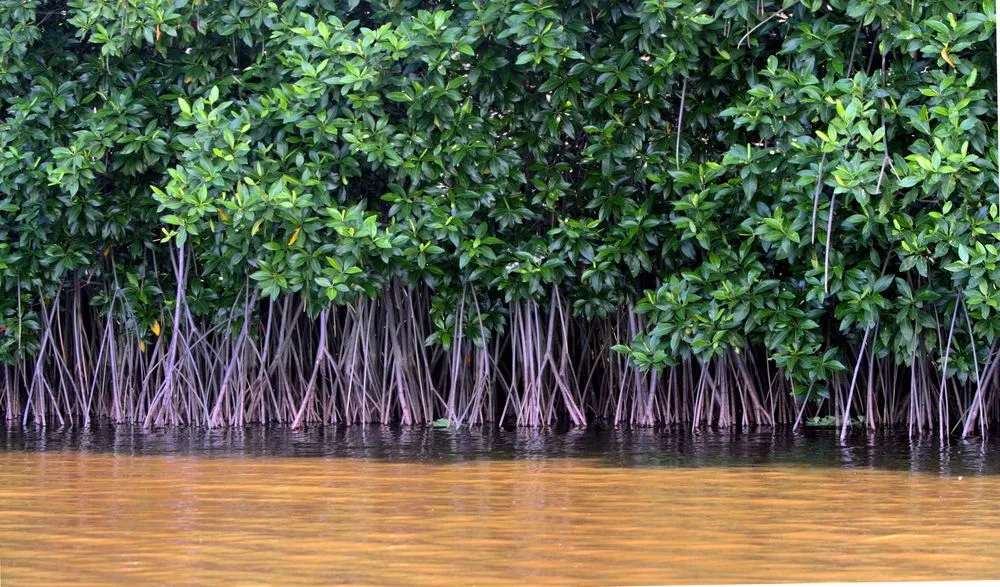
Wait… why are we talking about mangrove vegetation? Well, because mangroves are one of three coastal ecosystems — along with seagrass meadows and salt marshes — that the IUCN groups together as blue carbon stores. These plants absorb carbon dioxide from the atmosphere, perform photosynthesis, and lock the carbon away in the waterlogged sediments below them. Per acre, blue-carbon ecosystems can sequester two to four times more carbon than tropical forests, and roughly half to nearly all of it ends up in the underwater soils, not the plants themselves. As long as the ecosystem stays intact, that carbon can stay buried for centuries.
The open ocean has a related-but-distinct carbon sink driven by phytoplankton, the tiny photosynthesizers that float in the surface waters. They pull down enormous amounts of CO2 each year, and a small fraction of the carbon they fix sinks as marine snow to the deep ocean — a process called the biological carbon pump. Strictly speaking the IUCN reserves “blue carbon” for the coastal, rooted ecosystems above; the phytoplankton story is closely related but technically separate. Either way, the ocean as a whole acts as one of Earth’s biggest carbon sinks. And whenever a mangrove forest is cleared, a seagrass bed is dredged or a marsh is drained, the carbon trapped underneath can return to the atmosphere — current losses are estimated to release between 0.15 and 1.02 billion tonnes of CO2 each year.
What Is Black Carbon?
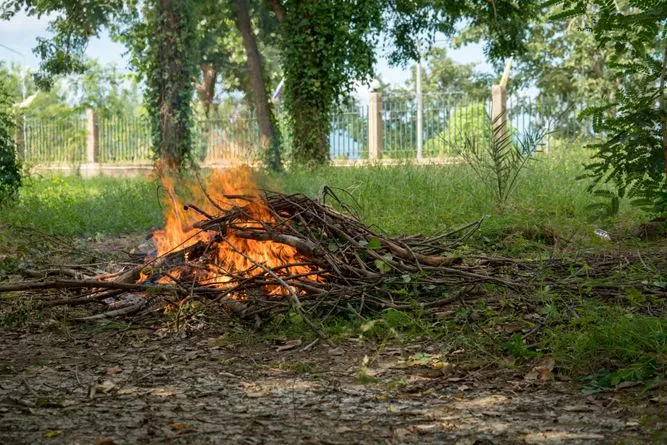
Black carbon is produced by the incomplete combustion of fossil fuels, biofuels and biomass. Combustion is nothing but a scientific term for “burning”. Globally, the biggest sources are open biomass burning (forest and crop fires), diesel engines and coal-fired power plants, and residential cook-stoves burning wood, dung or coal. Black carbon is the major constituent of soot, and it has emerged as a significant contributor to global climate change.
Gram for gram, black carbon absorbs roughly a million times more solar energy than CO2, making it the second-most-powerful human-caused climate forcer after carbon dioxide — current estimates put its direct radiative forcing at around +0.9 W/m². Unlike CO2, which traps Earth’s outgoing infrared radiation (the classic greenhouse effect), black carbon warms the atmosphere by directly absorbing incoming sunlight. It also darkens snow and glaciers when it settles, interferes with cloud formation, and shifts rainfall patterns — particularly the Indian and African monsoons.
What Is Brown Carbon?
The color palette of carbon also boasts another shade—brown. The idea of brown carbon came to the world’s attention when the Asian Brown Cloud was identified as one of the potential warming agents of the atmosphere. Brown carbon is emitted through the burning of biomass.
In rural parts of Asia, especially on the Indian subcontinent, the burning of cooking fuels causes the production of brown carbon in the atmosphere. This brown carbon accumulates in a layer about 3-5 km up in the atmosphere and forms a brown cloud.
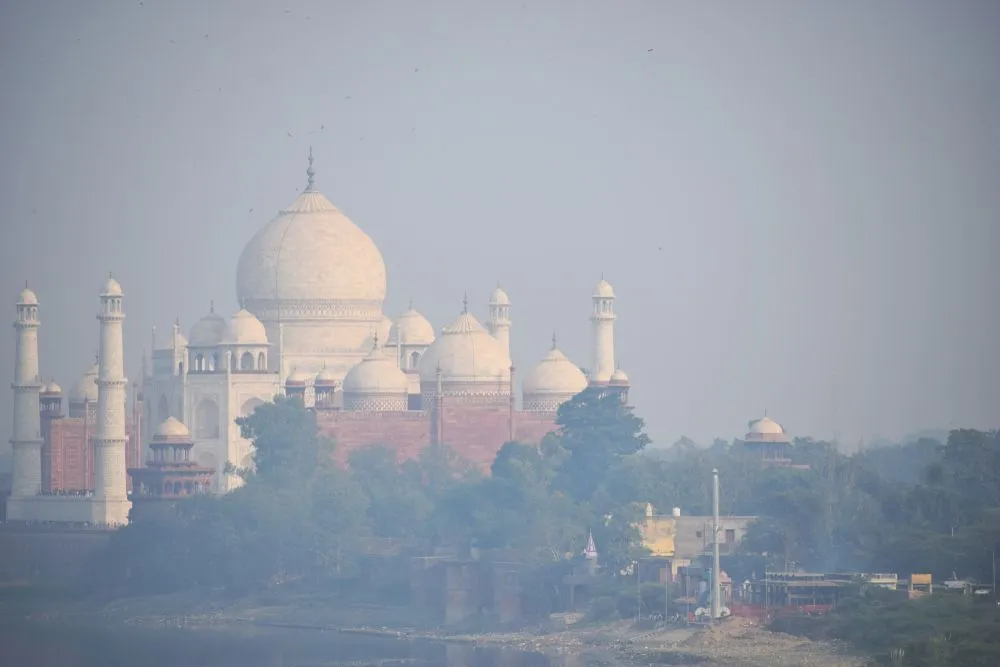
Brown carbon preferentially absorbs ultraviolet and short-visible (blue) wavelengths, with much weaker absorption in the red and infrared. That selective absorption is what makes it look yellow-brown to the eye. By absorbing sunlight, it reduces evaporation from water bodies, disturbs rainfall patterns and stresses crops. A 2015 study by Bergin and colleagues at Georgia Tech and IIT Kanpur traced the yellow-brown staining of the Taj Mahal not to acid rain (as long assumed) but to particles deposited on the marble — roughly 30% brown carbon from biomass and refuse burning, around 3% black carbon from vehicle exhaust, and the rest dust. Brown carbon and dust between them produce the yellow-brown hue.
However, scientists later found that the nomenclature of the Asian Brown Cloud is somewhat incorrect, as the issue of brown carbon is not limited to the Indian Ocean region. In 2003 the United Nations Environment Programme — working with Scripps atmospheric scientist V. Ramanathan — broadened the name to the Atmospheric Brown Cloud, reflecting both the discovery of similar pollution layers over Africa, the Amazon and North America and Indian government concerns that the original name stigmatized one region. The 2008 UNEP regional assessment report formalised the rebranding. The hazy cloud over South Asia, according to interviews with atmospheric scientists, is part of a much larger global phenomenon.
Conclusion
Given all that we’ve just covered, we can surely agree on the fact that carbon comes in a variety of different colors — literally, depending on how its atoms are arranged, and figuratively, in the way climate scientists tag it as it moves through the planet. Most of the climate “colours” we covered pose major threats to the well-being of our global environment, as they elevate the adverse impacts of climate change. Black, brown and grey carbon warm the planet; blue, green and teal carbon describe the ecosystems trying to hold the line. This is precisely why you should be aware of them. After all, if you don’t know about them, how will you contribute to lessening their impact and generation?
No matter how much our textbooks teach us, science always comes up with something unknown and mind-boggling. Carbon is one such element that is full of secrets and surprises. Apart from being the primary constituent of literally everything we see around us, it also causes damage to the environment in various forms. Therefore, it wouldn’t be wrong to say that carbon does come with its own color palette and the flexibility of a chameleon!