The Martian atmosphere is dominated by large-sized dust particles. These particles cause something called ‘Mie Scattering,’ which filters out the red light from the sun’s rays and only lets the blue reach our eyes.
A sunset is one marvel of the universe that touches the pondering soul of every human being. From paintings to poems to beautiful photographs, the shades of red, orange and pink that drape the sky at dusk awaken the introspective, artistic spark in all of us.
However, if you ever plan to visit Mars and enjoy your first night on the red planet by watching a beautiful sunset, you’re in for a surprise!
Unlike the earth, the sunset on Mars is not adorned by the rich tones of red.
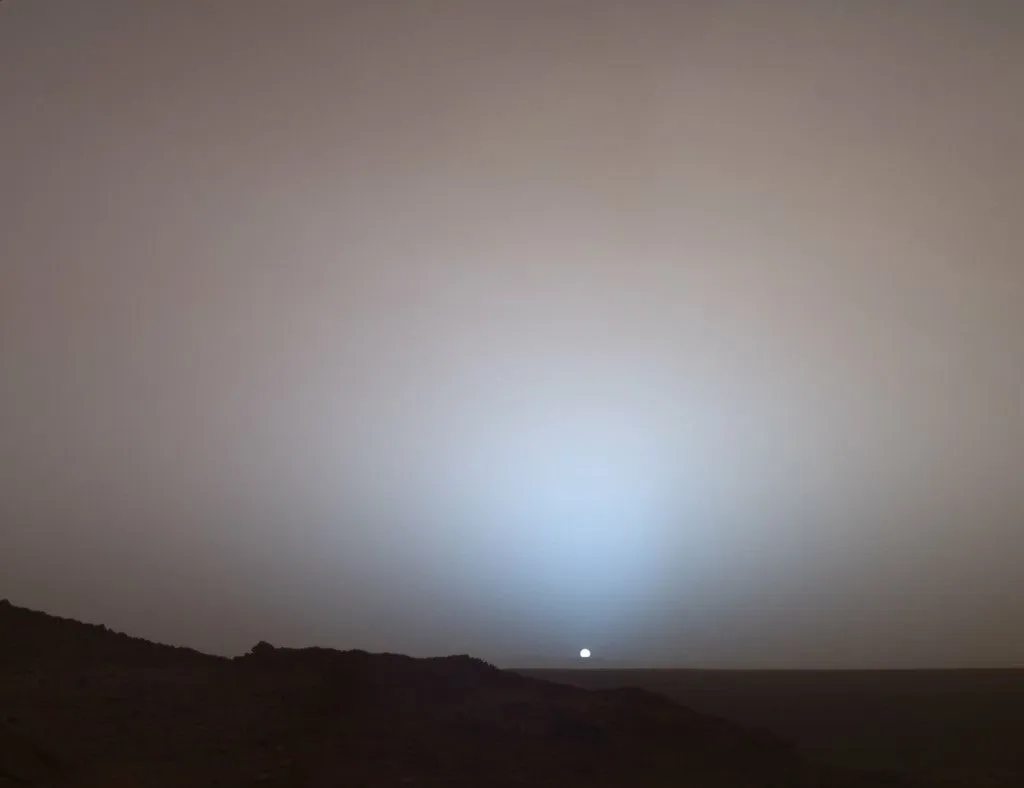
This stunning image of the Martian sunset was captured by NASA’s Spirit Rover in 2005. The picture shows a bluish-white sun surrounded by a halo of blue, which is very different from the appearance of a sunset on Earth.
The skies of Earth and Mars have a fascinating relationship. Our pale blue planet has a predominantly blue sky, which makes its way to orange-red at dawn and dusk.
Coincidentally, Mars, the Red Planet, has an orange-brown daylight sky that gently transforms into a bluish palette at sunset. The same sun is shining on both the planets, so why are their colors so different?
Recommended Video for you:
The Martian Sunset
Mars is much farther away from the sun than Earth. Hence, when seen from Mars, the sun looks smaller and fainter.
According to the data collected by various Mars rovers, the sun has a bluish-white shade when viewed from that planet’s surface. Also, during sunset, the sun appears to be surrounded by an aura of blue light, which fades out and blends with the reddish-grey Martian sky.
But what causes this? The secret lies in the Martian atmosphere.
How Does The Atmosphere Affect Sunlight?
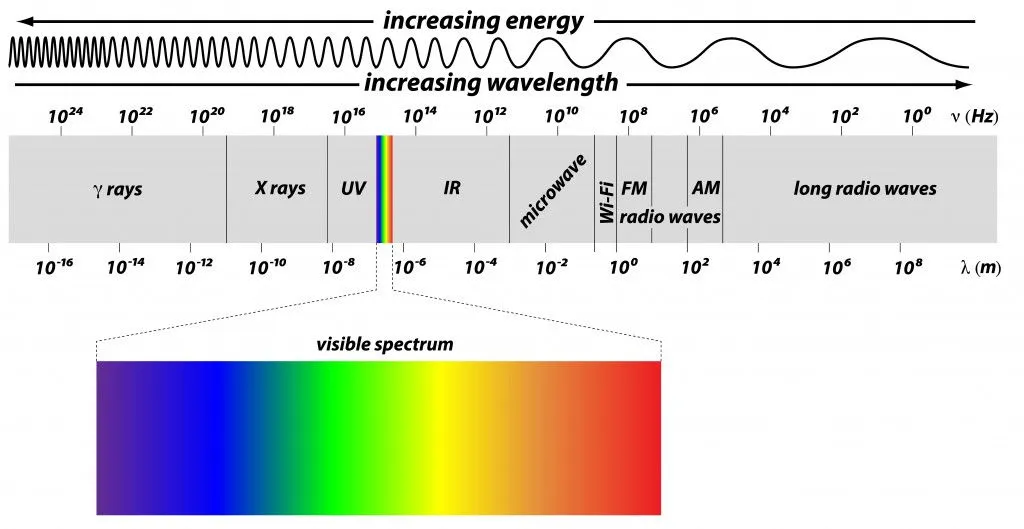
The sun emits a spectrum of electromagnetic radiation, ranging from high-frequency gamma rays to low-frequency radio waves. A part of this radiation called the visible spectrum can be detected by our eyes.
This visible spectrum, which we generally define as ‘white light,’ is further composed of seven different wavelengths that we all know by the famous acronym ROYGBIV.
In short, the same electromagnetic radiation reaches different planets with varying intensities.
But what about the color of the sky and the sun on each planet being totally different?
This is because, other than the sunlight itself, the colors that we see depend on something else: the medium through which it passes.
Light interacts differently with different particles. When it encounters a particle, the light can get absorbed, reflected, or scattered. The extent to which this happens depends on the nature of the particle with which it interacts. Some particles tend to scatter more of the longer red wavelengths, whereas others go for the shorter blue waves. Thus, some wavelengths get removed during the propagation of light and the resultant color that we see varies accordingly.
For example, in outer space, where there are no particles to scatter or absorb light, the sun appears white.
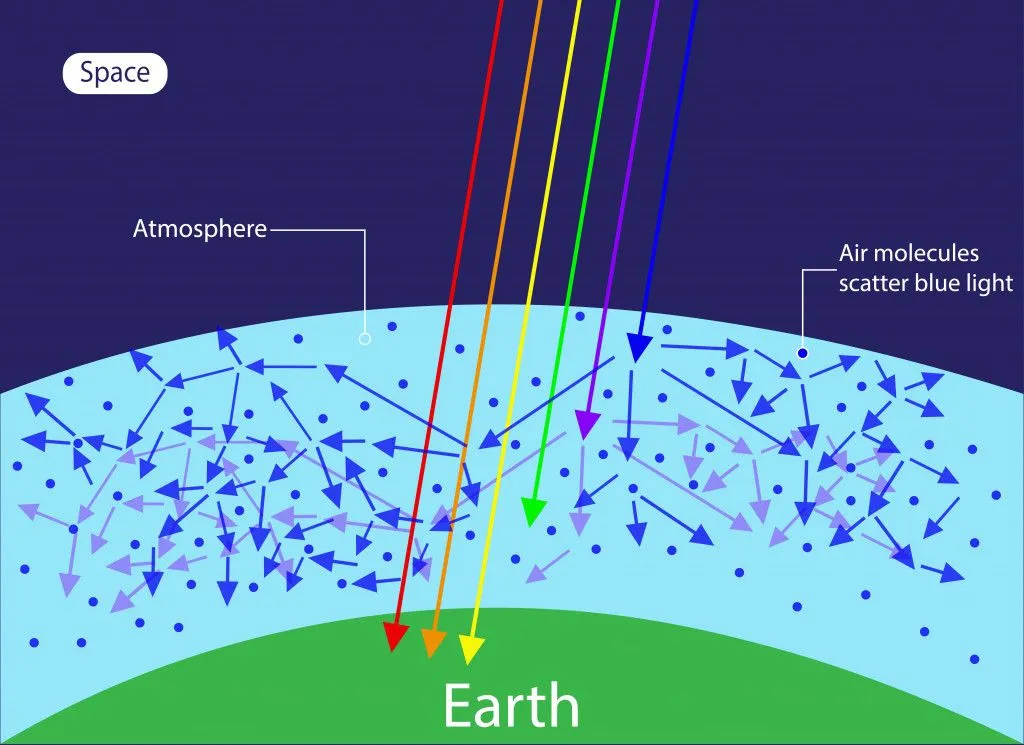
Why do sunsets on earth look red? This is due to something called Rayleigh scattering, which occurs when the size of particles is very small, as compared to the wavelength of the light.
The tiny nitrogen and oxygen molecules present in Earth’s atmosphere scatter the blue wavelengths, so by the time the light reaches our eyes, only the red remains.
Now, in order to understand why Martian sunsets are blue, we first need to inspect the composition of the Martian atmosphere.
The Martian Atmosphere
The atmosphere of Mars is exceedingly thin—the surface pressure is just about 1/160th of Earth’s, with an average density roughly 1% of ours at sea level. By volume, this whisper-thin atmosphere is about 95.1% carbon dioxide, 2.6% nitrogen, 1.9% argon, and just 0.16% oxygen, based on measurements by NASA’s Curiosity rover. However, something else dominates the Martian sky—dust particles. The surface of Mars is blanketed by fine dust rich in iron-bearing minerals like hematite, magnetite, olivine, and (per a 2025 Nature Communications study) ferrihydrite—and it is these airborne particles that are the major factor responsible for the blue sunsets on Mars.
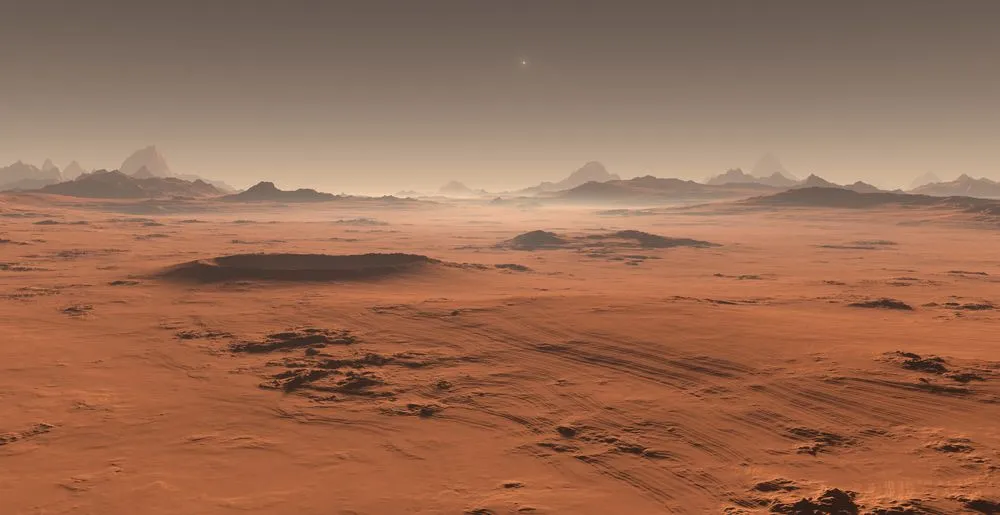
As discussed earlier, the scattering of light depends on the size of the particles. The smaller particles of Earth’s atmosphere favor Rayleigh scattering, but the situation on Mars is different. The dust particles suspended in its atmosphere have an effective radius of roughly 1.5 micrometers (around 1500 nm)—several times larger than the wavelengths of visible light, well beyond the Rayleigh regime. Instead, they follow a different optical phenomenon; Mie Scattering.
Mie Scattering
Mie scattering is the predominant type of scattering that occurs in larger particles. Unlike Rayleigh scattering, the phenomenon is not strongly wavelength-dependent. Instead, this scattering is more reliant on the direction of the rays. Here, scattering of light occurs more in the forward direction, as compared to sideways or backward scattering.
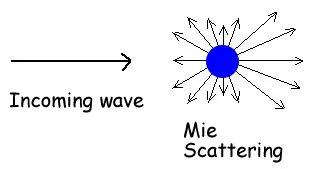
Generally, Mie scattering is said to scatter the lights of all wavelengths equally. However, depending on the size of particles present and the direction of the incident rays, the wavelength that they mainly scatter varies. For example, the dust particles in the Martian atmosphere scatter red light more than blue light. This, along with the presence of an abundant amount of red-colored iron oxide, is why the Martian sky looks red.
The Science Behind The Blue Sunset
When we analyze the Martian sunset, we immediately notice two features. One is the bluish disk of the sun, and the other is the fading blue halo around it. Why do these occur?
Why Does The Sun’s Disk Appear Blue?
The sun, when viewed from Mars, looks blue because the Martian atmosphere filters out the redder wavelengths. The dust size on Mars is perfect for scattering red light, so these particles scatter red wavelengths more than the blue ones.
Since the sunlight travels the longest distance during the sunrise and sunset, by the time it covers its long path, the red light goes “extinct”, and all that remains is the short, blue wavelengths. This is called wavelength-selective extinction, and it is what makes the sun appear bluish.
In simple words, think of the atmosphere as a filter for the sunlight. Earth’s atmosphere is good at filtering out blue light and letting in red light, whereas the Martian atmosphere is better at filtering out red light and letting in the blue.
What Causes The Blue Halo Around The Sun?
The enthralling blue glow around the sun cannot simply be explained through wavelength-selective extinction; here, the pattern of scattering is also significant. As mentioned earlier, Mie scattering is strongly dependent on the direction of the light rays, and it is more predominant in the forward direction.
Thus, when passing through the Martian atmosphere, most of the light will be scattered in the forward direction at small angles. As a result, instead of witnessing a blue tint spread across the horizon, we see more of a small, concentrated blue halo around the sun.

Also, the pattern of scattering is different for different colors. In the forward direction, the intensity of blue light is almost six times greater than that of red. This is why we see a brighter shade of blue closer to the sun. Blue light remains dominant within roughly a 10o cone around the sun, with the strongest blue scattering occurring straight along the line of sight. Afterward, as the scattering angle increases, the dominance of blue wavelengths begins to drop. Beyond a scattering angle of 28o, the intensity of reddish wavelengths becomes more dominant, and as a result, the bluish glow slowly fades into the reddish-grey sky of Mars.
In a nutshell, the bluish color of the sun is due to wavelength-selective extinction, while the blue halo is the result of the angular scattering of sunlight due to Mie Scattering.
Can We Witness A Blue Sunset On Earth?
Now, if you’re bummed that your only hope of witnessing a blue sunset is by taking a trip to Mars, you’re in for yet another surprise. Occasionally, blue sunsets have been observed on our very own planet! In 1883, following the eruption of the volcano Krakatoa, observers around the world reported that the sun and moon took on an eerie blue or green tint—an effect that lingered for months and produced occasional ‘blue moons’ for nearly two years afterward.
Around the same time, the Reverend Sereno Edwards Bishop—an American minister and amateur scientist living in Honolulu—reported witnessing a bluish halo around the sun, surrounded by a brownish ring. This phenomenon, caused by the large-sized volcanic dust particles spewed out into the atmosphere following the eruption, has been named ‘The Bishop’s Ring’ after Bishop, who first described it.
Besides volcanic eruptions, blue sunsets have also been occasionally reported in the deserts of Arabia, where dust storms are frequent. Sometimes, forest fires can also lead to red skies and blue sunsets.
Conclusion
Aside from every other factor mentioned above, the color of the Martian sunset depends greatly on something else—our eyes! The true color of the Martian sunset can only be described once it has been perceived by a human being. Until then, we have to be content with the images sent by our Mars rovers—including Curiosity, which in early 2025 captured the first sun rays photographed at sunset on another planet, glittering through twilight clouds—or wait around watching earthly blue sunsets that truly only occur once in a blue moon!
References (click to expand)
- Ehlers, K., Chakrabarty, R., & Moosmüller, H. (2014, March 18). Blue moons and Martian sunsets. Applied Optics. The Optical Society.
- What Does a Sunrise-Sunset Look Like on Mars?. The National Aeronautics and Space Administration
- Blue Sky and Rayleigh Scattering - Hyperphysics. Georgia State University
- Martian atmosphere - Mars Education - Arizona State University. Arizona State University
- Lecture 34 Rayleigh Scattering, Mie Scattering. Purdue University
- On This Day: Historic Krakatau Eruption of 1883 | News. The National Centers for Environmental Information