Table of Contents (click to expand)
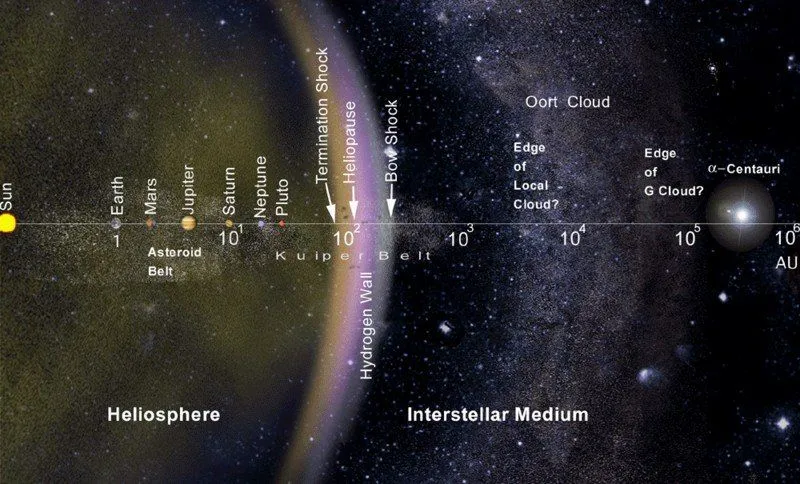
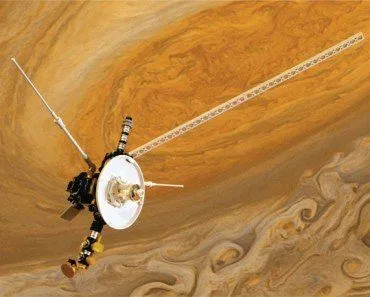
The farthest man-made object from the Earth is Voyager 1. It is a space probe that was launched by NASA on September 5, 1977 and has been in operation for nearly 49 years. It was the first space probe to cross into interstellar space, the region free from the influence of a particular star’s solar wind. At a distance of about 25.8 billion kilometers (172.6 AU) as of 2026, it is the farthest spacecraft from Earth, and is on track to reach one full light-day from us in November 2026.
We humans have come very far technologically, scientifically, and philosophically, and far surpassed the limits that early humans could have ever predicted. The presence and passion of men and women is too powerful to be bound by the limits of our planet. Have you ever wondered about those footprints on the moon and what they signified? About those numerous satellites revolving around the earth, feeding information to your phone, your computer, and your TV? The boundaries to our reach are slowly expanding, which brings us to this question, “How much do we really know?”
Voyager 1 is, at present, the farthest man-made object from the Earth. It’s farther away from our planet than any other human creation. It is whizzing past the outer reaches of our Solar System, making it the farthest human footprint out there in the vacuum of space.
Recommended Video for you:
About The Probe
Titan: Voyager 1’s mission included a flyby of Titan, Saturn’s largest moon, which had long been known to have an atmosphere. Earlier exploratory probes had already piqued the interest around Titan by finding its atmosphere developed and complex. Titan’s mass was calculated by observing its effect on Voyager 1’s trajectory. Although the surface wasn’t visible at the safe distance of 6,400 kilometers, the information discovered about the atmospheric composition and temperature led scientists to believe that liquid hydrocarbons could exist on its surface.
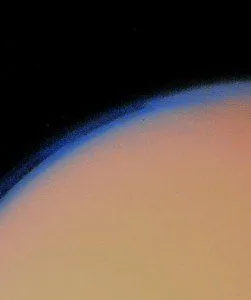
The Titan flyby took Voyager 1 out of the plane of the ecliptic (the plane of planetary revolution around the sun), thereby ending its planetary science mission. Still uninterrupted, the mission for Voyager 1 was extended to reach the end of the heliosphere (the region of space that is directly affected the Sun’s radiation and gravity) and into interstellar space.
Interstellar Travels
Voyager 1 took the first-ever portrait of the Solar System as seen from outside on February 14, 1990, which has become known as ‘the Family Portrait’. Soon afterwards, the cameras were deactivated to conserve power.
In 1998, Voyager 1 overtook Pioneer 10 as the most distant spacecraft from Earth, and continued traveling at about 17 kilometers per second. Its instruments continued to study the Solar System, namely directed to look for the ‘heliopause’, the boundary at which it would transition into interstellar space.
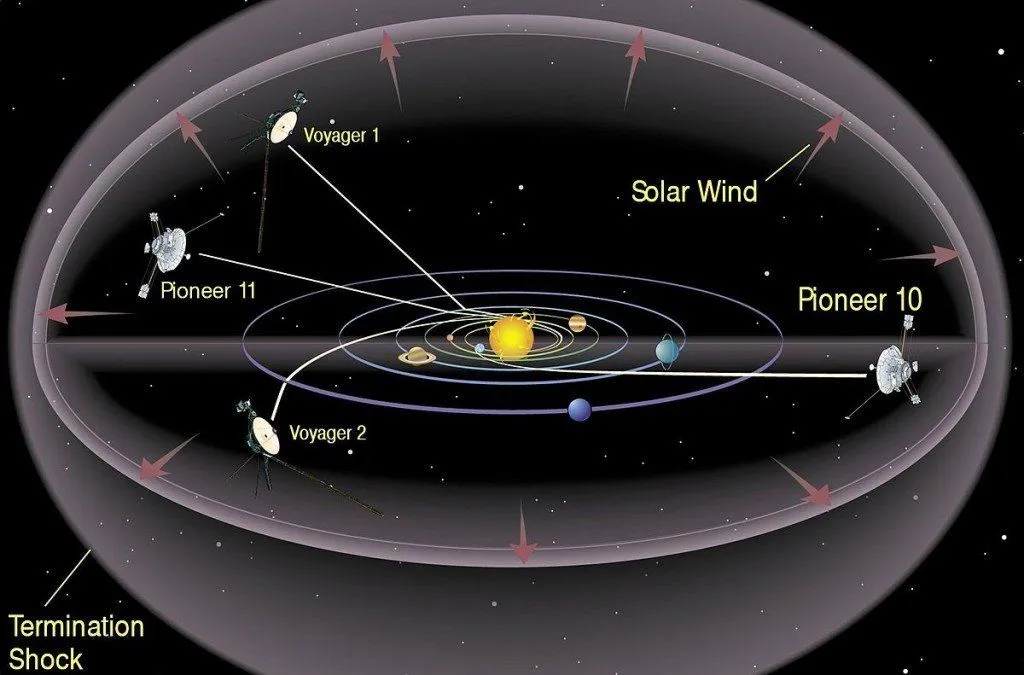
On September 12, 2013, NASA confirmed that the probe had crossed the heliopause into the interstellar medium on August 25, 2012. As of 2026, a one-way Voyager 1 transmission takes about 23.5 hours to reach Earth, and the spacecraft is expected to reach the symbolic one light-day distance (where a signal takes 24 hours to travel each way) in November 2026. NASA has released audio recordings of the plasma waves encountered by the probe, which represented the first sounds ever captured in interstellar space.
You can check the current location and other mission updates of Voyager 1 here.
Most Interesting Thing Onboard Voyager 1
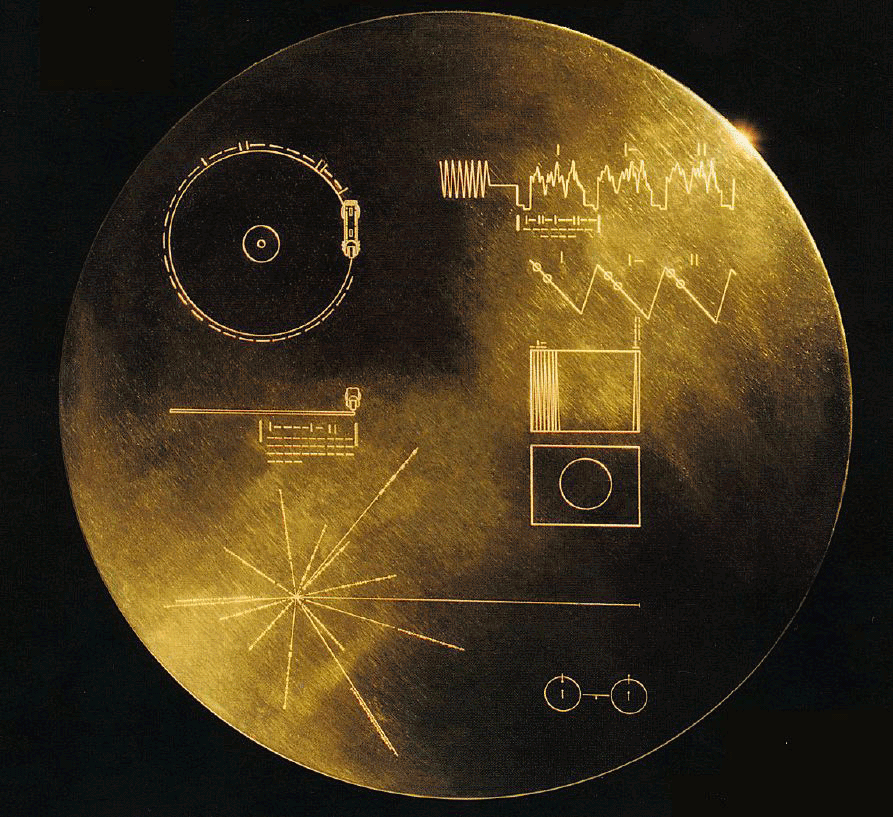
On board Voyager 1 is a gold-plated audio-visual disc meant to act as a ‘message in a bottle’. The disc carries photos of the Earth and its ecosystem, scientific information, spoken greetings from the Secretary-General of the United Nations and the President of the United States. Greetings in 55 different languages, works by Mozart and Chuck Berry, along with various performances of indigenous music from around the world, are also included. The contents of the record were made available by NASA as part of the public record.
The Twin Space Probe
Voyager 1 was launched 16 days after Voyager 2, but due to its shorter trajectory, it reached Saturn and Jupiter sooner than its counterpart. Voyager 2 crossed the heliopause into interstellar space on November 5, 2018, becoming the second spacecraft ever to do so, and is currently moving at a velocity slower than Voyager 1. It remains the only spacecraft ever to visit either of the two ice giants, Neptune and Uranus. Voyager 1’s plasma science instrument failed in 1980 and was switched off in 2007, so Voyager 2’s working plasma sensor produced the first direct measurements of interstellar plasma density and temperature after its 2018 crossing — that instrument was itself shut down in October 2024 to conserve power.
The Future
Although Voyager 1 is not heading towards any particular system, the closest star it will approach is Gliese 445 in about 40,000 years. NASA says that “The Voyager is destined-perhaps eternally-to wander the Milky Way”. Another interesting fact is that it will remain the farthest spacecraft from Earth, given that it doesn’t collide with anything. The ‘New Horizons’ space probe will never overtake it, as it is traveling at about 15 kilometers per second, which is 2 kilometers per second slower than Voyager 1 and it is still slowing down. Power has been the bigger challenge than distance: Voyager 1’s radioisotope thermoelectric generator loses about 4 watts every year, and engineers have already switched off seven of the spacecraft’s ten science instruments. NASA shut down the Low-Energy Charged Particle (LECP) experiment on April 17, 2026 to keep the remaining magnetometer and plasma-wave instruments alive, and is testing a "Big Bang" thruster maneuver on Voyager 2 in mid-2026 that, if successful, could buy Voyager 1 a few more years of operation. Once the power finally runs out, Voyager 1 will continue to drift silently through the Milky Way as a kind of message in a bottle — should any extraterrestrial civilization ever happen to find it.