The Doppler effect shifts the wavelength of light from objects moving relative to us: light from a galaxy moving away is stretched into a redshift, while light from one moving toward us is squeezed into a blueshift. By measuring those shifts, astronomers can read the speed and direction of stars and galaxies, and (combined with Hubble’s law) their distances — the same trick JWST used in 2024–2025 to confirm galaxies as remote as MoM-z14, seen 280 million years after the Big Bang.
Have you ever wondered how researchers and physicists have managed to map a massive amount of the universe from their secluded research labs with only a telescope, a computer and specific statistical data to help them? Do we no longer need to set out on journeys to see far and beyond? Has the era of Columbus, Marco Polo, Vasco da Gama and other great travellers come to an end?

Sadly, yes. Let’s try to understand the situation in a realistic manner.
To do this, let’s use a scaled-down map of our known universe. If the sun is positioned 1 inch from the earth, the next closest star (Proxima Centauri) is around 4.3 miles away. The sun, in actual distance, is about 149.6 million kilometres away from the Earth, so Proxima Centauri would be insanely farther. The number is unimaginable, around 40.14 trillion kilometres. We can no longer use ships or aeroplanes to explore such vast distances as we might do when travelling around the globe.
Humans aren’t technologically advanced enough to make such incredible trips into space in the current epoch. Instead, we have gotten smarter with our methods of exploration and observation.
Have you ever heard a police car speed by? As the siren approaches, its pitch sounds higher than the actual note; the moment the car passes you and starts moving away, the pitch drops sharply to a lower note. (You also hear the sound get louder and then quieter, but that’s just distance — the Doppler effect specifically refers to that change in pitch caused by the relative motion between the source and you.) This is known as the Doppler effect.
How does this help our space voyage? As mentioned earlier, humans are smart. We noticed that the Doppler effect could be observed, not only in sound waves but for all kinds of waves. Light is an electromagnetic wave; we used this fact to our advantage.

Recommended Video for you:
Doppler Effect In Light
When we are dealing with light as the subject wave, we obviously see the visible changes, not the audible ones, unlike the case of sound waves. However, the principle remains the same.
As the source of the waves (light) moves away from the stationary observer (you), the frequency of light waves reaching your eyes decreases (the wavelength increases). On the contrary, if the light source is nearing the observer, the frequency of the wave increases (the wavelength decreases).
What Are Redshift And Blueshift?
Have you ever witnessed a rainbow?
If yes, then you have surely noticed bands of colours comprising the rainbow. This is what you would call the visible spectrum of light, which an unaided eye can perceive in normal conditions.

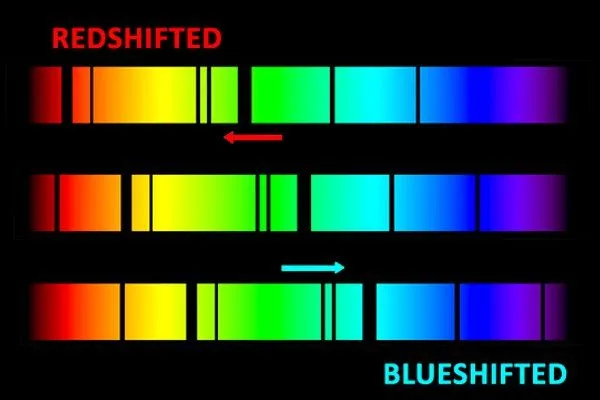
The Doppler effect is also observed in the visible spectrum. When a source of visible light moves away from an observer, the incoming light tends to move towards the red region (higher wavelength region) of the spectrum. This is called a redshift.
Similarly, if the source is moving towards the observer, the incoming light waves tend to shift nearer to the blue region (lower wavelength) of the visible spectrum. This is called blueshift.
How Do Redshift And Blueshift Help Us Map The Universe?
Now that you understand redshift and blueshift, get ready for some mind-blowing revelations those simple elements can provide.
Astronomers can use redshift to determine the motion of our Milky Way galaxy. This is achieved by measuring the Doppler shift in the incoming light from nearby galaxies and comparing the results, in particular, intervals of time, to determine the shifting.
That information reveals how other galaxies, nebulae or any other light-emitting body is moving, with what magnitude and in which direction.
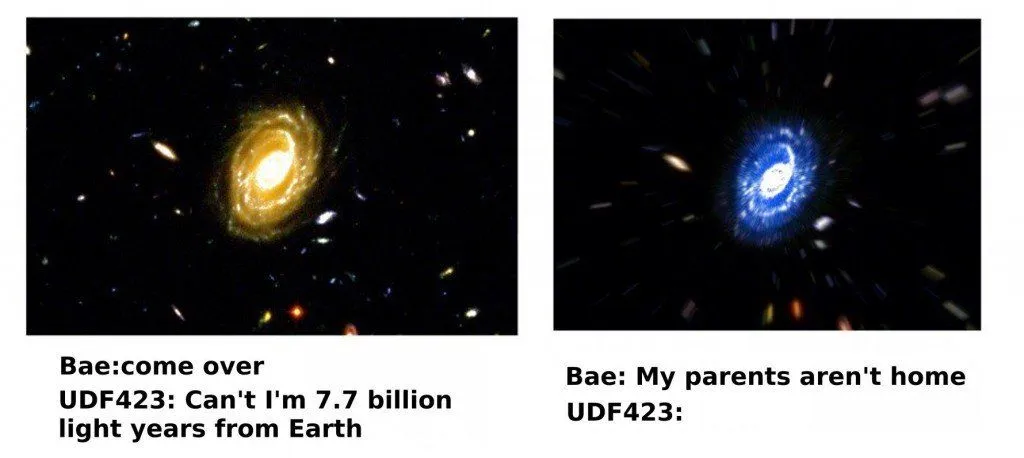
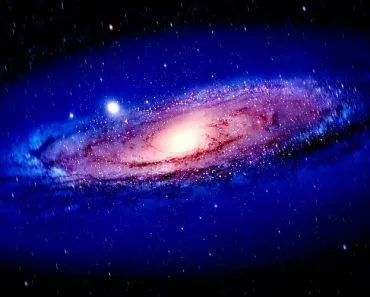
Spanning from the nearest galaxy, Andromeda, to the farthest “high redshifted” galaxies, the Doppler effect has paved the way for innumerable observations with extremely high levels of accuracy.
This has also given us a glimpse at the original state of the universe, around 13.8 billion years ago (Planck 2018), when cosmic history began with the Big Bang — although the precise age is currently the subject of an active debate known as the Hubble tension, in which independent local distance measurements consistently prefer a younger universe than the cosmic-microwave-background data does.
The universe has not only been expanding since that time, but its expansion is also accelerating. Achieving these results went a bit beyond the mere Doppler effect. It is, in fact, a result of spacetime itself expanding. As the universe is generally expanding, observing blueshift on a large scale is rare.
The Three Kinds Of Redshift
At least three different kinds of redshift have been observed in our universe.
You must be wondering: why is blueshift less significant? The reason is that the universe is expanding. Thus, the wavelength of light reaching observers is longer and is hence redshifted. That being said, blueshift does undoubtedly occur in some particular cases.
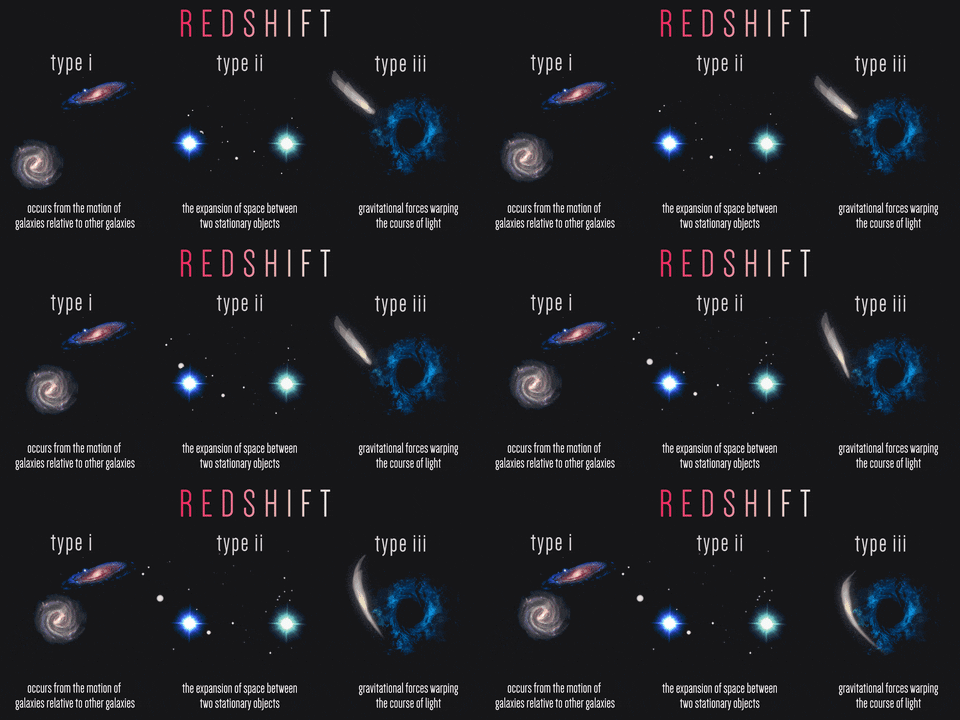
Type I redshift results from the motion of galaxies relative to their neighbouring galaxies. For instance, the Andromeda galaxy’s spectrum shows a clear blueshift, telling us it is moving toward the Milky Way at about 110 km/s. For decades that was taken as proof of an inevitable collision in roughly 4–5 billion years; a 2025 reanalysis using updated Gaia and Hubble data (Sawala et al., Nature Astronomy) softened that to roughly a 50/50 chance over the next 10 billion years, but the blueshift itself is unchanged. At the same time, a galaxy moving away from ours will show a redshift.
Type II is the most common form of redshift and is observed due to the expansion of space between two stationary bodies. The bodies, although not in motion, do experience an increase in the wavelength of incoming light.
The subtlest of all redshift varieties is Type III, gravitational redshift. It has nothing to do with light’s path bending (that’s gravitational lensing, a separate effect). Instead, a photon climbing out of a strong gravitational well — say, leaving the surface of a neutron star — loses energy, so its wavelength stretches and it arrives redder. Equivalently, time runs slower deeper in a gravitational field, so light emitted from down there reaches us with a lower frequency. The verification of this effect helped to validate Einstein’s theory of general relativity.
A classic example of gravitational redshift has been observed right here on Earth: the Pound–Rebka experiment at Harvard, in 1959, measured the effect using gamma rays sent up a 22.5-metre tower. Imagine you are shining a torch up to a tower and measuring its wavelength when it is emitted and again when it is received. You will find that the wavelength has very slightly increased, because the gravitational field of the Earth gets stronger the closer you are to its surface. That makes time pass slower — or to be "stretched" — near the surface, which in turn lowers the frequency (and lengthens the wavelength) of light climbing away from it.
Discovering Extrasolar Planets
Astronomers use redshift and blueshift to detect extrasolar planets through something known as the radial velocity method — the very technique with which Michel Mayor and Didier Queloz discovered 51 Pegasi b, the first exoplanet around a Sun-like star, in 1995 (work that earned them the 2019 Nobel Prize in Physics). Of the more than 6,000 confirmed exoplanets in NASA’s archive today, the transit method has overtaken radial velocity as the dominant detection technique, but the two together account for the vast majority.
This technique uses the fact that if a star has a planet (or planets) around it, it is not strictly true that the planet is orbiting the star. Instead, the planet and the star orbit their common centre of mass, as the star is so much more massive than its planets. The centre of mass is within the star, so the star appears to wobble slightly as the planet travels around it. Astronomers can measure this wobble using spectroscopy.
Consider a star travelling towards us; its light will appear blueshifted, and if it is travelling away, the light will be redshifted. This shift in colour will not change the apparent colour of the star enough to be seen with the naked eye. Instead, spectroscopy can be used to detect this change in colour from a star as it moves relative us, orbiting the centre of mass of the star-planet system.
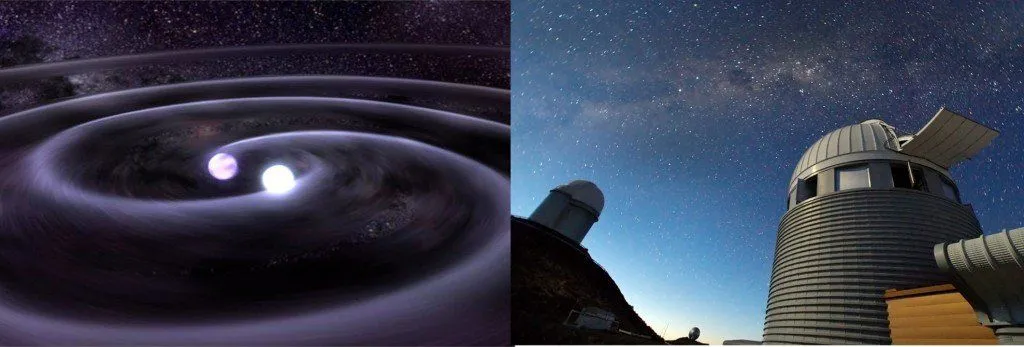
More generally, astronomers use redshift and blueshift to study objects that are moving, such as binary stars orbiting each other, the rotation of galaxies, the movement of galaxies in clusters, and even the movement of stars within our galaxy. Thus, by mapping the motions of these bodies, astronomers have managed to span an unusual amount of the “known universe”.
Conclusion
It might seem shocking that the farthest humans have ever travelled from Earth is around 407,000 km — a record set by NASA’s Artemis II crew during their April 2026 lunar flyby (just past the far side of the Moon), narrowly beating the 56-year-old Apollo 13 record. Yet despite still being technologically backwards by cosmic standards, humans have a strong urge to explore the unknown. We have observed the most distant gamma-ray burst, GRB 090423, an exploding star whose light has been travelling for about 13 billion years; the James Webb Space Telescope has spectroscopically confirmed galaxies as remote as MoM-z14 (z = 14.44), seen as they appeared just 280 million years after the Big Bang — a record that displaced the earlier Hubble-era leader, GN-z11. And we’ve done all this without stepping a single foot in space.
Researchers are continually brainstorming ideas to create and explore new methods of space exploration and map our universe to the most precise measurements. All of this is possible only because of our understanding of the nature of light. Our knowledge of the universe is primarily based on theories and statistical data. Therefore, it was a significant breakthrough, in the field of cosmological exploration, when the Doppler effect paved the way to the idea of redshift.
Today, spectroscopy is one of the most powerful tools in astronomy and underpins much of what we know about the composition, motion and distance of cosmic objects. Without it, it would have been impossible for astronomers to observe distant galaxies or cosmological events, let alone measure them precisely — and the same is true for newer windows on the universe like gravitational-wave astronomy (LIGO/Virgo) and the Event Horizon Telescope, which now sit alongside spectroscopy as complementary tools.
References (click to expand)
- The Doppler Effect - The Physics Classroom
- Cool Cosmos - coolcosmos.ipac.caltech.edu:80
- Redshift | Las Cumbres Observatory. Las Cumbres Observatory
- NASA Webb Finds Most Distant Known Galaxy - NASA Science
- What is the difference between the "Doppler" redshift and the "gravitational" or "cosmological" redshift? (Advanced) - Curious About Astronomy? Ask an Astronomer - curious.astro.cornell.edu
- D Dobrijevic —. Redshift and blueshift: What do they mean? - Space.com. Space.com