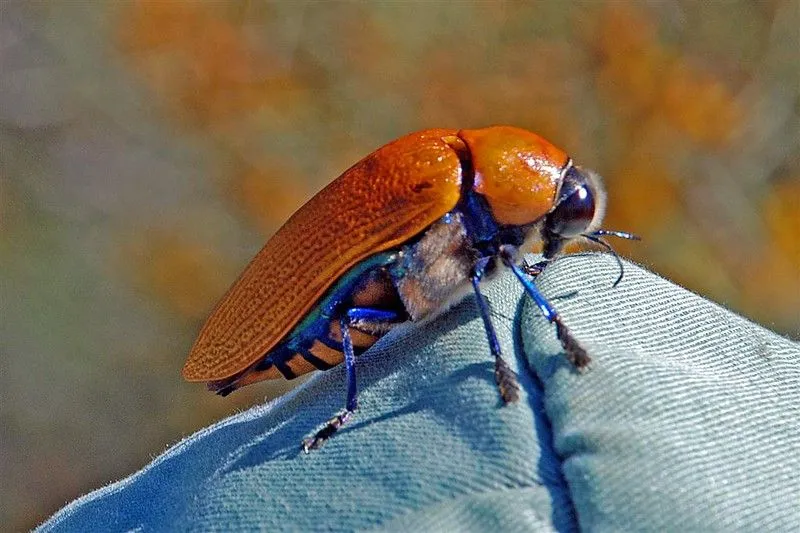
Male Australian jewel beetles (Julodimorpha bakewelli) repeatedly try to mate with discarded brown “stubby” beer bottles because the bottles look, to a beetle, like a giant ideal female: brown, glossy, with a dimpled glass texture that mimics her elytra (wing covers). The bottles are an artificially exaggerated version of the cues a male is wired to find irresistible — what behavioural ecologists call a supernormal stimulus. Darryl Gwynne and David Rentz reported the case in 1983 and won the Ig Nobel Prize for Biology in 2011 for the discovery.
It was the year 1983. Scientists Darryl Gwynne and David Rentz were camping out in Western Australia. One day while out on a walk, they stumbled on a bunch of male beetles going wild trying to crawl over and mate with…. beer bottles. Yes, you heard that right! Beer bottles.
But what’s the reason behind this unusual sexual attraction?
The beetles in question are Australian jewel beetles (Julodimorpha bakewelli), members of a family of wood-boring beetles. The discarded “stubbies” had all the important visual characteristics of a female jewel beetle: they were orange-brown in colour, glossy, and the textured glass at the base mimicked the dimpled pattern of her hardened wing covers (elytra). The poor males went wild and died in the hot scorching sun trying to mate with these beer bottles, while the bottles emitted some seriously over-sized signals that the beetles simply could not resist.
This research earned Gwynne and Rentz the 2011 Ig Nobel Prize for Biology — a tongue-in-cheek award for science that “first makes you laugh, and then makes you think.”
Recommended Video for you:
What Is This Attraction To Larger-than-life Stimuli?
Organisms in the natural world have an innate tendency to respond to the stimuli they perceive. The brain is wired to be attracted or repulsed by particular signals, depending on its effect on the survival of the animal.
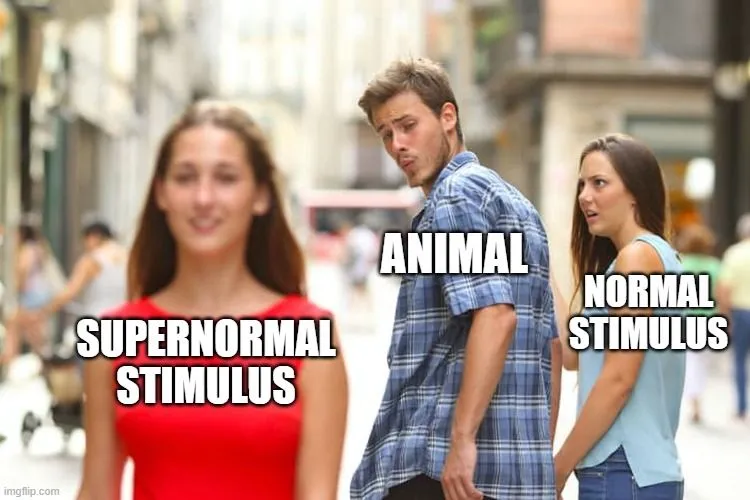
In normal scenarios, we come across only normal-sized stimuli, and our brain is prepared to handle them. However, in certain unexpected situations, when we see exaggerated stimuli or “supernormal” stimuli (like the beer bottles, in the case of jewel beetles), the animal cannot help displaying a stronger response or a “super response” to it. A supernormal stimulus is therefore an artificial stimulus that evokes a reaction stronger than the stimulus for which the original response mechanism evolved.
Who Discovered This?
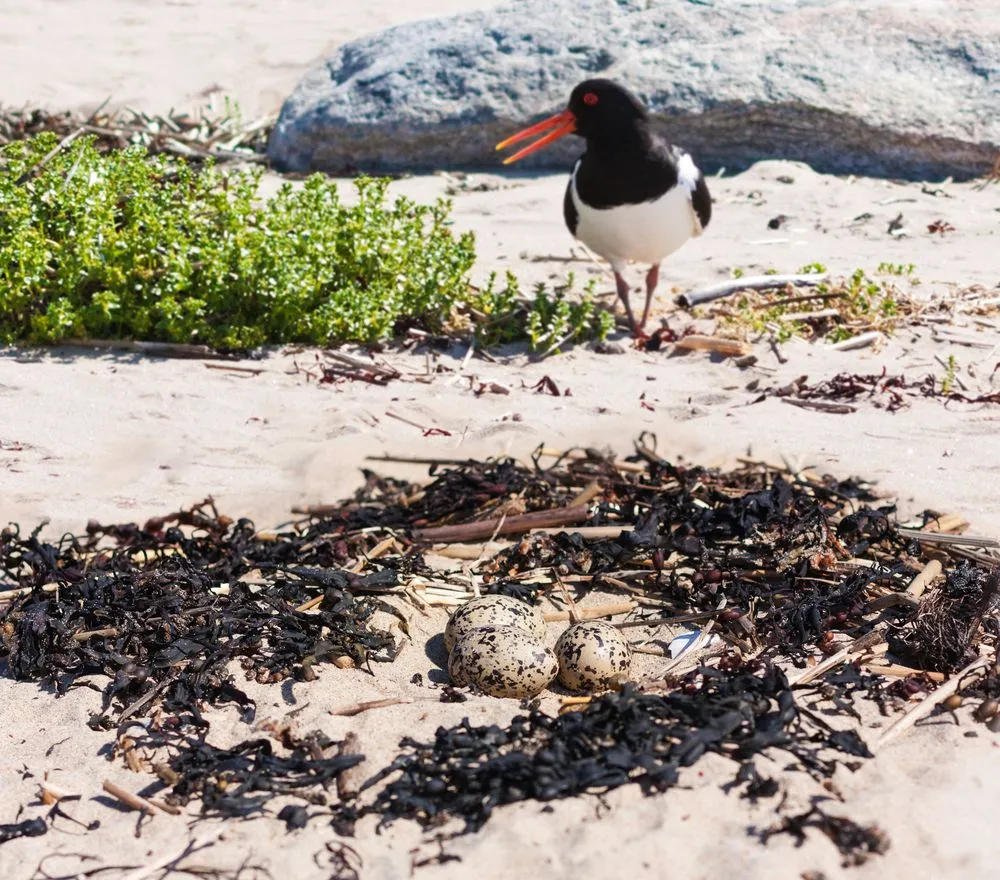
The term supernormal stimulus was developed in the 1940s and 1950s by the famous behavioural scientists Niko Tinbergen and Konrad Lorenz — who later shared the 1973 Nobel Prize in Physiology or Medicine (with Karl von Frisch) for their work on animal behaviour. When Tinbergen was studying shorebirds, called oystercatchers, he observed quite an interesting behavior. Once they lay eggs of different sizes, these birds showed a preference to incubate larger eggs (because a larger egg could indicate that the baby would be healthier, and that idea is then programmed in the bird’s brain).
So, Tinbergen tried offering them artificial eggs of different sizes. Guess what he saw? The birds started choosing the largest egg and forgot all about their own actual smaller eggs (one time he gave them a football-sized fake egg and the bird kept sliding off while attempting to sit on it).
There is also a fish called the three-spined stickleback that is territorial in nature (the males attack any other male in its territory). Male fish identify each other because of the red color on their underbelly. When Tinbergen showed them cardboard fish models with an exaggerated bright red underbelly, these fish attacked the cardboard more vigorously. The more red they saw, the more violent the attack. In one instance, the fish started acting aggressively right after they spotted a red mail van through the window! Essentially, animals do not recognize if the signal is real or artificial, and respond only to the intensity of the stimuli.
Is This Common Within The Animal Kingdom?
This phenomenon is not limited to experimental setups; there are many cases of it happening in the natural world. For example, supernormal stimuli explain why animals prefer mates who appear “extra attractive” (even if that feature does not actually have any survival advantage). This happens with peacocks, in which individuals with bigger and brighter tails are more popular with the females.
In birds like cuckoos, which show brood parasitism, the baby cuckoos open their mouths extra wide and beg intensely to ensure that they get extra food from the host parent.
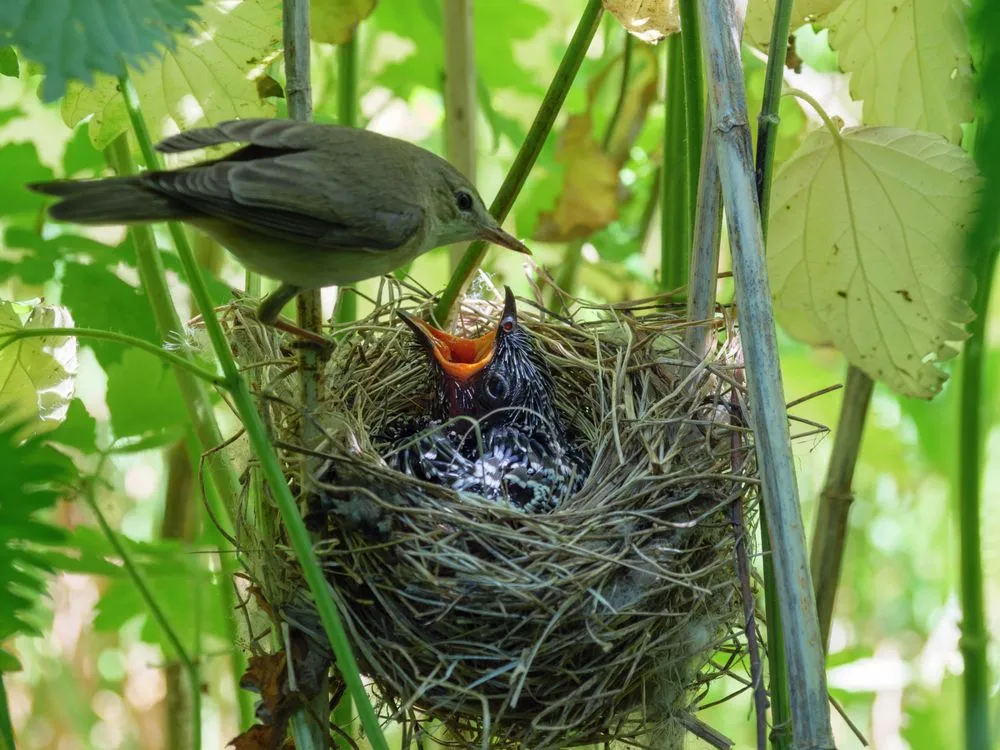
Supernormal stimuli in forms of color, size, patterns, or shapes, are effective because a creature that exhibits them is chosen by another organism that prefers it. As a result, both species evolve in that direction.
How Are Humans Exploiting This?
Ever since elucidating the concept of supernormal stimuli, there are settings in which humans have been utilizing this to our advantage. An example is the development of fly fishing baits (fly fishing is a method of fishing using a rod and an artificial fly as bait). We have been trying to create fly models that can act as a “super” stimulus for fish that would pick this fake-fly bait over the naturally available “dull-looking” food.
A Final Word
Every animal responds to both natural and artificial stimuli as an instinctive behavior. However, when larger-than-life artificial stimuli are present, the organism shows a tendency to choose it over natural ones. That’s why those beetles could not help going after the beer bottles, even though it ultimately ended in their death.
Supernormal stimuli may not be something animals bump into very often. However, a change in living conditions (like environmental modifications caused by humans) can create possibilities for abnormal signals. In such a scenario, it can have an impact on their behavior and cause harm to those species that are vulnerable or at risk of extinction.
The question is, does this phenomenon just affect other animals, or are humans also prey to supernormal stimuli?
References (click to expand)
- Gwynne, D. T., & Rentz, D. C. F. (1983, February). Beetles On The Bottle: Male Buprestids Mistake Stubbies For Females (Coleoptera). Australian Journal of Entomology. Wiley.
- Beer, C. (2020, June). Niko Tinbergen and questions of instinct. Animal Behaviour. Elsevier BV.
- Alcock J. (2013). Animal Behavior: An Evolutionary Approach. Sinauer
- (1952) The Curious Behavior of the Stickleback - jstor. JSTOR
- Tanaka, K. D., Morimoto, G., Stevens, M., & Ueda, K. (2011). Rethinking visual supernormal stimuli in cuckoos: visual modeling of host and parasite signals. Behavioral Ecology. Oxford University Press (OUP).
- Futuyma D. (2013). Evolution. Sinauer
- Doug S. C. R. (1971). Selective Trout. CROWN PUBLISHERS, INC.