Table of Contents (click to expand)
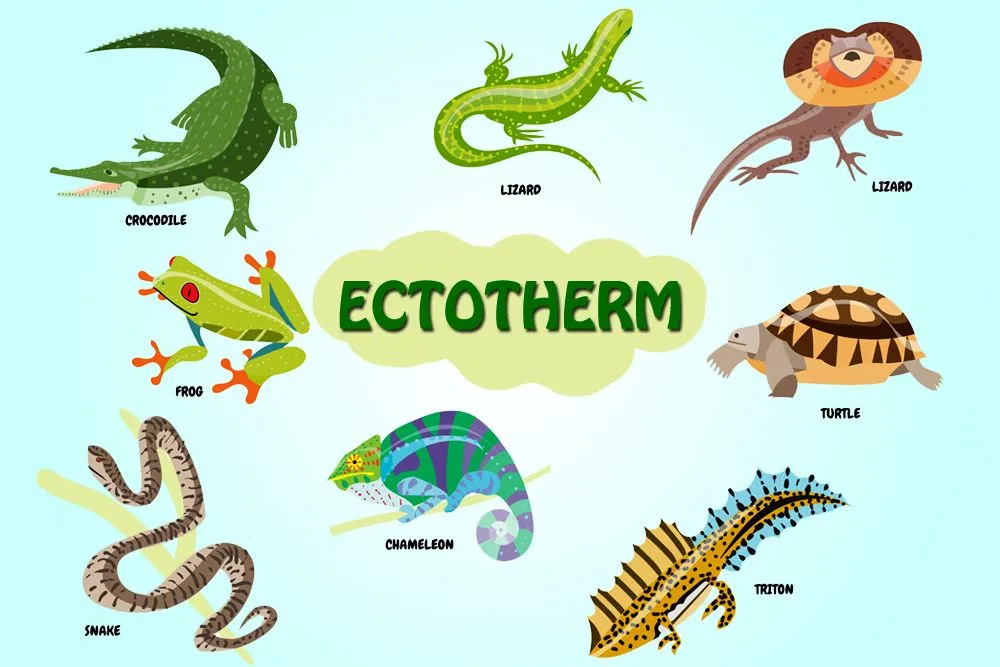
An ectotherm (“cold-blooded” animal) relies on the environment—sun, water, soil—to set its body temperature. Reptiles, amphibians, fish, and most invertebrates are ectotherms.
On a hot summer day, as you walk your dog down the street, you will notice that your dog’s tongue is hanging out as he pants, and your t-shirt is slowly soaking through with perspiration. Both of these activities are methods that our bodies (humans and dogs) utilize to control and stabilize our internal temperature. By sweating, we are able to cool down the body as the result of evaporation, while panting allows for the same thing to happen on a dog’s tongue.
However, humans, dogs, and other mammals—along with birds—are endotherms, whereas reptiles, amphibians, fish, and the vast majority of invertebrates are ectotherms. Instead of managing heat produced inside their bodies to keep temperature stable, ectotherms rely on the outside environment as their heat source and allow their body temperature to fluctuate much more than endotherms do.
Recommended Video for you:
What Is An Ectotherm?
As mentioned above, an ectotherm is commonly called a “cold-blooded” creature, and there are hundreds of thousands of ectothermic species. Unlike endotherms, “warm-blooded” animals, ectotherms are unable to increase their internal metabolic activity to boost heat production. They do produce some amount of metabolic heat, but not enough to completely fuel their body. Instead, they are at the whim of their external environment, relying on open spaces to soak up the sun, and also shaded areas to shield the creature from heat when it gets too hot outside.
If you have ever seen a lizard lying lazily on a rock, you’re witnessing a key element of ectothermy. This practice of “basking” allows the animals to directly soak up the heat of the sun and the heat of the rock beneath it. This will increase the creature’s internal temperature to a comfortable point. There is usually a preferred range of temperature for ectotherms, but there is less rigidity in that range as there is for endotherms.
Generally, humans and other mammals and birds will maintain an internal temperature at all times; for humans, this temperature is 98.6 degrees Fahrenheit (37 degrees Celsius). Most other mammals range from 97-103 degrees Fahrenheit, while many birds are near 105 degrees. However, ectotherms around the world are able to survive in more extreme environments because if the temperature plummets by 40 degrees, their body temperatures will gradually fall to match it. Similarly, if the temperature spikes to 100 degrees, their temperature will do the same.
Consider a lizard in the Sahara Desert, where daytime temperatures may soar above 110 degrees, but once night falls, the temperature could plummet to a chilling 25 degrees. That lizard will be able to sun itself on a rock during the early morning sun, seek shade from the scorching noon heat, and then finally adjust its internal body temperature for a chilly evening. It makes for an unpredictable life, but a much more flexible one!
Benefits Of Being An Ectotherm
The primary benefit of being an ectotherm is the smaller amount of food that must be consumed, in comparison to warm-blooded animals. Humans, birds and other mammals must consume a significant amount of calories per day so their internal temperature can be maintained. The majority of food consumed by endotherms does not, in fact, go to increasing or maintaining body mass; it is used as metabolic fuel that keeps our temperature level.
Similarly, smaller warm-blooded animals struggle to maintain their body temperature, due to their greater ratio of body surface area to mass; essentially, smaller endotherms must work very hard to keep themselves warm, since they are constantly losing heat to the environment. Small ectotherms, however, don’t need to worry about this problem, which may explain why cold-blooded animals tend to be smaller creatures.
Another benefit to having a fluctuating temperature is that ectotherms are less susceptible to infections, parasites and other pathogens that endotherms must face. The varying temperatures of their bodies make them anything but ideal for bacteria and other nasty microbes, which prefer a stable, warm temperature to thrive. That being said, the vulnerability of endotherms to more infections has improved the strength and complexity of their immune system beyond most ectotherms.

Finally, ectotherms are able to live in quite extreme conditions where endotherms prefer to avoid. More importantly, even in the most extreme areas, these creatures have adaptations to keep their body temperature within a safe range. Many ectotherms can burrow into the soil, open their mouths to release heat (the open-mouth gaping seen in lizards and crocodiles), change colours to absorb or reflect different amounts of sunlight, or simply re-orient their bodies relative to the sun when they get too hot. When an ectotherm’s body temperatures rises too high, it can cause the body’s proteins to denature, but in such a circumstance, they can release substances called heat-shock proteins. This will prevent the denaturing of the protein, and is considered part of the animals “heat shock response”. Endotherms also have heat shock proteins (HSPs), but they are less readily released, and are not considered our first line of thermo-protective defense.
On the other end of the spectrum (literally), if temperatures plummet to near-freezing, or even below, ectotherms can shiver, huddle together for warmth, or release cryoprotectant substances into their blood to prevent ice crystals from forming. These cryoprotectants consist of sugars, salts, glycerol, glucose and other proteins, depending on the particular species, allowing Arctic insects, fish and amphibians to survive.
Disadvantages Of Ectothermy
However, it isn’t all sun-basking on rocks and enjoying a low risk of infectious disease; there are some downsides to being a cold-blooded animal. Since an ectotherm’s body temperature fluctuates with the external temperature, so too does your activity level. When cold-blooded animals drop their body temperature, their activity also becomes very sluggish, both internally and externally.
They are unable to secure large stores of energy for hunting or mating, and are somewhat immobile and defenseless when the temperature plummets. Furthermore, there are some areas where they simply cannot survive (namely very cold regions) because they would never be able to boost their energy levels to move, hunt and eat. Before hunting, an ectotherm may bask in the sun for hours, as though it is charging a battery, whereas endotherms can increase their heart rate, body temperature and energy levels in mere moments.
A Final Word
In the grand history of life on this planet, ectothermy was on top for the vast majority, but as evolution continued and life began to diversify, certain circumstances drove natural selection towards endothermy. There are plenty of pros and cons to both ectothermy and endothermy, but as a human being reading this article, just be glad you don’t need to lie on a rock to warm up every morning.
References (click to expand)
- Angilletta, M. J. (2004, December 1). Temperature, Growth Rate, and Body Size in Ectotherms: Fitting Pieces of a Life-History Puzzle. Integrative and Comparative Biology. Oxford University Press (OUP).
- Ectotherm | Definition, Advantages, & Examples | Britannica. britannica.com
- Shabtay, A., & Arad, Z. (2005, July 15). Ectothermy and endothermy: evolutionary perspectives of thermoprotection by HSPs. Journal of Experimental Biology. The Company of Biologists.
- McNab, B. K. (1978, January). The Evolution of Endothermy in the Phylogeny of Mammals. The American Naturalist. University of Chicago Press.