Table of Contents (click to expand)
The side effects of staying in bed all day include the development of bedsores and body aches, especially in the lower back. Lying in bed all day is also associated with muscle weakness, blood clots, an increased risk of stress and depression, and other psychological and cardiovascular ailments.
Few people in the world leave their bed as soon as they hear the alarm, let alone before it! Lazing around in bed has ailed humankind for centuries, but it is probably much easier for a vast majority of us to spend an entire day in bed, thanks to technology. Your phone keeps you entertained, and if you have a home connected to a voice-activated system, then you don’t even need to get up to change the lighting or play some music. Social media has even given the habit a name: “bed rotting,” which trended on TikTok as a self-care practice but is, medically speaking, not a great idea.
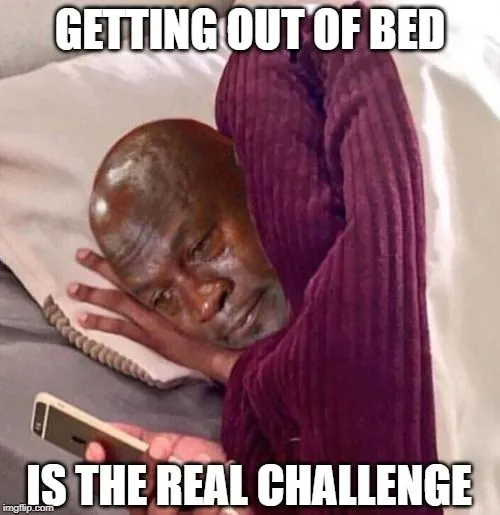
I must admit that I snooze the alarm more than I should, so much so that I sometimes wish someone would pay me to stay in bed. Well, this dream came true for Andrew “Drew” Iwanicki when he volunteered for a study conducted by NASA.
NASA Experimented To Study The Effects Of Laying In Bed For Days
In 2014, NASA conducted a study to find out what would happen to human bones and muscles in space. They simulated the conditions of space by making their volunteers lie down on a bed tilted six degrees below horizontal—head down, feet up—for 70 days straight. Iwanicki and the other volunteers could not get up at all, except for a 30-minute window when he could prop himself up on his elbows to eat.
Although the study—titled “CFT 70 (Countermeasure and Functional Testing in Head-Down Tilt Bed Rest Study)”—earned Iwanicki a paycheck of $18,000, it was no walk in the park (excuse the irony).
The study found that if a person lies down with their head tilted below their feet, more blood pools in their head, making their face look puffy. After 70 days, Iwanicki would nearly pass out after standing straight for just 15 minutes, and he had lost roughly 20 percent of his total blood volume.
Though most of us don’t lie in bed for 70 days, we have to ask is the habit of lying around in bed for hours at a stretch bad for our health too?
Recommended Video for you:
Is It Bad To Stay In Bed All Day?
Of course, it is!
It is not just the head-down position that can be bad for the body—too much bed rest in any position can be very harmful to a person’s overall well-being.
Most of us are rarely motionless and sedentary when we lie down, even if we’re asleep. We naturally move a little by twitching, turning, or shifting our weight when one position becomes uncomfortable. This helps encourage blood flow.
But when people can’t move—because of a disability, old age, or a medical condition—the lack of any movement can cause pressure ulcers, more commonly known as bedsores. Blood cannot circulate adequately to the affected areas, leading to tissue damage that causes the sores.
There are four stages of bedsores; if they reach Stage 4, they can damage muscle and bone, and in extreme cases the resulting infections can be fatal. This is why nurses continually change the position of bedridden and paralyzed patients.
Side Effects Of Staying In Bed For Too Long
But assuming you are asking this question to feel less guilty about being a bit lazy, lying in bed for too long has plenty of other ill-effects.
Muscle Weakness, Bone Loss And Back Pain
Lying down for too long and too often weakens muscles. Muscles support your skeletal system, and weak muscles lead to weaker joints. Studies of long-duration bed rest show measurable muscle atrophy within just 4–6 weeks, with strength dropping by 6–40 percent and bone mineral content falling by roughly 1–1.5 percent per month. Worryingly, that lost bone mass can take many additional months to recover even after muscle strength returns to normal.
Research also shows that bed rest is not effective in treating lower back pain. According to a landmark 1995 analysis in the New England Journal of Medicine, the researchers found that continuing routine activities (as long as they didn’t cause pain) was a more effective treatment for back pain than bed rest or even prescribed back exercises.
While brief bed rest can make people suffering from back pain feel better, too much bed rest is counterproductive—it weakens the very muscles, including those of the lower back and core, that support the spine.
Constipation And Blood Clots
People can also develop constipation and other gastrointestinal problems when their abdominal muscles lose their tone and intestinal motility slows down.
The inactivity associated with staying in bed for long hours also increases the risk of damaging the veins (especially those of the pelvis and legs) and developing blood clots, a condition called deep vein thrombosis. If a clot breaks away and travels into the lungs, it can cause a pulmonary embolism, which can be fatal.
Bed Rotting, Clinomania And Mental Health
Our mental health and sense of well-being also take a hit when we are confined to bed. One study that examined the psychological effects of bed rest over a 20-day period in nine young men found, using Zung’s Self-Rating Depression Scale and a General Health Questionnaire, that the participants’ depression and neuroticism scores rose as the bed rest continued.
Multiple studies conclude that oversleeping and the urge to remain in bed can hint at underlying mental health concerns that need to be addressed. The occasional need to rest after a hectic week is normal, but if it becomes a recurring behaviour, professional help should be sought. There is even a clinical-sounding name for the obsessive desire to stay in bed: clinomania (from the Greek kliné, meaning bed). Although clinomania isn’t a recognised diagnosis in the DSM-5, it is often a sign of depression, anxiety or chronic fatigue, and the recent TikTok-driven “bed rotting” trend has put renewed scientific focus on the behaviour.
Heart Disease, Stroke And Oversleeping
Consistently lying in bed for very long stretches isn’t just an emotional warning sign—it tracks closely with poor cardiovascular outcomes. According to Harvard Health and WebMD, people who routinely sleep nine or more hours a night have about a 23 percent higher risk of stroke and a 21 percent higher chance of becoming obese over six years compared with those who sleep seven to eight hours. Other studies link habitually sleeping 10 or more hours to higher rates of type 2 diabetes, heart disease and even all-cause mortality.
Psychological and physical ill-effects of extended periods of bed rest have also been found in pregnant women who were sent to bed due to complications in pregnancies. These effects included depression, anxiety, headache, muscle atrophy, and weight loss.
A Moderate Amount Of Bed Rest Good For You
If taken in correct amounts, bed rest is not all bad. On the contrary, it can be a good thing, especially for those who have suffered from a concussion or some other brain injury, as it helps restore the brain’s normal activities.
As it turns out, bed rest is not inherently evil; it only becomes so when it’s not regulated. After all, too much of anything is bad.
Do yourself a favor, and don’t laze around in bed unnecessarily for extended periods of time. Get out and see the world!
Also, if you are curious about why sitting in the same position even for an hour makes you feel uncomfortable, but sleeping for a good seven to eight hours doesn’t, we have answered it for you. Check this article out!
References (click to expand)
- Oversleeping Side Effects: Is Too Much Sleep Harmful? - WebMD.
- Too little sleep, and too much, affect memory.
- Liu, Q., Zhou, R., Chen, S., & Tan, C. (2012, December 17). Effects of Head-Down Bed Rest on the Executive Functions and Emotional Response. (M. G. Frasch, Ed.), PLoS ONE. Public Library of Science (PLoS).
- Changes in mood status and neurotic levels during a 20- ....
- Bed rest for back pain? A little bit will do you..
- Malmivaara, A., Häkkinen, U., Aro, T., Heinrichs, M.-L., Koskenniemi, L., Kuosma, E., … Hernberg, S. (1995, February 9). The Treatment of Acute Low Back Pain — Bed Rest, Exercises, or Ordinary Activity?. New England Journal of Medicine. Massachusetts Medical Society.