Table of Contents (click to expand)
Uvula, medically known as the Palatine uvula, is the little thing that hangs at the back of your throat. The uvula can produce large quantities of fluid saliva in a short time, and is believed to be an accessory to speech (it plays a role in enunciating uvular consonants).
At times, while looking at our face’s reflection in the mirror, your mouth may open itself instinctively and deliver a big yawn. During one such episode, you might have caught sight of the rather weird-looking thing dangling at the back of your throat. “What in the world is that?” you might have thought. Some people even wonder if having that unusual-looking organ is “normal”, or whether they should go consult a doctor.
First and foremost, let me tell you that having that weird thing hanging at the back of your throat is absolutely normal.

In fact, it turns out that the uvula is an important organ inside the mouth that, scientists believe, helps in a number of things. However, before we get to that, let’s start with the basics.
Recommended Video for you:
What Is The Uvula?
The Palatine uvula, commonly referred to as the uvula, is the soft flap of tissue that hangs down at the edge of the throat, or more specifically, at the edge of the soft palate.
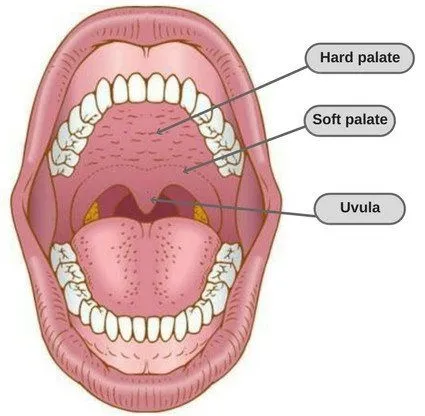
Although it does have a proper biological name, most people simply refer to the uvula as the ‘dangly thing at the back of the throat’. So, whenever you hear someone using this particular phrase, you’ll know that it’s the palatine uvula they’re talking about.
The uvula is made of muscle and connective tissue. It is also covered by a mucous membrane, the same that covers the rest of your mouth, i.e. the roof of the mouth and the insides of the cheeks. The musculus uvulae is responsible for shortening and broadening the uvula.
What Does The Uvula Do?
The uvula has been studied for many years by scientists and researchers, yet its precise roles and functions have not been determined with absolute certainty. It is the subject of many exciting, yet contradictory observations. Interestingly, the uvula is essentially unique to humans. A study by Finkelstein et al. examined multiple animal species, including sheep, chimps, and baboons, and found that only two baboons had small, underdeveloped uvulas. This uniqueness suggests the uvula plays an important role in functions specific to humans, such as complex speech.

Over the years, many hypotheses regarding the true purpose of the uvula have been put forth by medical scientists. Research has identified several roles, including saliva production, aiding speech, triggering the gag reflex, and contributing to immune defense. The uvula has also been linked to snoring and obstructive sleep apnea (OSA). Systematic reviews have confirmed that an enlarged or elongated uvula can contribute to airway obstruction during sleep, producing the vibrations characteristic of snoring (Source). An earlier claim that the uvula was linked to sudden infant death syndrome (SIDS) has not been substantiated beyond rare case reports.
Functions Of The Uvula
Studies have shown that the human uvula contains a mixture of muscular tissue, serous and seromucous glandular masses, and large excretory canals. Such a combination makes the uvula quite a sophisticated structure, as it helps this organ produce large quantities of fluid saliva very quickly. This claim is supported by examining people who have had their uvulas removed surgically (through a process called uvulopalatopharyngoplasty, usually as a treatment for sleep apnea). Patients who undergo this procedure frequently report chronic dry throat (xerostomia) as a side effect, directly highlighting the uvula's role in keeping the throat lubricated.

The uvula also plays a role in human speech, as it’s more or less essential to articulate a number of consonant sounds (called uvular consonants). The use of the uvula becomes highly prominent in certain languages, including Arabic, French, Hebrew etc.

Furthermore, since it can excrete a lot of saliva rapidly, its primary purpose is as an accessory to human speech, as adequate lubrication (inside the mouth) is required for complex human speech. Another purpose that it serves inside the mouth is that the uvula and the soft palate move together during swallowing to shut off the nasopharynx. This ensures that the ingested food doesn’t accidentally enter the nasal cavity.
The uvula also plays an important role in triggering the gag reflex. When the uvula or the surrounding soft palate is touched, it activates the pharyngeal reflex, which is an evolutionary protective mechanism that helps prevent choking by stopping foreign objects from being swallowed.
Research has also revealed that the uvula has an immunological function. Studies have found that it contains immune cells, including macrophages and gamma-delta T cells, which form a subepithelial barrier against microbial invasion. The uvula may also serve as a site for inducing mucosal tolerance to inhaled and ingested antigens, making it a small but meaningful part of the body’s immune defense system (Source).
References (click to expand)
- Back, G. W., Nadig, S., Uppal, S., & Coatesworth, A. P. (2004, December). Why do we have a uvula?: literature review and a new theory. Clinical Otolaryngology and Allied Sciences. Wiley.
- Swollen uvula (little thing that hangs in the back of your throat) | Go Ask Alice! - goaskalice.columbia.edu
- Finkelstein, Y., Meshorer, A., Talmi, Y. P., Zohar, Y., Brenner, J., & Gal, R. (1992, September). The Riddle of the Uvula. Otolaryngology–Head and Neck Surgery. Wiley.