Table of Contents (click to expand)
Human blood is always red — bright cherry red when oxygenated (in arteries), dark crimson when deoxygenated (in veins). Veins look blue or green because of how light interacts with skin: red light penetrates several millimetres into the skin, while blue is mostly absorbed and scattered near the surface. For veins sitting half a millimetre or more below the skin, the surrounding tissue reflects more red light than the vein itself, and our brain interprets that contrast as the vein being blue. The blood inside the vein never actually turns blue.
So, it’s amply clear that venous blood is indeed red. Yet the veins we see in our arms, wrists, hands and other parts of the body seem to have a greenish, bluish tinge. Why is that?
Vein Color Is Attributed To How Light Interacts With The Layers Of Skin
Human skin and the underlying tissue scatter visible light strongly but do not absorb most colours nearly as selectively as blood does. Blood, by contrast, absorbs visible light of essentially all colours — but it absorbs red light a little less than the rest, which is why blood always looks red. Crucially, red light penetrates several millimetres into skin, while blue light is mostly absorbed and scattered close to the surface (Source).
As a result, if a blood vessel is close to the surface of the skin, almost all blue light is absorbed by the skin (as blue doesn’t penetrate the skin), which makes the vessel appear red. However, if the vessel in question is located a little deeper (0.5 millimeter or more), not as much red or blue light will be absorbed. In this case, the ratio of blue light reflected to red light reflected would be around 2:3 (Source), and the vein would thus appear greenish-blue.
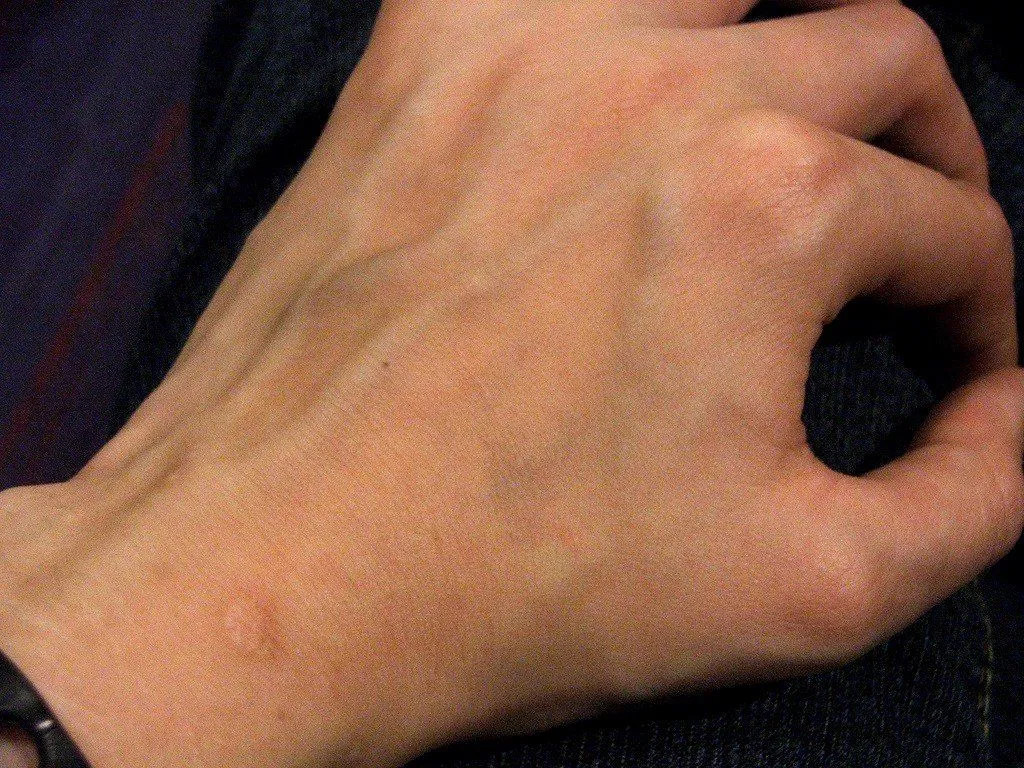
Interestingly, such ‘deeper’ vessels appear blue despite reflecting more red light (than blue). This strange phenomenon is attributed to relative color perception, or, in other words, how we perceive colors relative to other colors present in the surroundings.
Our vision is somewhat influenced by relative perception, so if a purple ball is placed adjacent to a red one, the purple ball will appear to have a bluish tinge. Similarly, some veins appear blue because the surrounding skin reflects more red light (than blue), thus making the veins look bluish. Furthermore, veins are larger, have thinner walls and are located closer to the skin surface than arteries, which is why we can actually see them (but not arteries).
In a nutshell, veins being blue has nothing to do with the kind of blood (oxygenated/deoxygenated) that they carry; it’s entirely dependent on their location beneath the skin!