Too tired to read? Listen on Spotify:
There is no ultimate threshold for pain in human beings. The dol scale, created by researchers at Cornell University, measured pain from 0 to 10.5, with second-degree burns reaching about 8 dol — but the scale was ultimately abandoned because pain proved too subjective to measure objectively.
When you slam your finger in a car door, it probably feels like the worst possible pain in that instant, but a few minutes later, when the searing ache begins to dull, we return to reality.
We remember that we hadn’t just been hit by a bus, shot by an arrow, or dismembered by a horse and carriage. From that perspective, all seems right with the world.
Yet it makes one wonder…what is the worst possible pain for human beings? More importantly, how much pain can we actually handle before passing out, dying, or completely losing our minds?
Recommended Video for you:
What Are Pain Threshold And Pain Tolerance?
Pain, at its most basic level, is an alarm bell telling you that there might be some damage to your body and prompting you to take action.
The pain threshold is when you begin to feel pain from a sensation. For example, a clamp being closed around your wrist would not immediately hurt. But, as the pressure increases, you feel discomfort and then pain. The tightness at which you go ouch would be your pain threshold pressure.
We can also bear some pain, but we all have an upper limit. The level at which the sensation of pain becomes intolerable is that person’s pain tolerance.
Dolorimetry And How We Measure Pain
Both pain threshold and pain tolerance are arbitrary without some sort of scale to measure them on. How do we quantify that being punched is more painful than being pinched?
So, in their efforts to quantify pain, researchers Hardy, Wolff, and Goodell at Cornell University devised an experiment in which they exposed subjects' skin (blackened to minimize reflection) to focused heat from a lamp for three seconds at a time. They tested over 70 medical students and 13 women in labor, conducting hundreds of measurements, and asked subjects to report their pain levels.
Based on the Latin word dolor (pain), they created a unit of measurement for pain (the dol). One dol was the just noticeable difference between one pain intensity and another. Based on this, they created a 0 to 10.5 dol scale.
Many of the subjects reported feeling about 8 dol when they sustained second-degree burns. Beyond this point, pain became difficult to quantify. This method of measuring pain sensitivity is called dolorimetry.
This unit of measurement never really caught on in the scientific community. For starters, hardly anyone could reproduce their results. Second, pain is a subjective experience that depends on one’s emotional state at the time, their psychological outlook, as well as gender, age, and genetics.
That’s the reason doctor’s offices still use those smiley-face charts (of which there are several types as well) when they ask you how much pain you’re experiencing. If you said, “Approximately 3.5 dols, the doctor probably wouldn’t even know what you meant, but when you point to an animated frowning face with tears in its eyes, the doctors understand.
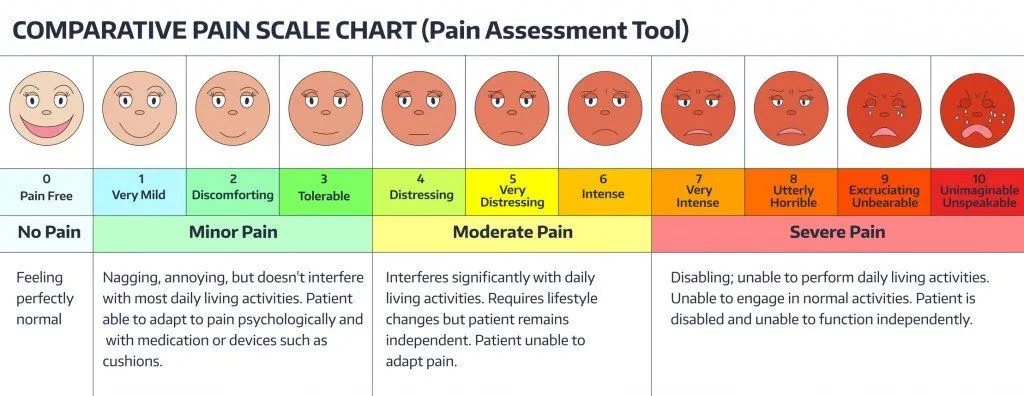
As mentioned above, physical, psychological, and genetic factors all play a role in the subjective perception of pain for human beings, making precise quantification and comparison nearly impossible.
Scientists are making progress toward more objective pain measurement. Researchers using fMRI brain imaging combined with machine learning have shown promise in decoding pain intensity from brain activity patterns. A 2025 review highlighted advances in multimodal pain biomarkers that combine neuroimaging, molecular markers, and psychosocial data. While a universal, objective pain measurement tool remains elusive, these advances may eventually allow doctors to assess pain more precisely than smiley-face charts.
The Brain’s Perception Of Pain Plays A Role In How Much Pain Someone Can Tolerate
As a child, imagine that you were protected from every possible danger by your parents (e.g., no climbing trees, no roughhousing, no bikes, no sports, etc.). If you have never experienced a sprained ankle, a blackened eye or a broken bone, your pain threshold might likely be low. Another child who grew up scraping their knees, spraining their ankles, and being in and out of casts would likely develop a higher tolerance for pain. Once you break a few fingers falling off your skateboard, a bruised elbow doesn’t really seem that bad, right?
This experience is backed by research and sometimes in odd ways. During World War II, Henry Beecher found that injured soldiers reported significantly less pain than civilians with comparable injuries. For the soldiers, their wounds meant they were leaving the battlefield alive — the injury was associated with relief, not distress, which dramatically reduced their pain perception.
Reasonably, sports persons and dancers are found to have a higher pain tolerance than, say, a writer who spends their entire day hunched in front of a computer.
More bizarrely, if your brain believes there is no pain, then you stop feeling pain. This is called the placebo effect, and it applies to more than just pain. It is the power of belief on how your body feels, which includes pain. So, the attitude of some cultures saying “mind over matter” have a point, even if in a roundabout way.
But, of course, the brain is complicated and we’re still unsure of just how the brain processes pain.

So, even though you and I might experience pain differently, it is likely that some times are still going to max anybody out.
Among the most painful experiences reported by patients are cluster headaches (often called "suicide headaches," rated 9.7 out of 10 in research studies), kidney stones, severe burns, and bone fractures — particularly the femur, the longest bone in the body. Childbirth is also consistently rated among the most painful experiences. The popular claim that testicular injury pain is "equivalent" to childbirth has no scientific basis, as pain experiences are too subjective to compare directly across different types of stimuli.
Heartbreak Hurts
Social pain is a real pain. We reflect this in the way we talk about such pain, “You hurt my feelings,” or “I’m heart broken.” The thought of losing a loved one is the same as actual pain for the brain. The thought or event activates two parts in the brain—the dorsal anterior cingulate cortex (dACC) and anterior insula (AI)—that are also activated when you feel distressing physical pain. You might not be able to measure this on a dol or visual analog scale, but it is real!
Can You Pass Out Because Of Excessive Pain?
If you experience intense pain, your brain can push the emergency shut down button. Fainting because of intense, unbearable pain is called a vasovagal syncope.
Many people have experienced it and the reason behind this is the lack of blood supply to the brain. When you experience a sudden and sharp pain, it can overstimulate the vagus nerve, which is responsible for controlling your heart rate (HR) and blood pressure (BP). So the interruption in its working can lead to a drop in the HR and BP. This affects the blood supply to the brain which causes stress, which results in fainting. The amount of pain which could cause fainting depends on the person’s tolerance towards pain.
Just take our word for it…. and please don’t try to measure your own pain tolerance!
References (click to expand)
- threshold: observations on spatial - summation of pain.
- Hardy, J. D., Wolff, H. G., & Goodell, H. (1947, November 1). Studies On Pain: Discrimination Of Differences In Intensity Of A Pain Stimulus As A Basis Of A Scale Of Pain Intensity. Journal of Clinical Investigation. American Society for Clinical Investigation.
- Laatikainen, L. M., Sharp, T., Harrison, P. J., & Tunbridge, E. M. (2013, April 16). Sexually Dimorphic Effects of Catechol-O-Methyltransferase (COMT) Inhibition on Dopamine Metabolism in Multiple Brain Regions. (T. Burne, Ed.), PLoS ONE. Public Library of Science (PLoS).
- The measurement of pain, 1945–2000.
- Weisenberg, M., Tepper, I., & Schwarzwald, J. (1995, November). Humor as a cognitive technique for increasing pain tolerance. Pain. Ovid Technologies (Wolters Kluwer Health).
- Tajet-Foxell, B., & Rose, F. D. (1995, March 1). Pain and pain tolerance in professional ballet dancers. British Journal of Sports Medicine. BMJ.
- Schmitz, A., Vierhaus, M., & Lohaus, A. (2012, June 19). Pain tolerance in children and adolescents: Sex differences and psychosocial influences on pain threshold and endurance. European Journal of Pain. Wiley.
- Eisenberger, N. I. (2012, May 3). The pain of social disconnection: examining the shared neural underpinnings of physical and social pain. Nature Reviews Neuroscience. Springer Science and Business Media LLC.
- Getting the measure of pain. Wellcome Collection.
- Cluster headache is one of the most intensely painful human conditions. PMC (2021).
- Innovations in acute and chronic pain biomarkers. PMC (2025).