Table of Contents (click to expand)
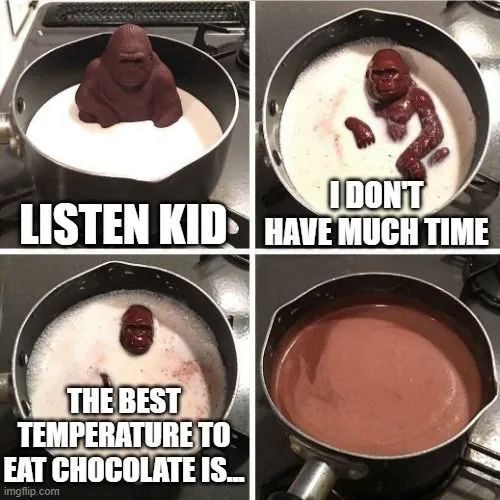
Slightly melted chocolate tastes better because cocoa butter’s Form V crystals melt at around 34°C (93°F) — just below mouth temperature — releasing the fats, sugars and over 600 volatile aroma compounds that flood your tongue and nose almost instantly. Cold chocolate, by contrast, stays solid longer and hides much of that flavor.
Try this… before you eat a piece of chocolate that’s been kept in the fridge, place it in the microwave for a few seconds. It doesn’t matter whether it’s white, dark or milk chocolate, just heat it until it is just about soft. Most people agree that it tastes better when it’s slightly soft and melted… what do you think?
I love how warm chocolate just oozes flavor in the mouth and soaks through the tongue, immersing you in its intense flavor. Believe it or not, there is a scientific basis to this warm delight.
Recommended Video for you:
What’s So Special About Melted Chocolate?
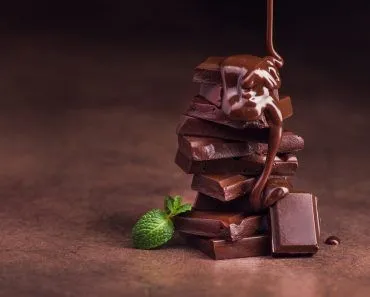
Put a piece of chocolate in your mouth and let it rest on your tongue for a few seconds. Don’t bite or swallow it. Do you feel that rich, creamy taste intensifying as the seconds pass? The temperature inside our mouths sits around 35–36° C (95–97° F) — comfortably above cocoa butter’s melting point of about 34° C — so chocolate liquefies cleanly on the tongue.
As it melts, the chocolate goes from a solid phase to a semi-liquid phase, mixing with saliva as it dissolves the sugar. The melting sugar, cocoa and milk solids that make up chocolate coat the tongue, exciting your taste buds. As that happens, chocolate also releases its aroma in the mouth, further improving its taste. Over 600 volatile compounds have been identified in chocolate. Key contributors include the Strecker aldehydes 2-methylpropanal, 2-methylbutanal and 3-methylbutanal, alongside pyrazines that drive the roasted notes. These aromas are also responsible for the typical chocolatey smell.
Premium artisanal chocolate makers add dried nuts or fruits like cranberries, blueberries and pomegranate. This enhances the flavor, as the fruits have aromas and add a sour taste of their own. Another bonus is that these fruits are good antioxidants too, which makes me feel less guilty when I’m disappearing large chocolate bars all by myself.
However, the main flavor comes from the milk fats, which take longer to melt if the chocolate is refrigerated.
Cold chocolate exists as solids pieces and when it’s put inside our mouths, it takes longer for it to melt and release all those heavenly flavors. The chocolate doesn’t melt in time before we chew and swallow it, so we often miss out on the good stuff!

The best-tasting chocolates have a firm texture and a creamy thickness that leaves a pasty mouth feel. The remnants left in the mouth continue to provide that chocolatey taste we so dearly enjoy. It all boils down to the flavor compounds released in the mouth and nose, which happens as the chocolate melts and breaks in your mouth.
What Is The Best Temperature At Which To Eat Chocolate?
Unfortunately, no one has conducted a study where loads of people are taken and made to eat chocolate at different temperatures. If a study like this ever happens, sign me up!
There isn’t one temperature value that’s best to eat chocolate… it’s more complicated than that.
Chocolate comes in different physical forms, depending on the composition and processing techniques. For example, adding milk solids lowers the melting point of chocolate.
Cocoa butter — the fat that gives chocolate its texture — crystallizes in six different polymorphic forms, designated I through VI. These forms are produced by heating and cooling chocolate at different temperatures (a process called tempering). Form V is the most desired, as it has the best texture, shine and snap. Form V melts at about 33.8° C (92.8° F), meaning it melts easily in the mouth.
This doesn’t mean that melting chocolate in the microwave for 1 minute until it’s basically a liquid will make it taste best. At higher temperatures, the sugar and milk solids will just melt, so it will feel like you’re just swallowing chocolate syrup. It will remove the nice mouth feel of eating thick and creamy chocolate.
Remember, the darker the chocolate, the higher the melting point. At room temperature, milk chocolate will have a softer texture than dark chocolate. If you’re a dark chocolate lover, you can simply keep it in your mouth for longer, until all the flavors ooze out. Sensory studies suggest our sweet and bitter taste receptors (driven by the TRPM5 channel) are most active between roughly 20–35° C, which is why chocolate tastes most intense at room temperature or after a gentle warming — but not when it’s piping hot.
However, if you like to savor your chocolates, it’s better to store them at a constant temperature; avoid repeatedly cooling and warming them, as that triggers fat bloom — Form V crystals transition to the more stable Form VI, and liquid triglycerides migrate to the surface and recrystallize as a dull white film. The chocolate is still just as tasty, but the appearance and texture will change. (A separate phenomenon, sugar bloom, is caused by humidity dissolving sugar that then recrystallizes on the surface.)
Conclusion
Why do some people swear by cold or frozen chocolate, then? The science actually supports that preference too — but for different reasons. Cold chocolate is harder and snappier, the melt is slower and more drawn-out, and the TRPM5 taste channel dampens both sweetness and bitterness at low temperatures. The aroma volatiles also stay locked inside the solid fat. The result is a cleaner, less intense, more refreshing experience — perfect for very sweet milk chocolate on a hot day. So both camps are right; you’re just optimizing for different sensations.
There is a lot of research that goes into chocolate making. There is also plenty of material science involved in optimizing the shape, the nature of sugar, milk fats and solids, and the type of cocoa to make the very best-tasting chocolate. The Belgians and Swiss deserve a lot of credit for their hard work in making the best chocolates in the world.
The latest research focuses on making chocolates by combining three essential factors: shape, melting rate and air volume. The idea is to design the best chocolate shapes that melt quickly in the mouth, so that the flavorful compounds are carried effectively by air through the mouth so that we perceive the most delicious taste possible!
References (click to expand)
- Paixão, J. A., Rodrigues, J. B., Esmerino, E. A., Cruz, A. G., & Bolini, H. M. A. (2014, December). Influence of temperature and fat content on ideal sucrose concentration, sweetening power, and sweetness equivalence of different sweeteners in chocolate milk beverage. Journal of Dairy Science. American Dairy Science Association.
- Afoakwa, E. O., Paterson, A., & Fowler, M. (2007, June). Factors influencing rheological and textural qualities in chocolate – a review. Trends in Food Science & Technology. Elsevier BV.
- Lenfant, F., Hartmann, C., Watzke, B., Breton, O., Loret, C., & Martin, N. (2013, May). Impact of the shape on sensory properties of individual dark chocolate pieces. LWT - Food Science and Technology. Elsevier BV.
- Beckett, S. T. (2003, August). Is the taste of British milk chocolate different?. International Journal of Dairy Technology. Wiley.
- Fryer, P., & Pinschower, K. (2000, December). The Materials Science of Chocolate. MRS Bulletin. Springer Science and Business Media LLC.
- Nightingale, L. M., Cadwallader, K. R., & Engeseth, N. J. (2012, April 27). Changes in Dark Chocolate Volatiles during Storage. Journal of Agricultural and Food Chemistry. American Chemical Society (ACS).