Table of Contents (click to expand)
Oil makes paper translucent because it creates an index-matching medium for paper. This means that the refractive index of oil is similar to that of paper, so light can pass from one to another without reflection or refraction.
You must have observed this rather interesting phenomenon a number of times yourself: a perfectly normal piece of paper suddenly becomes very different when smeared with oil. A practical, daily-life example of this is that a pizza box or a cheesesteak bag becomes slightly transparent when they come in contact with the greasy contents kept inside them.
Why does this happen?
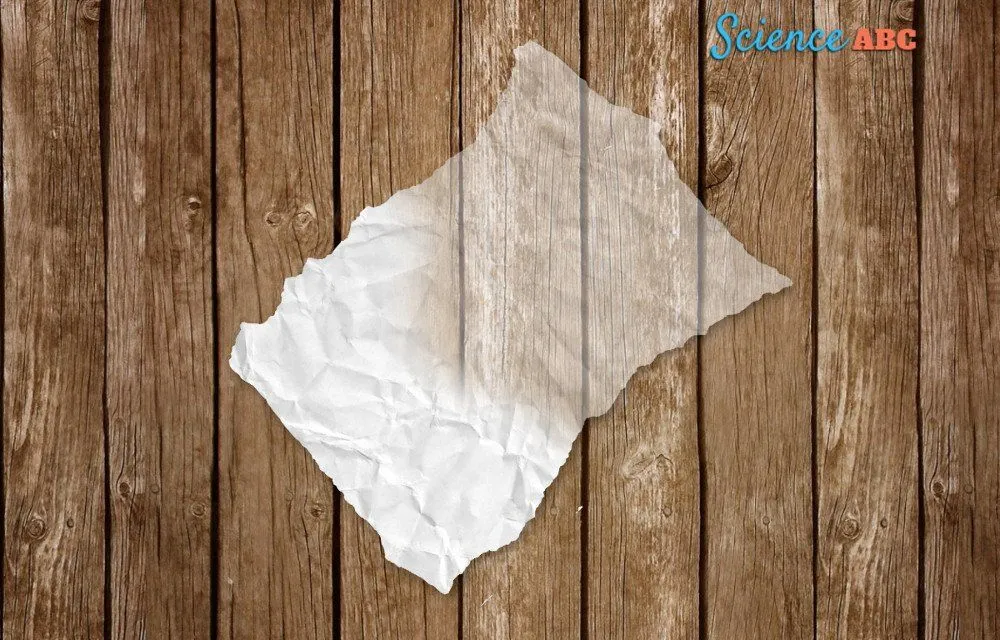
The answer to this question lies in how light interacts with matter.
Recommended Video for you:
Light And Matter
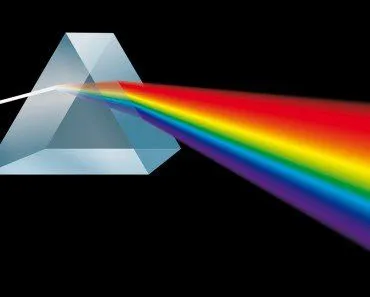
When a light ray strikes an object, a few things can occur (depending on the type of material): it can bounce right back off its surface, it can scatter (i.e., be reflected in multiple directions off its surface), it can pass through it and emerge on the other side at a slightly different angle (refraction), or it can simply transmit through it, making the object transparent.
Another aspect that you should be well-versed with for the scope of this article is how we see colors. To put it simply, the color of any object we see is actually the color of the light reflected from its surface. An apple is red because it reflects red light, i.e., light that lies in the red part (longer wavelength) of the visible spectrum.

Another example is that of snow: snow is white because it scatters and reflects all colors equally, which makes it look like snow is white.
Light’s Interaction With Paper
Paper, as you might already know, is made up of a tangled web of irregular cellulose fibers with countless tiny air pockets between them. The cellulose fibers themselves are nearly translucent, but every fiber-to-air boundary inside the sheet sends light bouncing in a different direction. After many of these jumps, the light is scattered every which way (a process called diffuse reflection), and very little of it makes it through to the other side — which is why a dry sheet of paper looks white and opaque. When that same piece of paper is smeared with oil, it appears more transparent (the appropriate word would be ‘translucent’), because the oil seeps into those air pockets and replaces the air with a medium whose refractive index is much closer to that of cellulose. With far fewer optical mismatches inside the sheet, light no longer has to do all that bouncing and scattering, and simply passes through, which lets us read words right through the paper.
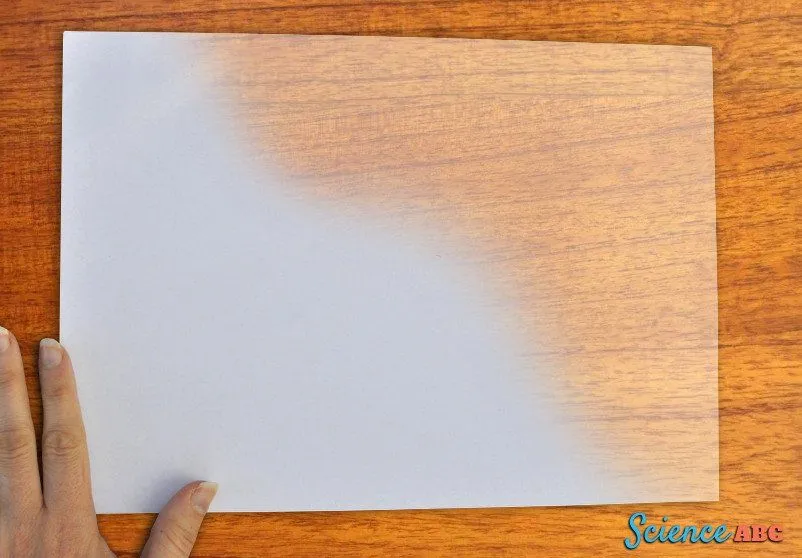
Index-matching Medium
You see, the way light distinguishes between the media it travels through is determined by the refractive index of that medium. Cellulose fibers in paper have a refractive index of roughly 1.47 to 1.55, while air sits at exactly 1.00. Most cooking and vegetable oils land at around 1.46 to 1.48 — a far closer match to cellulose than air, and even closer than water (which is about 1.33). This is why oil acts as an index-matching medium for paper: with the air pockets replaced by oil, the optical contrast across each fiber boundary almost disappears, so light is barely deflected as it crosses the sheet.
In optics, an index-matching material is a substance, usually a liquid or gel, whose refractive index is pretty close to that of another object. When this material and the object in question are brought close together, light passes through from one to another without reflection or refraction.
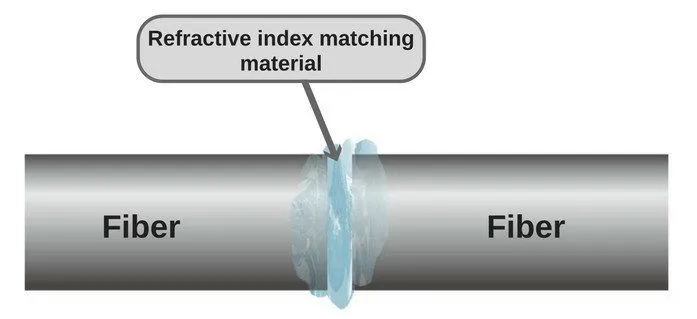
In the case of paper smeared with oil, the paper scatters much less light (thanks to the oil that adheres to the paper’s surface), which, in turn, allows more light to be transmitted through the paper, making it look more translucent.
References (click to expand)
- Oil Immersion, Refractive Index and Lens Design - ZEISS Microscopy
- Optimal clearing and mounting media for confocal microscopy of thick specimens Kurt Thorn, Chester Chamberlain, and Nan Tang - nic.ucsf.edu
- Ray Optics, Lecture 4 - Photonic Materials and Devices. MIT OpenCourseWare
- Ziming Sun, J., Erickson, M. C. E., & Parr, J. W. (2005, December). Refractive index matching and clear emulsions. International Journal of Cosmetic Science. Wiley.